Friday, February 26, 2010

Plot That Movie Plot

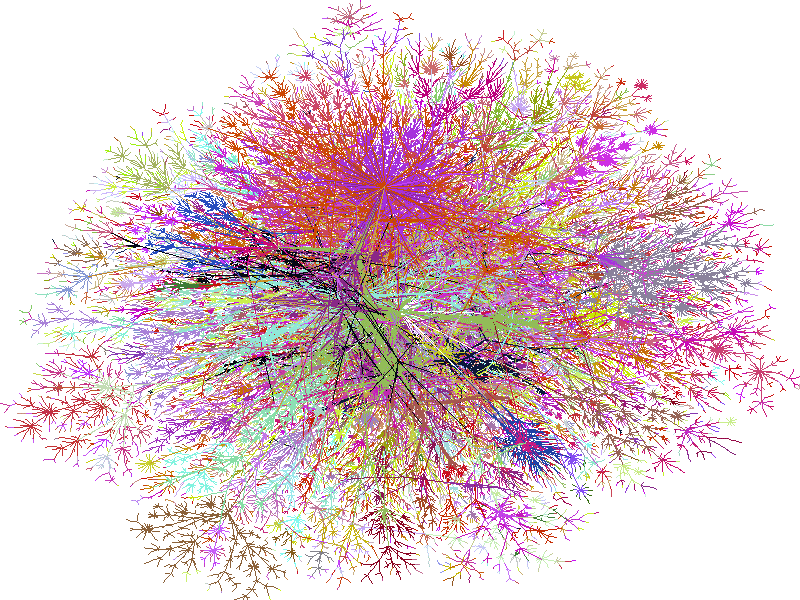
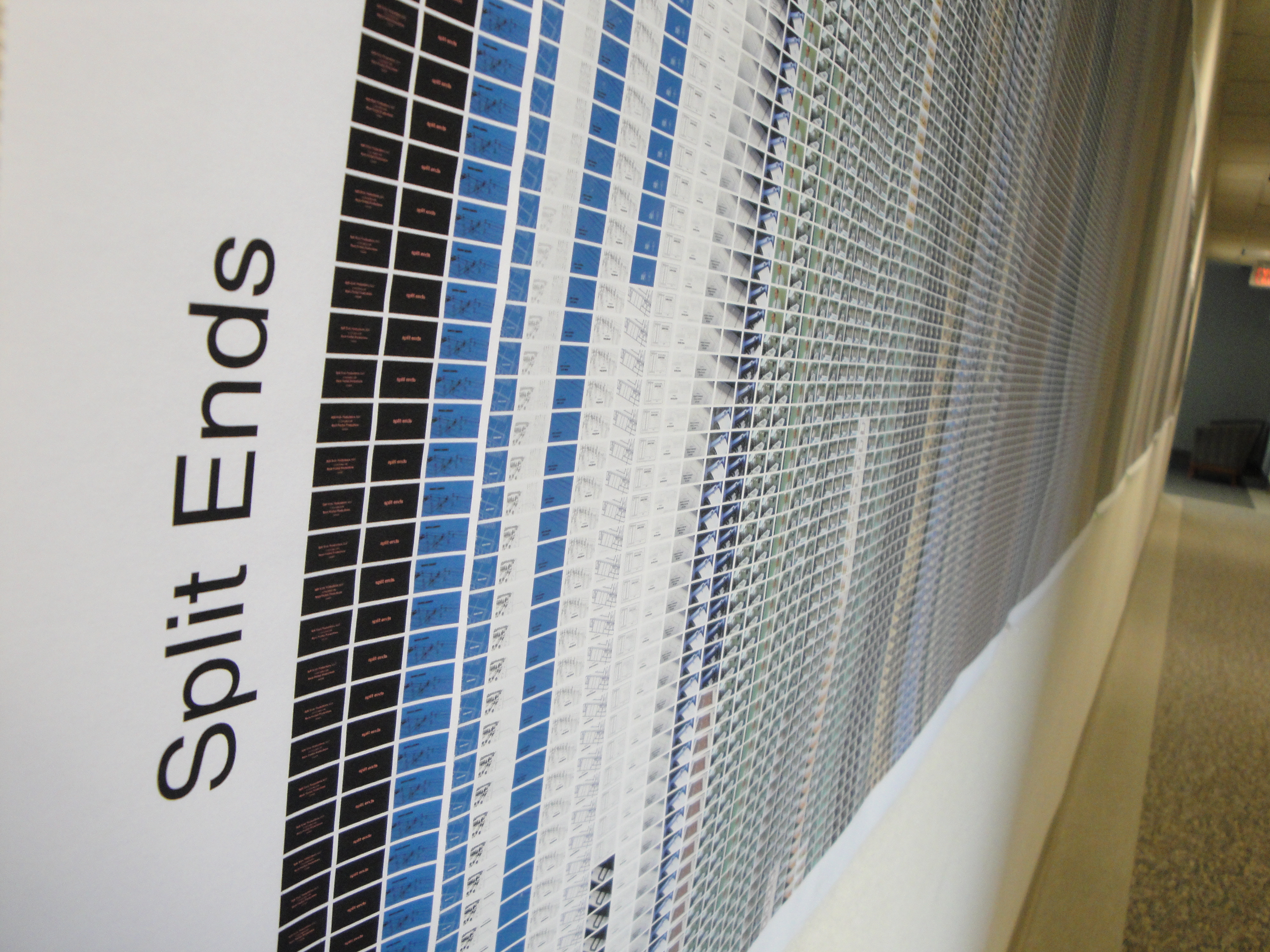
Reading Nathan's remark about seeing bits, reminded me of Bill Cheswick's recent off-the-wall project where he (previously of Internet map posters c. 1998) prints movies, frame by frame, using an HP DesignJet 6100ps plotter. Yes, every frame of the movie is literally printed as part of a contiguous whole—which really makes it more of an on-the-wall project, I suppose.


The plotter output shown above is from a 1.36 h animated movie comprising 720 frames per column by 163 columns. Cheswick's original motivation was to hammer the printer but, by considering each of the 117,360 micro-frames to be a color-encoded pixel, it might be possible to detect emergent global structure among the "bits" that is different from the typical story-board structure. However, caution is required because, although all meaning has a pattern, not all patterns have a meaning.

Intoxicating Colors and General Equilibrium

Yes - it's another online color study!

In this case the study is from DEVO!

Just Click It!


The same day Tim sent me the above link Brian sent me a link to the paradox of toil. Coincidence?

Thursday, February 25, 2010

Computer History Museum on MagCloud

The Computer History Museum has recently published a number of magazines using MagCloud. The magazine on the IBM 1401 has a delightful back cover image.


There's just something about tangible bits.

CIE Division 8 Meeting Agenda and 2010 Activity Report

The agenda for the upcoming March 15, 2010 meeting of Division 8 of the CIE has been posted to the Division 8 web site (under What's New). In addition, the 2010 annual activity report has been uploaded. This division of the CIE has the terms of reference: "To study procedures and prepare guides and standards for the optical, visual and metrological aspects of the communication, processing, and reproduction of images, using all types of analogue and digital imaging devices, storage media, and imaging media." So if you will be attending the upcoming CIE meeting in Vienna or have in interest in it's activities these documents may be of interest.

Wednesday, February 24, 2010

Nothing To Sneeze At ... Unless It's Sunny

Apparently, exposure to sunlight can elicit a sneezing reaction in some people. A recent PLoS paper, by researchers at the University of Zurich, concludes:
We propose that the photic sneeze phenomenon might be the consequence of higher sensitivity to visual stimuli in the visual cortex and of co-activation of somatosensory areas. The ‘photic sneeze reflex’ is therefore not a classical reflex that occurs only at a brainstem or spinal cord level but, in stark contrast to many theories, involves also specific cortical areas.

Ah choo! (Please draw the curtains)

Friday, February 19, 2010

A Thousand Points of Flying Light

Maybe President Bush 41 wasn't having a senior moment, after all.

Mantis shrimp eyes

Is green a composite hue, modulated by blue-yellow opponent cells?

In the end of 2009, I had the opportunity to re-visit current models of human visual perception investigating color perception as a function of spatial frequency. Based on my engineering background, a simple sinusoidal sweep pattern modulated by different opponent colors appeared to be appropriate to examine some interesting observations.


Figure 1. 4 sinusoidal sweep patterns showing spatial bandwidth of cone bipolar cells; (leftmost) black-white demonstrating highest bandwidth without hue changes (achromatic), (center left) blue-yellow demonstrating lowest bandwidth with hue shift toward black-white, (rightmost) red-cyan demonstrating medium bandwidth with hue shift toward black-white, and (center right) magenta-green demonstrating bandwidth similar to blue-yellow with hue shift toward red-cyan.

Thursday, February 18, 2010

1976 Uniform Chromaticity Scales: Yu'v'

A while back I came across Seyno Sluterman's short article "The NTSC Color Triangle is Obsolete, But No One Seems to Know". It's an interesting and short read but it also makes a call to use the 1976 Yu'v' Uniform Chromaticity Scales instead of the typical CIE 1931 chromaticity values when plotting display gamuts.

Which is a great reminder (1).


Plotting display gamuts using CIE 1931 chromaticity values appears to be pervasive but it is obsolete.

Some Solace in the Strangeness

My online review of the recent biography about the quantum physicist Paul A. M. Dirac, has just been published by the New York Journal of Books. Dirac predicted the existence of antimatter in 1928, but didn't hype it ... out of "shear cowardice." He also formulated the original many-body description of how light interacts with matter (Quantum Electrodynamics but, as Graham Farmelo informs us, Dirac felt it was flawed and that ultimately he had failed to fix it.


The book jacket shows a 31 year old Dirac in the grounds of The King's Head, near Thorpe-le-Soken, Essex. (Pop quiz: What is Dirac holding?) By that time, Dirac was already the youngest winner of the Nobel Prize in Physics and had a day job as Lucasian Professor of Mathematics at Cambridge University. Problem: How was he going to top that?

Sun Dog Suffers Shocking Death

A sun dog is a prismatic effect formed when sunlight is refracted through plate-shaped ice crystals. On February 11, the Atlas V rocket carrying NASA's Solar Dynamics Observatory flew past a sun dog during its launch. The shock waves produced by the first-stage rocket motor completely obliterated the sun dog.


The shock waves are clearly visible in this amateur video @ 1:53. The sun dog is the colored patch in the cirrus clouds located to the right of center.

Saturday, February 13, 2010

100 Billion Operations per Second with Parallel Image Processing

Taking a break from videos about digital presses (1,2,3,4,5,6 & 7), let's look at parallel processing for imaging. Giordano has previously solicited participation on this topic but surely there are some related videos out there? First up is a video about a parallel image processing system that is capable of "as many as 100 billon operations per second". (1 minute 41 seconds)


This video also states "the key to image recognition is parallel processing." (49 seconds) Of course high speed image recognition makes me think of a robotic system with the uncanny capability of following a gray sphere (see next video).

Friday, February 12, 2010

Pale Blue Dot + 20

Voyager I, along with its twin spacecraft Voyager II, was launched in 1977 and is now 2/3rds of a light-day away from Earth or 113 AUs.

Twenty years ago this week, Voyager 1 snapped the "pale blue dot" image showing our planet from a distance of 43 AUs. This image ranks up there with Earthrise from the Moon (Apolo 8, 1968) and the "big blue marble" (Apollo 17, 1972).

Earth is the tiny speck of light indicated by the arrow, and enlarged in the upper left-hand corner. The pale streak over Earth is an artifact of sunlight scattering in the camera optics.

In addition to the Voyager twins being the most distant man-made objects in the universe, I have slightly more than a passing interest in the adventures of these little machines.

Wednesday, February 10, 2010

Seminar on the Spectral Sudoku of Halftone Dots

Today at 4 pm Eastern Time Dr. J. A. Stephen Viggiano will present a seminar at the Ceneter for Imaging Science at RIT. The seminar is entitled: "Spectral Sudoku of Halftone Dots: The New Math Catches Up Wth Print Color".

The abstract is intriguing:

"When the colors that come of a printer don't resemble what's displayed on the monitor, better prediction of print color may be needed. These models are also useful for simulating the system, even before it can be built. Paradigms for color print modeling will be examined and classified. Challenges will also be discussed.

Modern algebra provides a link between a popular puzzle and the colors produced by printers. One of the modeling paradigms uses Hilbert-like spaces where, depending on the image microstructure, vector addition may or may not hold. Other models derived include a class that account for multiple scatter. The latter are spatial generalizations of the Kubelka-Munk model."


Real-time viewing of the seminar will be available online: https://connect.rit.edu/cis_seminar/.

Hottest color in 2010

What’s the hot new color for 2010? According to Color Marketing Group, the leading international organization of color design professionals, it’s grape.

Tuesday, February 9, 2010

Cheap, Green & Diffuse: A Paper & Binder Clip Light Tent

Does the web need yet another how to post on making your own light tent? There are certainly other good options out there for DIY light tents.


But using just paper and binder clips it's possible to make an even cheaper and even simpler light tent. And if for some reason you get beet juice on it, it can be recycled.

Monday, February 8, 2010

Science and Engineering Indicators 2010

The National Science Board (NSB, the governing board of the National Science Foundation and policy advisors to the President and Congress) has released the 2010 Science and Engineering Indicators (SEI) report.

Saturday, February 6, 2010

Friday, February 5, 2010

Color naming at EI

I did not yet summarize the discussions on color naming at EI three weeks ago, so here we go…

Topics with traction

The key method for achieving top performance is feedback. At work we usually are given a set of objectives at the beginning of the year and a year later are graded based on how well we reached the objectives. During the rest of the year we just slave away in our cubicles, and nothing has any real consequences.

Steampunk Remote Proofing

From an 1892 letter to the editor in Science by Milton Bradley comes the following quote:

"As a manufacturer of an extended line of colored papers I am constantly putting this proposed nomenclature to a severe test by ordering new colors by telephone. That is to say, we make the desired combinations on the wheel in our office and then telephone them to the factory, ten miles distant, where they are again made on the wheel and the papers are manufactured to correspond with the results of these combinations. Under this plan we are liable to have occasion to 'telephone a color' frequently. In the same way we could cable colors to Europe should it be necessary."


Sounds like a possible steampunk remote proofing project.

Wednesday, February 3, 2010

Parallel Processing for Imaging

We are planning to start a new conference on Parallel Processing for Imaging. If you have any ideas, suggestions, or want to contribute on the program committee, please shoot me an email.

Tuesday, February 2, 2010

Evolution of the Silicon Valley

When I arrived in the Silicon Valley, it was the center of the universe for anything connected to silicon. Engineers, scientists, and researchers at the many think tanks were outbraining the Russians and inventing so many new technologies that still today young entrepreneurs are trolling expired patents and old papers to create new products. Some think tanks like Fairchild, SRI, and Xerox PARC generated cascading start-ups, because invention was much faster than business creation.

1 Billion Ink Drops a Second


Assuming full coverage of the largest 42 pL drops, that one billion drops would be about 2.52 L of ink per minute.

Monday, February 1, 2010

Color Measurement Webinar from the Printing Applications Laboratory at RIT

On February 11th from 2:00 pm to 3:00 pm EST, the Printing Applications Laboratory of RIT will offer a free webinar on Assessing Color Measurement Instrument Capability. The webinar to be given by Robert Chung is described as follows:

"Color management depends on printing process control. Printing process control begins with color measurement. This beginner-level webinar will define a number of important concepts (e.g., calibration, calibration reference materials, tristimulus integration, colorimetric parameters (L*, a*, b*, C*, h, ∆H, ∆E), accuracy, precision, reproducibility, and inter-instrument agreement), and elaborate on these concepts with process control examples in the graphic arts. Participants will become more aware and knowledgeable when using spectrocolorimeters for press/proofer profiling and printing process control."

More details about this (and other upcoming webinars), including a link to the registration page is here.