A couple of weeks ago, I was trying to get a handle on the performance of an algorithm I had implemented a couple of decades ago. I wanted to get a rough idea on how fast it would be on a modern PC. By "rough idea" I mean within an order of magnitude.
Comparing computer performance over decades it tricky, because in the past we could always make things run much faster by programming the inner loops in microcode. Because of this, PCs 20 years ago were more responsive than a PC today. But then, we progressed from $50,000 ECL PCs consuming 3,000 W to $500 CMOS PCs consuming 15 W. And today's PC use a lot of cycles on fancy animations, sounds, and other GUI effects versus the frugal wabi-sabi (侘寂) GUIs of yore. Finally the system architectures are quite different.
In the old days, computers were rated in MIPS, or million operations per seconds. I thought this should still be a valid measure for comparing the performance in scientific computing. I went to HP's product page to look up the MIPS rating of my PC, but could get no other ratings than CPU clock speed and front side bus speed. Such numbers are not very meaningful, because you do not know how much time the processors are idling waiting for data (very little in the past, a lot today), etc.
I was equally left in the dark on Intel's product page, so I resorted to a search engine. The top result was a Wikipedia page, which rated the CPU in my PC to about 20,000 MIPS. I thought this did not feel right, so I asked the performance specialist on the Performance Agora. Read here what he has to say on modern microprocessor MIPS: http://perfdynamics.blogspot.com/2009/04/modern-microprocessor-mips.html.
There has been quite a bit of speculation about the motivation behind our work on the g(2) camera; we have even been slashdotted last January 25th, so we might as well open the kimono on it, at least a little tiny bit.
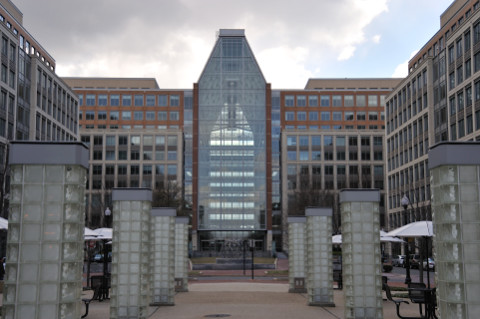
In fact we are now well protected after getting the necessary patents. Every year, 15 days before Tax Day, viz. on April 1st, the Patent Office allows inventors to demo their apparatus directly to the examiners, instead of filing a written patent application. Doing a demo is very efficient. We set up shop in the enormous hall of the Madison Building (see picture below, the tables outdoors are for inventors demonstrating a perpetuum mobile). We had two rows of tables with all the prototypes, gizmos, and gadgets we had developed and demonstrated them step by step and claim by claim to the attentive Examiners.
Of course the examiners had many questions and doubts, but fortunately at the left of the hall shown in the above picture there is one of the best libraries on this planet, so while we engineers were haggling with the Examiners, our managers and patent attorneys were busy building stronger cases and strengthening the claims.
Further down on Duke Street, on the block after the Whole Foods Market, there is a Marriott Residence Inn, where we could stay six people in each suite and get a lot of quality time to polish our inventions, while our interns prepared hearty meals for us. Our patent attorneys were comfortably lodging at the Westin across the street from the Federal Court building.
But, we are digressing — back to the motivation for the g(2) camera. In high-speed digital printing, the bottleneck has always been in the ripping (RIP, Raster Image Processor) or, in HP parlance, the DFE (Digital Front End). For example, when we were working on the Xenith system at PARC in the mid-Eighties, Nick Sheridon was running the print engine at 300 ppm using Tibor Fisli's quad-spot laser diodes, while Gary Starkweather cranked the resolution up to 4000 dpi. Yet, even after adopting the Dragon's MBus, the shipping Docutech product could only run at 100 ppm and 600 dpi due to RIP limitations.
Concomitantly, at Canon the A-printer had been developed. This poster printer had a 40 inch wide array and was printing on paper rolls using bubble jet. The head actually consisted of four 10 inch heads mounted in a staggered pattern, and it was incredibly fast. Only, it required a MasPar mini-supercomputer to deliver the bits. The galleries and poster shops in Roppongi never ordered enough printers to make the product commercially viable.
Today, our valued customers buying high-speed digital presses still have to dive deep into their pockets to buy a costly DFE. This is why in Director Gary Dispoto's Print Production Automation Lab, Dr. I-Jong Linmanages the RIP project. This is also why Dr. Ray Beausoleil — who just became an HP Fellow — moved to the Quantum Science Research Department. We need quantum information technology (QIT) to deliver affordable DFEs for our high-speed digital presses.
One of the challenges in QIT is to store quantum bits (qbits) while avoiding a collapse of the wave function or decoherence. Typically, qbits are stored in a semiconductor (gallium arsenide, GaAs) microcavity, therefore, we have to study the interface interactions of emanating photons.
More formally, we need to study the Bose-Einstein condensation (BEC) phase transition in a polariton system in a semiconductor microcavity. The macroscopic quantum degeneracy is typically detected by probing the statistical properties of light emitted from a microcavity, under the presumption that the statistics of the exciton polaritons are faithfully transferred to the emanating photons.
The figure below shows Interference fringes (a) at 770 nm wavelength used to verify the BEC of polaritons in GaAs microcavity and (b) at 546 nm measured for the green line of a pulsed Hg-Ar discharge lamp.
This figure shows, that a coherent light source (e.g., a photon laser or decaying polariton BEC) can exhibit the same first-order correlations as a chaotic (or thermal) light source (e.g. Hg-Ar discharge lamp in (b)). The table below shows that proper disambiguation of a coherent state also requires measurement of the second-order correlation function g(2) associated with intensity noise correlations:
Function
Incoherent
Coherent
Chaotic
g(1)
0
1
1
g(2)
1
1
2
In summary, as we wrote in our slashdotted paper, the application of the g(2) camera is to take pictures to confirm the presence of true Bose–Einstein condensates (BEC). The next challenge is calibrating the camera. As we wrote in or popular technical report on Spectrophotometer Calibration and Certification, tight calibration is very critical in this kind of applications.
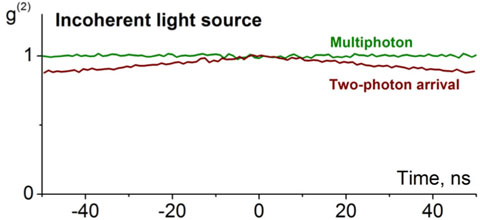
Fortunately, there is a condensate that is readily available and which is produced industrially at very tight tolerances: condensed milk. Alas, in our experiments we found a caveat. From the figure below we know that we are dealing with photon pairs. To correctly calibrate the SPADs, we have to be certain that both calibration photons have exactly the same color.
As our esteemed colleague and co-blogger Steve Simske keeps warning us about, the caveat is in the rampant counterfeiting happening in the supply chain. What happens if one photon comes from the condensed milk but the other photon comes from melamine?
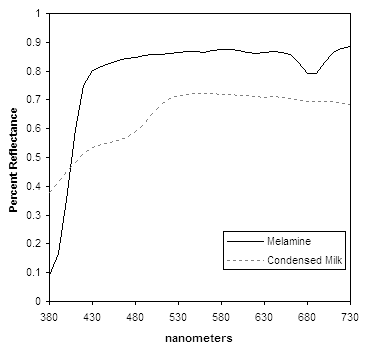
In our lab we have built a special spectroradiometer, which we use as a reference for the calibration instrument. We have used it to measure the spectrum of pure condensed milk and that of melamine. Here are the plots:
Now we just use the CIE formula with the color matching functions for the 2º observer:
and get the RGB values of the two photons.
Color science is about observers, and in the end what counts is whether an observer can tell apart photons with these two RGB values. The old way of doing this was to compute the ∆E*ab value in a perceptually uniform color space or in a CIECAM02 color appearance space based on the JND (just noticeable difference).
In our work on the color thesaurus we have established that a more reliable method is to determine whether the names of the two photon's colors are synonyms. Since the first to take a picture of a BEC will almost certainly get the Nobel Prize, we decided to use the data from our Swedish corpus of the färgbenämningsexperiment.
The RGB values calculated above yield mjölkaktig vit for the condensate and snövit for the melamine. Clearly there is no match and the g(2) camera would be calibrated incorrectly if the condensate is counterfeited. How did we solve this problem? The solution is in this Feinman diagram:
Since photons are massless bosons, time is symmetric and at an event E we can say that a first photon (signal s) comes from a second photon (idler i) when the two photons are entangled to form a biphoton, In other words, each biphoton can be regarded as forming a loop between source and detector (CC is the coincidence counter).
Entanglement is just a fancy technical term to say that the two photon share the same wave function, also known as Schrödinger equation. Since the color of a photon is given by its wavelength, by entangling two photons we make them of the same color.
In other words, all we have to do, is to entangle the condensed milk photons with the melamine photons and we can always calibrate correctly the g(2) camera, regardless of possible counterfeiting with melamine, because the photons get the same color.
This movie shows principal color scientist Nathan Moroney in our lab entangling the photons.
Of course, the stirring requires a lot of training, because the wave function can easily collapse, so do not try this at home!
For the viewpoint of our performance analyst, see his post in the Performance Agora.
For now, having tattooed on our tonsils to finish the new RIP, we are focusing on that. Once we have delivered product, our future research ideas include feeding the entangled condensed milk photons to Schrödinger's cat and take its pictures with the g(2) camera. We will post our images here, so stay tuned!
In the meantime, we wish you a happy April Fool's Day.
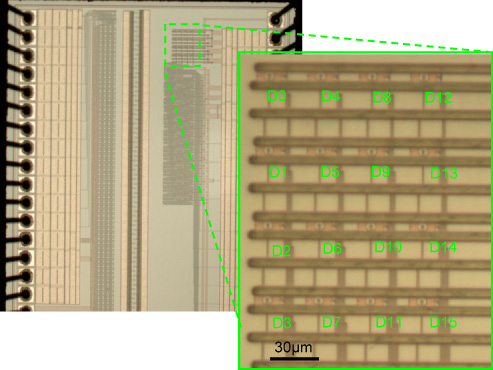
We report on a device capable of imaging second-order spatio-temporal correlations g(2)(x, τ) between photons. The imager is based on a monolithic array of single-photon avalanche diodes (SPADs) implemented in CMOS technology and a simple algorithm to treat multiphoton time-of-arrival distributions from different SPAD pairs. It is capable of 80 ps temporal resolution with fluxes as low as 10 photons s−1 at room temperature. An important application might be the local imaging of g(2) as a means of confirming the presence of true Bose–Einstein macroscopic coherence (BEC) of cavity exciton polaritons.
Last weekend, as like an astronaut in a Mercury capsule I sat strapped in a small seat in a metal tube being flung across the Atlantic and Canada's Northern Territories, I was reading the day's press from both sides of the Atlantic to catch up with the last two weeks of news and get an appreciation of the reality field's distortions.
On both sides of the Atlantic, physicists made first page news, but for very different reasons, as you would expect in a Riemannian reality field. In the US newspaper, a journalist had been chasing so-called financial geniuses in New York and London to get the rap on $700 billion of toxic financial papers. In the European newspapers the story was on page four, with the question of why the US Government was talking about $700 billion when the actual amount of toxic paper was $3,500 billion, or $3,500,000,000,000.00.
Anyway, that is what you get with reality distortion, but it was not what caught my attention. The journalists were not able to get any financial genius to speak on the record, so they reported remarks from both sides of the Atlantic stating that the financial instruments were so complex that there was no way they (the geniuses) could understand them, that is why they hired quantum mechanics physicists to cook up risk models.
So, there it was written black on white: the quantum mechanics physicists are to blame for the $3,500 billion toxic papers. Hmm, and I thought the only toxic paper quantum physicists handle is that in the litter box of Schrödinger's cat. And they can even not known if the cat is dead or alive.
The story about the quantum physicists would have been more believable, if they had written the $3,500 billion disappeared in a black hole when the Large Hadron Collider (LHC) was turned on in Geneva (see this article on page 1291 of Science magazine of 5 September 2008).
That is what I read in the US newspapers. In the European newspapers physicists made the first page for completely different reasons. The first reason was the LHC. There had been some apprehension about black holes, but the operation start on 10 September was a full success. Unfortunately, over a week later, a possible faulty electrical connection between two of the accelerator’s magnets caused a large helium leak into sector 3-4, moving the start of the experiments to March 2009.
What the newspapers explained in some detail, was how beneficial the $8 billions spent on the LHC was for European industry, because it spurred a large amount of new technology in fields like superconductors and low-temperature materials. While I was reading this, I thought, wow, $8 << $3,500 billion. We could have had our own supercollider in Texas for only the bonuses of one bank in one year!?
The second front page news related to physics in European newspapers was Zhai Zhigang's space walk and the impact the development of the Shenzhou 7 capsule and its launching technology had on Chinese industry, leading it to develop more advanced technologies.
As a whole, from a European perspective, quantum physics and rocket science are not as bad as it is believed to be on this side of the Atlantic. From an international point of view, that had already been decided in the Nüremberg trials, which lets me continue with the meat of this post without shame.
It did not make the newspapers, but last week our paper on experiments supporting the concept of a g(2)-camera was published. If your institution does not subscribe to SPIE's Digital Library, you can buy it for only $18.00 (those are plain dollars, not billions).
Recent experiments have reported the Bose-Einstein condensation (BEC) phase transition for exciton-polariton systems in a semiconductor microcavity. The macroscopic quantum degeneracy is typically detected by probing the statistical properties of light emitted from a microcavity, under the presumption that the statistics of the exciton polaritons are faithfully transferred to the emanating photons.
The macroscopic quantum degeneracy can be established by measuring the correlations viz., first-order in the electric fields:
and seconds-order in the electric fields:
Moreover, it has been assumed that observation of the interference fringes similar to those in Michelson or Young interferometers is sufficient to establish the fact of macroscopic coherence in exciton-polariton systems. Two points on the wave front separated by a distance x12 produce an intensity pattern
such that the fringe visibility measures the magnitude of the first-order correlation function g(1)(x12, τ). But simply measuring this quantity alone is ambiguous because a coherent light source (e.g., a photon laser or decaying polariton BEC) can exhibit the same first-order correlations as a chaotic (or thermal) light source (e.g. Hg-Ar discharge lamp). The table below shows that proper disambiguation of a coherent state also requires measurement of the second-order correlation function
associated with intensity noise correlations. Here, I1,2(t) is the light intensity at a point ±½ x12 and time t.
Maximal values of respective correlation functions for incoherent, coherent and thermal light states
correlation function
photon states
incoherent
coherent
chaotic
g(1)(x, 0)
0
1
1
g(2)(x, 0)
1
1
2
∆g(2)(x, 0)
0
0
1
The minimal condition to confirm the BEC phase transition in a polariton system then becomes
Our imager detects the spatial correlation excess shown as ∆g(2) ≡ g(2)(x, 0) – 1 in the third row of the table above.
In our paper, we present a novel g(2)-imager built with conventional CMOS technology, which is capable of measuring second-order spatio-temporal correlated photons and thereby offers an important means for verifying the existence of a BEC state of cavity exciton polaritons.
One potential limitation when imaging BECs with our device is the requirement that ∆g(2) = 0, which corresponds to a null measurement. For BEC detection, however, we anticipate that a more practical device could combine conventional g(1)-imaging with g(2)-imaging, either as the same camera operated in two distinct modes or as two distinct cameras working together.
Future work will include the development of larger arrays of SPADs, the integration of on-chip data processing based on equation
and the extension to other g(2)-imaging applications.
A surprising feature of the g(2)-camera is that the parallelism of the sensor stemming from using N detectors does not scale linearly but binomially. For example with a 4 x 4 SPAD array all 16 detectors have separate parallel outputs so that (162) = 120 simultaneous pairwise measurements are possible.