Showing posts with label conscience. Show all posts

Friday, October 23, 2009

Using Neural Measures of Economic Value to Solve the Public Goods Free-Rider Problem

The end of the year is the time for performance reviews in laboratories across the world. The question is always about the metrics. Managers could use measures like the number of ICC profiles created, the lines of code written, or the ∆E precision improvement in the color transformation algorithm.

Monday, October 19, 2009

Lawsuits in Suits

In what many regard as a decade-long abuse of the legal system, SCO Group (remember Xenix and UnixWare?) has finally fired CEO Darl McBride. McBride was the man behind SCO lawsuits against multiple corporate Linux users for copyright infringement and demands for hefty licensing fees.

Wednesday, October 15, 2008

Have scanner, will travel

Recently, our reader Dan B. from Google sent a link to an article about Prof. Kent A. Kiehl he read in Science magazine Vol. 321 pp. 1284-1286 (also available here). Prof. Kiehl did his graduate work with Prof. Robert Hare at the University of British Columbia in Vancouver, whom you know from his book Snakes in Suits I reviewed over a year ago.

Actually, in that post I displayed this image, which is from Prof. Kiehl's work.

Limbic abnormalities in affective processing by criminal psychopaths as revealed by functional magnetic resonance imaging

In that post I wrote jokingly that we color scientists have an advantage over the general population because in case of a suspicious colleague we could use a modified version of the color naming experiment to unmask them, or we could walk down the hall to a colleague with an fMRI machine and collaborate on an experiment.

The Science magazine article describes how Prof. Kiehl is actually doing just that. With a custom-built mobile functional magnetic resonance imaging (fMRI) scanner — roughly $2.3 million of equipment packed into a 15-meter-long trailer — and permission from the New Mexico governor to work in all 12 state prisons, Kiehl aims to scan 1000 inmates a year.

Kiehl's research is funded by four R01 grants from the National Institutes of Health, which pay about $900,000 a year in direct costs; the Mind Research Network (MRN) at the University of New Mexico in Albuquerque paid for the scanner.

The reason for recruiting the subjects in the state prisons is that these are places where it is easy to find them. However, if Prof. Kiehl would start his research project today, he might have chosen a different venue and population. In fact, In Snakes in Suits Prof. Hare and Dr. Bobiak describe in detail the evolution to the transitioning organization and present the concept of entrepreneurial pretenders.

The book cited several instances of such entrepreneurial pretenders in the saving & loans crisis and Enron. If one follows the news, one might suspect Manhattan is a biotope where Prof. Kiehl might find an abundance of subjects to study.

Speaking about the news from Manhattan, in an earlier post I blogged about how the end of communism and the cold war made the concept of outbraining the communists obsolete and started the demise of scientific think tanks. If one believes the news, one might think we are currently witnessing the end of capitalism, with the widespread nationalization of financial institutions.

This might bring a new era where it is no longer about being number one, but just about working and making a contribution to society. And this might not require think tanks, in the view of our leaders. In fact, the latest issue of Science magazine has a news item by Laura Margottini on Italy Restricts Academic Hires, in which it is reported that academic hiring is being severely cut back and institutions should look for private sponsors. Apparently it will not be the western hemisphere who will dig world economics out of the current hole with new science and technology. We will have to look elsewhere.

Monday, May 12, 2008

Aftermath: surviving psychopathy

As this blog's title suggests, we are not just writing about color perception. This is a good time to put some entropy in our blog. Last summer I reviewed a few books on psychopathy, which generated quite a bit of feedback email. Here is an update.

Very loosely I started with a Science magazine paper on contributors, slackers and quitters, and then moved over to a book with a perspective from a psychologist specializing in psychopath victims, Hare's classical Without Conscience, to the more more updated book on psychopaths in the next cubicle, and finally to a book taking a broader perspective in time and from neurosis to psychopathy. According to the blog traffic log, these posts are still of great interest, so I think I should give an update.

In the past 15 years we have learned a lot on the functioning of the brain, and there is strong evidence, that when the brain gets rewired from back to front during adolescence, in some people with a genetic predisposition the speech area does not get wired up to the bilateral inferior frontal gyrus, preventing the development of emotions and of the conscience.

fMRI

As described in Snakes in Suits, we are increasingly exposed to psychopaths at work. Yet, only few of us have access to an fMRI system at work and even when we do, it may not practical to scan the potential psychopaths in our lives. Since there is no test that can administered by us laymen and psychopaths are not required to wear a bell, we are confronted with the problem of having to deal with the psychopath's victims.

I received an email from a prominent researcher in this field, that a web site for people with psychopaths in their lives has been set up under the name Aftermath: Surviving Psychopathy. It has several forums and a very useful Primer on Psychopathy by the foremost experts David Kosson and Robert Hare themselves, as well as a number of links to other resources.

If you think there might be a psychopath in your life, check this aftermath web site. If you know somebody who you think might be a victim, send them this link.

Friday, April 4, 2008

Promoting happiness

Last December I wrote a short post about a Science paper providing neurophysiological evidence for the importance of social comparison on reward processing in the human brain. The last print version of Science has a paper teaching us how we can be even happier.

Elizabeth W. Dunn and Lara B. Aknin of the University of British Columbia, Vancouver, BC, and Michael I. Norton of the Harvard Business School in Boston write in their paper Spending Money on Others Promotes Happiness that although much research has examined the effect of income on happiness, they suggest that how people spend their money may be at least as important as how much money they earn.

Specifically, they hypothesize that spending money on other people may have a more positive impact on happiness than spending money on oneself. Providing converging evidence for this hypothesis, they found that spending more of one's income on others predicted greater happiness both cross-sectionally (in a nationally representative survey study) and longitudinally (in a field study of windfall spending). Finally, participants who were randomly assigned to spend money on others experienced greater happiness than those assigned to spend money on themselves.

They conclude that given that people appear to overlook the benefits of prosocial spending, policy interventions that promote prosocial spending — encouraging people to invest income in others rather than in themselves — may be worthwhile in the service of translating increased national wealth into increased national happiness.

The United States Declaration of Independence already postulates a right to pursue happiness, and the IRS encourages charitable donations by allowing a generous tax deduction for them, so our Government has already made the correct policy interventions. Now, when I look at my bank transactions for March, I am convinced I must be the happiest person in the world!

bringing gifts

Thursday, September 20, 2007

Mini review. In sheep's clothing

This is my fourth mini review in the 301.7—terrorism @ home series. In this post I review a practical booklet that can help you if you or somebody for whom you care feels terrorized by somebody in their ecosystem.

In my first three mini reviews in this series I got you acquainted with books intending to build awareness: The sociopath next door, Without conscience, and Snakes in suits. These books started by informing you that 1% of the population is a psychopath and 4% are sociopaths, hence each day you come across a psychopath and four sociopaths. After stating that they are gaining more and more acceptance in society — for example in business, where the transitioning companies have become psychopath friendly — they present composite case studies to illustrate the havoc they wreak.

However, they mostly build awareness, they are not practical guides (except for hiring, in Snakes in suits). In fact, they show how difficult these people are to diagnose and tell you to never ever label anyone a sociopath or psychopath. Their only advice is to steer clear from them.

In Sheep's Clothing: Understanding and Dealing with Manipulative PeopleThis is where Dr. George K. Simon's little booklet In Sheep's Clothing: Understanding and dealing with manipulative people comes in. In short, it teaches how to recognize manipulators, label them, and deal with them by being assertive.

Again, it is important to understand the concepts of personality, which derives from the Greek word persona for mask, and character, which refers to those aspects of an individual's personality that reflect the extent to which he or she has developed and maintained personal integrity and a commitment to responsible social conduct.

Dr. Simon explains how the society of the Victorian era was repressive and caused many people to become neurotic, in response to which Freud et al. developed psychology as a technique to help people overcome neurosis. In the meantime — among others through the influence of such thought leaders as Ayn Rand and her 1957 Atlas shrugged — society has become more and more permissive, but the field of psychology is still hanging on to the premises of the Victorian era. The mission of his book is to help correct this situation.

The book explains how personality traits form a multidimensional space, one dimension in it being the axis of neurosis. When this axis is extended in the opposite direction, it reaches the psychopath syndrome. Dr. Simon teaches that when you consider just this portion of the axis, you do not have to use the term "psychopath", just the general trait, and therefore you can label people on this portion of the axis. This also frees you from having to make a formal diagnosis, you just recognize a general trait.

Dr. Simon uses terms like manipulators, covert-agressive personalities, and disordered character, which are all terms you can use informally to label people. Aggression refers to the forceful energy we all spend in our daily bids to survive, advance ourselves, secure the things we believe will bring us some kind of pleasure, and remove obstacles to those ends [p.5]. When we do not fight aggressively, we are assertive, and when we do not fight, we are neurotic. This is the axis, and Dr. Simon wants to help us staying in the healthy neutral assertive location. In short, if a person is making himself miserable, he is probably neurotic, and if he makes everyone else miserable, he is probably character-disordered

neurotic personality axis

The tactics of manipulation are explained by exposing the powerful deception techniques manipulators use. Dr. Simon shows how hard it is to think clearly when someone has you emotionally on the run, and therefore even harder to recognize the tactics for what they really are. He writes: Severely disturbed covert aggressives are capable of masking a considerable degree of ruthlessness and power-thirstyness under a deceptively civil and even alluring social façade […], but even though a covert aggressive personality can be a lot more than just a manipulator, habitual manipulators are most always covert-aggressive personalities. The primary characteristic of covert-aggressive personalities is that they value winning over everything.

While the book's first part is about understanding manipulative personalities, the second part is about dealing effectively with manipulative people. Dr. Simon teaches you that to guard against victimization, you must:

  • be free of potentially harmful misconceptions about human nature and behavior
  • know how to correctly assess the character of others
  • have high self-awareness, especially regarding those aspects of your own character that might increase your vulnerability to manipulation
  • recognize and correctly label the tactics of manipulation and respond to them appropriately
  • avoid fighting losing battles

If you are dealing with a person who rarely gives you a straight answer to a straight question, is always making excuses for doing hurtful things, tries to make you feel guilty, or uses any of the other tactics to throw you on the defensive and get their way, you can assume you are dealing with a person who — no matter what else he may be — is covertly aggressive.

Dr. Simon concludes [p. 142]: In many arenas of life today — political, legal, corporate, athletic, personal relationships, etc. — we have become a nation of unscrupulous, undisciplined fighters, and we are greatly damaging ourselves and our society in the process. More than ever, we need to recover a guiding set of principles about how we must conduct the daily battle to survive, prosper, and succeed.

This mini review is somewhat out of line with this blog on research. I will make up for it in the next and final post in this series on 301.7—terrorism @ home with a review of current research on psychopaths.

Monday, September 3, 2007

Mini review. Snakes in suits

This is the third review in this series I am calling 301.7—terrorism @ home, and as promised it is about the workplace. In the previous two reviews we visited The sociopath next door and Without conscience. In science, the Nineties were the decade of the brain, and so much progress was made—think for example functional magnetic resonance imaging (fMRI)—Dr. Hare's latest book, written with Dr. Babiak, gives us a much more precise picture of the psychopath than Without conscience. Yet, there is still no other cure than capital punishment while concomitantly we have made our organizations more inviting for psychopaths.
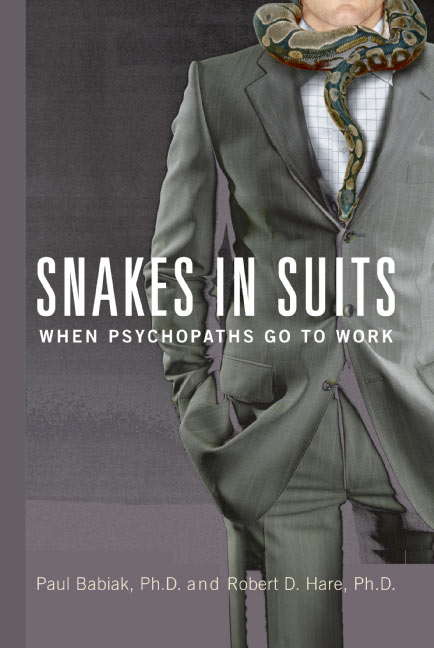
Snakes in Suits book coverSnakes in Suits: When Psychopaths Go to Work should be required reading for all executives, but everybody who did not drop out of society should also study it slowly and carefully. You get your money's worth when you buy this book, because you get actually two books: an updated version of the relevant content of Without conscience and a manager's guide on how to avoid that your organization becomes another Enron (Drs. Bobiak and Hare quote this pearl from Enron's 1998 annual report: "We do not tolerate abusive or disrespectful treatment. Ruthlessness, callousness, and arrogance don't belong here.")

Let's start with the research in psychopathy. Although as I mentioned above there is still no cure other than capital punishment, there are now many hundreds of researchers working in this field, compared to a few academics and forensic psychiatrists when Cleckley wrote The Mask of Sanity. There is now even a Society for the Scientific Study of Psychopathy (SSSP).

Yet, there is still confusion even in the name of this personality disorder. Although the terms psychopathy, sociopathy, and antisocial personality disorder are still used interchangeably, this latest book now makes the following distinction:

Psychopathy
A personality disorder described by the personality traits and behaviors that form the basis of Snakes in Suits. Psychopaths are without conscience and incapable of empathy, guilt, or loyalty to anyone but themselves.
Sociopathy
This is not a formal psychiatric condition. It refers to patterns of attitudes and behaviors that are considered antisocial and criminal by society at large, but are seen as normal or necessary by the subculture or social environment in which they developed. Sociopaths may have a well-developed conscience and a normal capacity for empathy, guilt, and loyalty, but their sense of right and wrong is based on the norms and expectations of their subculture or group. Many criminals might be described as sociopaths.
Antisocial personality disorder (APD)
This is a broad diagnostic category found in the DSM. Antisocial and criminal behaviors play a major role in its definition, and, in this sense, APD is similar to sociopathy. Some of those with APD are psychopaths, but many are not. The difference between psychopathy and APD is that the former includes personality traits such as lack of empathy, grandiosity, and shallow emotion that are not necessary for diagnosis of APD. APD is three to four times more common than psychopathy in the general population and in prisons. The prevalence of those we would describe as sociopathic is unknown but likely is considerably higher than that of APD.

The new results include that the number of psychopaths in the normal population is about 1%, and in the prison population they make up about 15%. When we do the math, the number of APDs is 4%. The important new number is that among high-potential executives psychopaths make up 3.5%. The average PCL: SV (see below) score for corporate psychopaths was 19 (out of a top score of 24), which is well within the research range for psychopathy. In evaluating these findings, it is important to note that scores of at this level indicate the presence of enough psychopathic features to be problematic for the organization (p. 193).

If you think these numbers are small, consider that they are responsible for at least half of the persistent serious and violent crimes committed in North America. As for executives, the authors bring up Enron, who was able to infiltrate and manipulate the top levels in government, caused billions of damages to California's utility users, and financially ruined thousands of workers in the collapse of the company.

PCL:SVOn a more positive note, the authors report and an improved version of the Psychopathy Checklist called PCL-R, and more importantly on a new Screening Version PCL: SV, which allows the quick scoring of subcriminal psychopaths by evaluating the domains and traits of the psychopath:

Interpersonal
Affective
The person is:
  • superficial
  • grandiose
  • deceitful
The person:
  • lacks remorse
  • lacks empathy
  • doesn't accept responsibility
Lifestyle
Antisocial
The person:
  • is impulsive
  • lacks goals
  • is irresponsible
The person has a history of
  • poor behavioral controls
  • adolescent antisocial behavior
  • adult antisocial behavior

The authors insist that scoring each item requires professional qualifications, adherence to the scoring instructions in the PCL: SV Manual, and access to extensive interview and collateral information. In particular, these traits are partially very similar to those with narcissistic personality disorder and histrionic personality disorder; aggressive or malignant narcissism being particularly difficult to distinguish from psychopathy. So, never ever call somebody a psychopath, because you have no way to know.

This is a bummer, because hopefully there will never be a law requiring psychopaths to wear a bell, yet they can kill us, or at least destroy our lives. Since this blog is on visual perception, if you think you might be a victim of a psychopath, your best bet may be to walk down the hall to a colleague with an fMRI machine and collaborate on an experiment. As these renderings from the paper Limbic abnormalities in affective processing by criminal psychopaths as revealed by functional magnetic resonance imaging [if this link fails, search the paper from the Library's site to get the full text] illustrate, psychopathy is easy to make out: the neural areas in which criminal psychopaths showed significantly less affect-related activity than noncriminal control subjects for the comparison of all affective phases versus all neutral phases from the random-effects analysis. Regions include (top left) posterior cingulate, caudal and rostral anterior cingulate, and ventral striatum (top right), right amygdala/hippocampus. Also shown are the regions in which criminal psychopaths showed greater affect-related activity than noncriminal control subjects and criminal nonpsychopaths. These regions include bilateral inferior frontal gyrus.

fMRI of a psychopath

Alternatively, if you do psychophysics, you can also rig up a fake color naming experiment where you present the suspect with words made of random characters and ask the subject to hit a key when the random characters form a valid word. In the set of valid words, intermix color names with emotional words like rape, sex, love, mother, etc. Probit analysis will quickly tell you if the reaction time is the same for all words (you are probably dealing with a psychopath), or takes longer for the emotional words (the subject is likely not a psychopath).

The authors write that the number of people with psychopathic personalities suggests that most of us will come across at least one psychopath during a typical day (p. 37). Their skills make them difficult to detect, because first, they are motivated to, and have talent for, "reading people" and sizing them up quickly. They identify a person's likes and dislikes, motives, needs, weak spots, and vulnerabilities. We all have "buttons" that can be pushed, and psychopaths, more than most people, are always ready to push them. Second, many psychopaths come across as having excellent oral communications skills. In many cases these skills are more apparent than real because of their readiness to jump right into a conversation without the social inhibitions that hamper most people, especially scientists. In the great card game of life, psychopaths know what cards you hold, and they do cheat.

Snakes in Suits also has several references to new research showing that psychopathy has a strong hereditary component. It runs in families and psychopathic parents will certainly nurture the condition in their evil offspring. Not only is psychopathy a package (syndrome, see below), but psychopaths come in packages.

Even when the authors tell us not to jump to conclusions and label somebody as a psychopath, do not hesitate to use your skills as a scientist to unmask them and to use the mechanisms in your organization to exterminate them. For example, here in HP we have the Rules of Business Conduct (brochure) as an effective tool to keep our work environment psychopath-free.

In my view, the weakest point of Snakes in Suits is that it tells us to just stay away from psychopaths. As I argued in a previous post on research in transition, it is our duty towards the organization for which we work, and as members of the scientific elite of society, to have a zero tolerance attitude against psychopaths and to get them locked up. Do not just climb on the armoire and listen through the ceiling what the pyromanics are doing in the attic, as Biederman did!

Psychological "autopsies" have shown that even if family members, close friends, and associates had noticed that all was not right with these individuals, they would not necessarily have appreciated the potential significance of the information and might not have known how to act on it. Therefore, do not hesitate and read Snakes in Suits now to educate yourself before it is too late and your life is jeopardy.

If you chicken out, be prepared for the psychopath at work to take you through three phases: assessment, manipulation, and abandonment. In the first phase, upon hiring, the psychopath will seek out the pawns he or she can use to do their work. They also build connections to executive management (see p. 123) to hit their detractors from above when the shit hits the fan. In the manipulation phase, psychopaths use their uninhibited social skills to create chaos in the organization. In the last phase—abandonment—once you are no longer useful, you will just get dumped like an old rag.

How does the psychopath get you in a fatal bond? You have three selves. The first is you inner or private personality, all the good and bad you subjectively know about yourself. The second is your public self or persona, how you want others to see you. The third is your reputation—how others see you. The psychopath is a master in getting you to fully disclose your persona and will create a mask, your simulated persona he or she will put on to create the psychopathic bond. In the abandonment phase, the psychopath will fully destroy your reputation. No kidding!

The authors describe (p. 132) how the employees most at risk of being manipulated into covering for psychopaths, actually carrying out their workload in exchange for things that are not readily apparent at the time, are highly skilled specialists with poor social skills. The latter prevents them from having a successful career and the high skills allow them to cover for the psychopath with little effort. All the psychopath has to do, is to give them the little attention and praise of their work they are not getting from their managers.

In a chapter titled Darkness and Chaos, Drs. Babiak and Hare review how organizations have changed in the past 50 years. From the 1940s to the 1970s, the relation between organization and employees was based on a "psychological contract." During the late 1970s, teamwork replaced traditional command-and-control hierarchies, and employees were entrusted with the decisions affecting their own work and group decisions about needed business improvements often took precedence Then change became a key method to run a business (see also my first post on research in transition).

However, in the 1980s and the 1990s, the rate of change accelerated too quickly and there were too many changes at once. The "psychological contract" was challenged, and it gave way eventually to a world where the employee-employer relationship was seen as a transitory one rather than a long-term partnership.

Since the turn of the century the rate of change has increased exponentially, so that organizations now find themselves in a constant state of transitioning (p. 159). Organizations are now characterized by unclear, outdated, unenforceable, or nonexistent work rules and policies; inconsistent risk taking; greater tolerance for controversial, perhaps even abusive, behaviors; and antiquated measurement systems and communication networks. The leader's job becomes increasingly complex but far less well defined—itself a frustrating thing. Traditional strategic planning, organizing, and motivating skills are of limited use.

Today, employees are treated as individual contributors, responsible for their own career advancement, and organizations act rewarding them with large salaries for innovative, fast-paced problem solving—as well as the chance to continue to work on new, exciting projects. The symbiosis of employees with entrepreneurial talents and the transitioning organization can lead to the constant reinventing, rebuilding, and reenergizing that both need for survival and growth. If well managed, the results can be impressive.

The gist of the book is, that while the old "psychological contract" was a deterrent for psychopaths and relegated them into the penal system, the transitioning organizations have become psychopath friendly, a bonanza for the psychopath. Rapid business growth, increased downsizing, frequent reorganizations, mergers, acquisitions, and joint ventures have inadvertently increased the number of attractive employment opportunities for individuals with psychopathic personalities—without the need for them to correct or change their psychopathic attitudes and behaviors (p.164).

These "entrepreneurial pretenders" capitalize on the lessened reliance on rules and policies and the increased need for free-form decision making that characterize organizations in a chaotic state. Because a leader's ability to get people to do things is often of more importance than his or her technical capabilities to perform work tasks, pretenders lacking in real work expertise are not disadvantaged; their talents are assumed and their phony or exaggerated backgrounds often accepted at face value.

The authors have identified three main "psychopathic styles" in these pretenders. The classic style consists of those with a high score on each of the psychopathy dimensions (see table above): interpersonal, affective, lifestyle, and antisocial. They exhibit virtually all the features that define psychopathy.

The manipulative style consists of those with a high score on the interpersonal and affective dimensions, and somewhat lower scores on the lifestyle and antisocial dimensions. They manipulate, deceive, and charm but are less impulsive and antisocial than the other types. They are talkers more than doers.

The macho style consists of those with a high score on the affective, lifestyle, and antisocial dimensions, and a low score on the interpersonal dimension. They are aggressive, bullying, and abrasive individuals, less charming and manipulative than the other types. They are doers more than talkers.

A cynical reader may state that in their dysfunctionality these psychopaths may actually have value for the transitioning organization. However, Drs. Babiak and Hare warn that we can safely say that those who believe that "psychopathy is good" clearly have not had much exposure to the real thing. The problem is that you cannot choose which psychopathic traits you want and ignore the others; psychopathy is a syndrome, that is, a package of related traits and behaviors that form the total personality of the individual. Unfortunately for business, the "good" traits often conceal the existence of the "bad" when it comes to a psychopath (p. 194).

Moreover, visionary thinking, the ability to conceptualize the future of the organization, is a complex skill requiring a broad perspective, the ability to integrate multiple points of view, and a talent for looking into the future—that is, to think strategically. Psychopaths are not good at establishing and working towards long-term strategic objectives; they are much more opportunistic. They can weave compelling stories about situations and events of which they know very little into superbly believable visions of the future.

Snakes in Suits contains comprehensive tips on interviewing job candidates. Even for those trained in the study of psychopaths, one of the problems that researchers who interview psychopaths face is losing control of the interview. Psychopaths avoid answering direct questions, but rather introduce topics into the conversation that are interesting to the interviewer. Before you know it, you are the one being interviewed and your plan is derailed. You lose sight of what the interview was about in the first place (p. 223).

Many individuals believe that they are good at telling if someone is lying or not. Few of us can really tell. Even those who are trained to detect lying and deception are not particularly good at it (p. 231).

The book concludes with explicit practical tips on what to do when you find a psychopath in your organization. Study them before you have that dooming encounter.

Interwoven in the book is a play presenting a comprehensive case study. It might be tempting to read it ahead of the book's meat, but I was glad I refrained, because the play has a surprise ending you can only appreciate is you have learned about psychopaths during your diligent study of the book.

Links mentioned in the comments:

Wednesday, August 22, 2007

Mini review. Without conscience

As mortgage investments are in crisis, I'll offer you my second mini review in the 301.7—terrorism @ home series, because you indicated in my post on risk management that all that is necessary is to understand the risks and hedge against them. Today's book among others briefly discusses the Savings & Loans crisis and what you learn from that may help you develop a proper risk management strategy for the current crisis, which has many similarities.

Dr. Robert D. Hare is the foremost expert in the antisocial personality disorder syndrome and his book Without conscience is accessible to us non-specialists. Dr. Hare wrote his book ten years before Dr. Stout wrote hers (see my previous post), so while the latter was influenced by the events of September 11, 2001, the former was written after the Desert Storm war in Iraq.

However, the books are completely different for more fundamental reasons. While Dr. Stout works with APD victims, Dr. Hare researches the psychopaths themselves, and therefore offers a diametrically opposite perspective. Again, also with this book you should not draw any quick conclusions about any person; instead you should read the book slowly and carefully so you can learn to protect yourself. [As a CYA, I am citing actual text in block quotes instead of paraphrasing it in a few words. For your convenience, each block quote has an anchor.]

Dr. Hare starts with electroencephalograms (EEG) that do not look human:

Everybody has met these people, been deceived and manipulated by them, and forced to live with or repair the damage they have wrought. These often charming—but always deadly—individuals have a clinical name: psychopaths. Their hallmark is a stunning lack of conscience; their game is self-gratification at the other person's expense. Many spend time in prison, but many do not. All take far more than they give.

Like Dr. Stout, also Dr. Hare is flabbergasted by the high incidence rate of this condition and by how physically close they are to us.

The most obvious expressions of psychopathy —but by no means the only ones—involve flagrant criminal violation of society's rules. Not surprisingly, many psychopaths are criminals, but many remain out of prison, using their charm and chamaleonlike abilities to cut a wide swath though society and leaving a wake of ruined lives behind them.

He then asks

is the psychopath mentally ill or simply a rule breaker who is perfectly aware of what he or she is doing?

The question is not just a semantic one; posed another way, it has immeasurable practical significance: Does the treatment or control of the psychopath rightly fall to mental health professionals or to the correctional system? Everywhere in the world, judges, social workers, lawyers, schoolteachers, mental health workers, doctors, correctional staff, and members of the general public need—whether they know it or not—the answer.

One important criterion is that

unlike psychotic individuals, psychopaths are rational and aware of what they are doing and why. Their behavior is the result of choice, freely exercised.

In other words, these individuals are not sick or insane and the correctional system has to deal with them.

By the way, the terms sociopath and psychopath are often used interchangeably. Some people prefer the former because it is less easy to be confused with psychotism or insanity. However, Dr. Hare makes a clear distinction between the two terms and does not consider them to be synonyms:

"antisocial personality disorder" refers primarily to a cluster of criminal and antisocial behaviors. The majority of criminals easily meet the criteria for such a diagnosis. "Psychopathy," on the other hand, is defined by a cluster of both personality traits and socially deviant behaviors. Most criminals are not psychopaths, and many of the individuals who manage to operate on the shady side of the law and remain out of prison are psychopaths. Keep this in mind if you have occasion to consult a clinician or counselor about a psychopath in your life. Make sure that he or she knows the difference between antisocial personality disorder and psychopathy.

Dr. Hare has developed a complex clinical diagnostic tool, the Psychopathy Checklist (PCL). The diagnosis is difficult, because psychopathy is a syndrome—a cluster of related symptoms. Anyway, the symptoms are:

Emotional/Interpersonal
Social deviance
  • glib and superficial
  • egocentric and grandiose
  • lack of remorse or guilt
  • lack of empathy
  • deceitful and manipulative
  • shallow emotions
  • impulsive
  • poor behavior controls
  • need for excitement
  • lack of responsibility
  • early behavior problems
  • adult antisocial behavior

As for lack of remorse or guilt, Dr. Hare notes

In an ironic twist, psychopaths frequently see themselves as the real victims.

And regarding shallow emotions he notes that

Laboratory experiments using biomedical recorders have shown that psychopaths lack the physiological responses normally associated with fear.

Given these two facets of the psychopath—feelings & relationship and social deviance—one could assume these people could not only become our neighbors next door but also terrorists who are jealous of our freedom and democracy. However, Dr. Hare notes that

it is […] unlikely that psychopaths would make good spies, terrorists, or mobsters, simply because their impulsiveness, concern only for the moment, and lack of allegiance to people or causes make them unpredictable, careless, and undependable—likely to be "loose cannons."

Thus psychopaths usually do not get along well with one another and operate individually. However, occasionally they can become partners in crime, and then

generally, one member of the pair is a "talker" who gets his or her way through charm, deceit, and manipulation, whereas the other is a "doer" who prefers direct action—intimidation and force. As long as their interests are complementary, they make a formidable pair.

An interesting perspective is how psychopaths see the PCL:

Recently, an ex-con offered me his opinion on the Psychopathy Checklist: he wasn't to impressed! Now middle-aged, he had spent most of his early adult life in prison, where he was once diagnosed as a psychopath. Here are his responses:

  • Glib and superficial—"What is negative about articulation skills?"
  • Egocentric and grandiose—"How can I attain something if I don't reach high?"
  • Lack of empathy—"Empathy toward an enemy is a sign of weakness."
  • Deceitful and manipulative—"Why be truthful to the enemy? All of us are manipulative to some degree. Isn't positive manipulation common?"
  • Shallow emotions—"Anger can lead to being labeled a psychopath."
  • Impulsive—"Can be associated with creativity, living in the now, being spontaneous and free."
  • Poor behavioral controls—"Violent and aggressive outbursts may be a defensive mechanism, a false front, a tool for survival in a jungle."
  • Need for excitement—"Courage to reject the routine, monotonous, or uninteresting. Living on the edge, doing things that are risky, exciting, challenging, living life to its fullest, being alive rather than dull, boring, and almost dead."
  • Lack of responsibility—"Shouldn't focus on human weaknesses that are common."
  • Early behavior problems and adult antisocial behavior—"Is a criminal record reflective of badness or non-conformity?"

Interestingly, he had nothing to say about Lack of remorse or guilt.

The main trait is, however, the lack of a conscience, hence the book's title.

We don't know why the conscience of the psychopath—if it exists at all—is so weak. However, we can make some reasonable guesses:

  • Psychopaths have little aptitude for experiencing the emotional responses—fear and anxiety—that are the mainsprings of conscience.
  • The "inner speech" of psychopaths lacks emotional punch.
  • Psychopaths have a weak capacity for mentally "picturing" the consequences of their behavior

Like Dr. Stout, also Dr. Hare is very concerned of contemporary American society encouraging and glorifying many of these symptoms. He concludes

Are we unknowingly allowing a society to evolve that is the perfect breeding ground, and perhaps even a "killing field," for psychopaths? As our morning newspaper tells us, this question grows more pressing every day.

Some numbers he quotes are;

  • On average, about 20% of male and female prison inmates are psychopaths.
  • Psychopaths are responsible for more than 50% of the serious crimes committed.

A recent study by the FBI found that 44% of the offenders who killed a law enforcement officer on duty were psychopaths.

In a chapter on white-collar psychopaths, the author writes:

Grambling's ability to rationalize his behavior is typical of the attitude psychopaths have towards their victims. In addition to his wish to be "liked by everyone," his euphemistic view of himself as a "financial architect," and his "fear of losing face," he considered his crimes logical responses to frustration and pressure, or more the victim's fault than his own. "In Grambling's mind, anyone who is stupid enough to trust or believe him deserves the consequences," said [New York Assistant District Attorney] Rosner.

Your homework: reflect on the above paragraph every time you say "risk management."

To illustrate how difficult it is to diagnose a psychopath, Dr. Hare relates an anecdote of a personal experience he had with the organizer of a conference on crime here in California, who stole his honorarium:

Ironically, I had spent quite a bit of time with this man, at a luncheon held just before my talk and later in a bar. I detected nothing unusual or suspicious about him; my antenna failed to twitch in his presence. Would I have lent him money? Possibly. I do recall insisting that I pick up the bar tab. He wasn't wearing a bell around his neck!

In fact,

many psychopaths never go to prison or any other facility. They appear to function reasonably well—as lawyers, doctors, psychiatrists, academics, mercenaries, police officers, cult leaders, military personnel, businesspeople, writers, artists, entertainers, and so forth—without breaking the law, or at least without being caught and convicted. […]

Rather than refer to these individuals as successful psychopaths—after all, their success is often illusory and always at someone else's expense—I prefer to call them subcriminal psychopaths. Their conduct, although technically not illegal, typically violates conventional ethical standards, hovering just on the shady side of the law. Unlike people who consciously adopt a ruthless, greedy, and apparently unscrupulous strategy in their business dealings but who are reasonably honest and empathetic in other areas of their lives, subcriminal psychopaths exhibit much the same behaviors and attitudes in all areas of their lives. If they lie and cheat on the job—and get away with it or are even admired for it—they will lie and cheat in other areas of their lives.

Dr. Hare then elaborates on the victims of these white-collar psychopaths—victims who live in fear of retributions—and notes how only few of them become visible, like the tip of an iceberg. The others suffer in the dark.

Tragically these victims often cannot get other people to understand what they are going through. Psychopaths are very good at putting on a good impression when it suits them, and they often paint their victims as the real culprits. As one woman—the third wife of a 40 year old high school teacher—recently told me: "For five years he cheated on me, kept me living in fear, and forged checks on my personal bank account. But everyone, including my doctor and lawyer and my friends, blamed me for the problem. He had them so convinced that he was a great guy and that I was going mad, I began to believe it myself. Even when he cleaned out my bank account and ran off with a 17 year old student, a lot of people couldn't believe it, and some wanted to know what I had done to make him act so strangely."

Writing then about the corporate psychopath, Dr. Hare then goes into the S & L crisis, which

at the time of this writing, the projected cost to U.S. taxpayers of what has become known as the S & L bail-out approaches $1 trillion—more than the entire cost of the Vietnam War.

He then finally starts writing about what all this means for us average people who are just living a normal life and try to make a contribution to society.

The sad fact is that we are all vulnerable. Few people are such sophisticated and perceptive judges of human nature that they cannot be taken in by the machinations of a skilled and determined psychopath. Even those who study them are not immune; as I've indicated in previous chapters, my students and I are sometimes conned, even when aware that we're dealing with a probable psychopath.

In an analogy that is easy to understand for us color scientists, he notes that

the psychopath is like a color-blind person who sees the world in shades of grey but who has learned how to function in a colored world. He has learned that the light signal for "stop" is at the top of the traffic signal. When the color-blind person tells you he stopped at the red light, he really means he stopped at the top light. He has difficulty in discussing the color of things but may have learned all sorts of ways to compensate for this problem, and in some cases even those who know him well may not know that he cannot see colors.

Like the color-blind person, the psychopath lacks an important element of experience—in this case, emotional experience—but may have learned the words that others use to describe or mimic experiences that he cannot really understand. As Cleckley put it, "He can learn to use ordinary words … [and] will also learn to reproduce appropriately all the panthomime of feeling … but the feeling itself does not come to pass."

Recent laboratory research provides convincing support for these clinical observations.

However, there is a twist:

Psychopaths are notorious for not answering the questions posed to them or for answering in a way that seems unresponsive to the question. […] Psychopaths also sometimes make it difficult for their listeners to understand parts of their narrative.

And

We are sucked in not by what they say but by how they say it and by the emotional buttons they push while saying it.

As for the moral stance we should take, Dr. Hare writes

psychopaths do meet current legal and psychiatric standards for sanity. They understand the rules of society and the conventional meanings of right and wrong. They are capable of controlling their behavior, and they are aware of the potential consequences of their acts. Their problem is that this knowledge frequently fails to deter them from antisocial behavior.

[…] In my opinion, psychopaths certainly know enough about what they are doing to be held accountable for their actions.

About their modus operandi he then teaches us

Psychopaths tend to see any social exchange as a "feeding" opportunity, a contest, or a test of wills, in which there can be only one winner. Their motives are to manipulate and take, ruthlessly and without remorse.

[…] Although psychopaths may talk a lot, they are not necessarily skilled wordsmiths. It is primarily the "show," not eloquent use of language, that attracts our attention and cons us. Good looks, a touch of charisma, a flood of words, contrived distractions, a knack for knowing which buttons to press—all these can go a long way toward obscuring the fact that the psychopathic presentation is nothing more than a "line." A good-looking, fast-talking psychopath and a victim who has "weak spots" is a devastating combination. If the psychopath's "show" is not enough, the adroit use of "stage props"—phony credentials, flashy car, expensive clothes, a sympathy-inducing role, and so forth—will usually complete the job.

Pondering on how our American culture is encouraging more and more the traits of psychopaths, Dr. Hare envisions a dark future reminiscent of A Clockwork Orange.

If, as I believe, our society is moving in the direction of permitting, reinforcing, and in some instances actually valuing some of the traits listed in the Psychopathy Checklist—traits such as impulsivity, irresponsibility, lack of remorse, and so on—our schools may be evolving into microcosms of a "camouflage society," where true psychopaths can hide out, pursuing their destructive, self-gratifying ways and endangering the general student population. […] our society may be not only fascinated but increasingly tolerant of the psychopathic personality. Even more frightening is the possibility that "cool" but vicious psychopaths will become twisted role models for children raised in dysfunctional families of disintegrating communities where little value is placed on honesty, fair play, and concern of the welfare of others.

[…] today our streets, our schools, and even our homes might afford the psychopath the chance to blend in undetected, undiagnosed, and actively encouraged. I hope that this book will draw attention to this frightening possibility by putting psychopathy in children into bold relief.

Eventually Dr. Hare discusses therapies for psychopaths. Unfortunately there aren't any and the only possibilities are to either teach them to use cognitive skills not to do harm—after all they are sane—or must outcast them.

With few exceptions, the traditional forms of psychotherapy, including psychoanalysis, group therapy, client-centered therapy, and psychodrama, have proved ineffective in the treatment of psychopathy. Nor have the biological therapies, including psychosurgery, electroshock therapy, and the use of various drugs, fared much better.

Psychopaths don't feel they have psychological or emotional problems, and they see no reason to change their behavior to conform to societal standards with which they do not agree.

To elaborate, psychopaths are generally well satisfied with themselves and with their inner landscape, bleak as it may seem to outside observers. They see nothing wrong with themselves, experience little personal distress, and find their behavior rational, rewarding, and satisfying; they never look back with regret or forward with concern. They perceive themselves as superior beings in a hostile, dog-eat-dog world in which others are competitors for power and resources. Psychopaths feel it is legitimate to manipulate and deceive others in order to obtain their "rights," and their social interactions are planned to outmaneuver the malevolence they see in others.

Dr. Hare then suggest we should refrain from sending them into therapy, because

unfortunately, programs of this sort merely provide the psychopath with better ways of manipulating, deceiving, and using people. As one psychopath put it, "These programs are like a finishing school. They teach you how to put the squeeze on people."

To conclude, Dr. Hare gives a survival guide teaching you how to protect yourself.

  • Know what you are dealing with.
  • Try not to be influenced by "props." (Don't pay too much attention to any unusually captivating characteristic of people you meet—dazzling looks, a powerful presence, mesmerizing mannerisms, a soothing voice, a rapidfire verbal pitch, and so forth. […] Close your eyes or look away and carefully listen to what the person is saying.)
  • Don't wear blinkers. (Ask the individual about his or her friends, family, relatives, employment, place of residence, plans, and so forth. Psychopaths usually give vague, evasive, or inconsistent replies to queries about their personal lives. Be suspicious of such replies, and try to verify them.)
  • Keep your guard up in high-risk situations.
  • Know yourself. (Psychopaths are skilled at detecting and ruthlessly exploiting your weak spots, at finding the right buttons to press. Your best defense is to understand what your weak spots are and to be extremely wary of anyone who zeros in on them.)
  • Obtain professional advice.
  • Don't blame yourself.
  • Be aware of who the victim is. (Psychopaths often give the impression that it is they who are suffering and that it is the victims who are to blame for their misery. But they are suffering a lot less that you are, and for different reasons. Don't waste your sympathy on them; their problems are not in the same league as yours. Theirs stem primarily from not getting what they want, whereas yours result from a physical, emotional, or financial pounding.)
  • Be careful about power struggles. (Keep in mind that psychopaths have a strong need for psychological and physical control over others. They must be in charge, and they will use charm, intimidation, and violence to ensure their authority. In a power struggle a psychopath will usually focus on winning. This doesn't mean you shouldn't stand up for your rights, only that it will probably be difficult to do so without risking serious emotional or physical trauma.)
  • Set firm ground rules. (Although power struggles with a psychopath are risky at best, you may be able to set up some clear ground rules—both for yourself and for the psychopath—to make your life easier and begin the difficult transition from victim to a person looking out for yourself.)
  • Don't expect dramatic changes. (To a large extent, the personality of psychopaths are "carved in stone.")
  • Cut your losses. (The psychopath may succeed in shattering your self-confidence and may convince you—and your friends—that you are unworthy of his or her time or even that you are "losing it." The more you give in, the more you will be taken advantage of by the psychopath's insatiable appetite for power and control. Rather than make fruitless attempts to adapt to a hopeless situation—usually by giving in, accepting your lot in life, or losing your self-identity—it may be better to recognize that your emotional and physical survival requires that you take charge of your life. This can be a tricky move—even a dangerous one—and it requires good professional advice, both clinical and legal.)
  • Use support groups.

The book concludes with

The social and financial costs to society of failing to solve the daily mystery of the psychopath will be staggering. It is imperative that we continue to search for clues.

Take action, read one of the books in this review series, and build your risk management strategy. And do not forget you are a member of this society, so when you spot a psychopath, write your Congress Person.

In the next mini review I will review a book about our workplace.

Wednesday, August 15, 2007

Mini review. The sociopath next door

This mini review is the first in a series that I would call 301.7—terrorism @ home. In Europe the Seventies brought IRA, ETA, RAF, and BR and with them terrorism in our immediate environment. In the USA, 30 years later, after 11 September 2001, we also have to deal personally with terrorism. As a society, we have entities like military strategists, politicians, covert agencies, and historians to study the phenomenon; and we have institutions like the Secret Service, police, and army to deal with it.

Informally, we label the agents of terrorism with terms like sociopaths and psychopaths. However, for the past 60 or so years (actually, since Cleckley wrote The Mask of Sanity in 1941) these terms have been associated by the medical profession with an actual disease. The medical name of this disease is antisocial personality disorder and it is described in section 301.7 on page 706 in the Diagnostic and Statistical Manual of Mental Disorders IV of the American Psychiatric Association.

It turns out that antisocial personality disorder, or APD for short, is a quite common disease—4% of the population are affected by it. For comparison, here in California, according to the Centers for Disease Control and prevention, the "alarmingly high" colorectal cancer incidence rate is 0.045%. Therefore APD has pandemic proportions and you should be aware of it, because you might have to deal with a sociopath living next door.

A good starting point is Dr. Martha Stout's book The sociopath next door. Dr. Stout has served on the Harvard Medical School for 25 years and is also in private practice, specializing in the victims of sociopaths. The book is easy to read and gives you an overview of the disease and some guidance on how to recognize and deal with APD sufferers.

Diagnosing and treating a disease is complex and requires a trained physician. For example, if you checked out section 301.7 above, you will have noticed that page 705 is all about when the symptoms are not those of APD, and the diagnostic criteria requires you to have some anamnesis prior to age 15 of the diseased.

If you think your friend has a heart attack, you do not take out your Swiss Army knife and perform a bypass on him; similarly, if you think you are the victim of a sociopath, seek immediate help from your family doctor, who can then refer you to a specialist. With this caveat, Dr. Stout teaches you some symptoms of this disease, namely

  1. failure to conform to social norms
  2. deceitfulness, manipulativeness
  3. impulsivity, failure to plan ahead
  4. irritability, aggressiveness
  5. reckless disregard for the safety of self or others
  6. consistent irresponsibility
  7. lack of remorse after having hurt, mistreated, or stolen from another person

But she teaches you also that there is little you can do, other than avoid any contact with sociopaths. In fact she elaborates on these 13 rules for dealing with sociopaths in everyday life:

  1. the first rule involves the bitter pill of accepting that some people literally have no conscience
  2. in a contest between your instincts and what is implied by the role a person has taken on—educator, doctor, leader, animal lover, humanist, parent—go with your instincts
  3. when considering a new relationship of any kind, practice the Rule of Threes regarding the claims and promises a person makes, and the responsibilities he or she has. Make the Rule of Threes your policy
  4. question authority
  5. suspect flattery
  6. if necessary, redefine your concept of respect
  7. do not join the game
  8. the best way to protect yourself from a sociopath is to avoid him, to refuse any kind of contact or communication
  9. question your tendency to pity too easily
  10. do not try to redeem the unredeemable
  11. never agree, out of pity or for any other reason, to help a sociopath conceal his or her true character
  12. defend your psyche
  13. living well is the best revenge

So far I have not told you what this disease is. Dr. Stout explains that we have 7 senses. You know about about the first 5. The 6th is intuition and the 7th is conscience. A person with APD is a person completely lacking the 7th sense. Like some people are born blind, some persons are born without a conscience. Because the incidence is so high—1 in 25, like for color blindness—you sooner or later will have to deal with a sufferer, although at first sight it is not obvious.

Like color blindness, APD is a genetic disease. Comparing monozygotic with dizygotic twins, scientists researching the Texas Adoption Project have estimated that APD is 54% inherited, the rest being acquired. Worse than many color blind people not being aware of their disease, the sociopaths cannot be aware of their disease because they do not have the conscience that is necessary to detect a conscience.

If you recall the research published early 2003 about Genghis Khan's propagating his APD-carrying genes to some 16 million men living between Afghanistan and northeastern China—almost one in every 200 men alive—you would expect this disease to be prevalent in Central Asia.

This is not so, because of the acquired component, which in this case should be qualified as "demonically nurtured." In fact, the Asian cultures focus on the relation among people, therefore sociopaths tend to be outcast or even executed, like the Inuit do with the kunlangeta, as they call the sociopaths. In America's Judeo-Christian culture of individualism, instead, many traits of sociopathy are praised and reinforced, such as impulsivity, irresponsibility, and lack of remorse.

In conclusion, right here is where you can become the victim of a sociopath. If you live here, slowly and carefully reading Dr. Stout's book is a must.

Thursday, July 19, 2007

Risk Management

This is a summary of the feedback I received on my previous blog entry.

I always had two feedback channels for this blog: the open comments and the personal email. After the system problems in the first half of June, which prevented you from posting comments and me from blogging, the comment channel has closed up. However, the personal email still keeps coming.

Posting comments works again and I much prefer comments to personal email, because this is supposed to be a conversation — with personal email it just looks like I am pontificating. In this post I summarize the feedback I received on the last blog entry, hoping further feedback uses the comment channel, which is up and running.

The emailers agreed among them that I had it all wrong. They observed that Christoph Hauert et al. had the typical European view of a social state, which is proven to be inefficient. Readers pointed out at how efficient the American businesses have become and therefore that one has to study them to learn how to build a successful society.

Using the terminology in Hauert's paper, cooperators tend to become inefficient over time. Defectors are the good guys who identify these inefficiencies and by exploiting them become the punishers of the lazy cooperators and build a better society. Examples given included hedge funds and takeover partnerships like Steel Partners in the Bull-Dog Sauce case.

The question then is about the morality of defectors punishing cooperators to create a better society. The answer to that was that every cooperator has to have a risk management strategy in place to be useful to society. Hence, the risk manager should replace the abstainer proposed by Hauert et al. An example of risk management in business is the poison pill, but the emails I received mentioned this as a bad example, without giving me good examples.

Anyway, what does risk management mean for us in color science? We do research, which is about taking risk. None of the emails I received touched this topic.

Some classical strategies to manage risk include transferring the risk to an outside party (i.e., out-source research to a university), and reducing the negative effect of the risk. The risk is that the invention cannot be transferred into a product, hence researchers should only take on projects proposed by marketing as a result of a customer study. In our jargon we call this going only for the low-hanging fruit, and the associated tactic is to stick to incremental product improvements.

Practically this means we should stop research in solid state light sources and focus instead on improving the color rendering index of fluorescent and halogen discharge lamps. Similarly, instead of spectral imaging, color Fourier imaging, or high-dymanic-range imaging we should keep improving look-up table methods, add parameters to ICC profiles, and measure more color patches.

Do you have a better understanding you can share?

Tuesday, July 10, 2007

Contributors, slackers, quitters, and Bull-Dog Sauce

If you saw the news on Japanese TV yesterday, the top story was the Bull-Dog Sauce take-over and specifically the morality of the High Court decision in this matter. It just so happens that the latest Science issue has a paper on a new model of collective action showing how socially beneficial punishment can arise and evolve. Color science relies heavily on mathematical models, so this is an interesting case for us.

In well oiled successful societies, there is a strong sense of community and solidarity. Periodically, this sense of community can weaken and a subculture of social parasites or slackers (scientific term: defectors) can emerge an grow. Society can then punish the slackers to remain competitive.

Dr. Joseph-Ignace GuillotinA historical example was the aristocracy in XVIII century France. When at the end the illuminated created a philosophy and Dr. Joseph-Ignace Guillotin popularized an efficient punishment tool, the problem was tamed. We can explain this superficially by arguing the contributors got fed up and boiled over, but this is not a scientifically tenable explanation, because punishers pay a social price and are not motivated.

Worldwide, from Bucharest to Tokyo, but especially here in the US we see a rapid increase of these defectors. This takes many forms, from insurance fraud to frivolous litigation, elder abuse, family member blackmail, phishing, pharming, and identity theft. Some are legal and some are not, but the common thread is that currently the defectors usually are not punished. At the moment there is no effective punishment mechanism and the situation is worsening, so there is a collective interest in understanding how punishment evolves.

Christoph Hauert et al. have published new research results in their article Via Freedom to Coercion: The Emergence of Costly Punishment in the 29 June edition of Science, who also published the perspective A Narrow Road to Cooperation in the same issue. The editors summarize the research as follows:

Collective endeavors among individuals are often accompanied by risk. Defectors (those who do not invest but who share in the return) fare better than cooperators (who do invest), but a third type of participant, the punisher, who acts against the defectors, can stabilize a cooperative group of individuals. The Science paper now now provides a theoretical basis for the emergence of such punishers, who incur costs that mere cooperators do not and would thus be expected to suffer in evolutionary terms. Allowing for a fourth type of individual — the abstainer — leads to population dynamics where punishers flourish. In essence, it appears that voluntary submission to social norms is a prosocial act.

The mathematics behind this paper is elegant and beautiful, but does a slick mathematical model entail an accurate and useful description of reality? Can it explain the Bull-Dog Sauce debacle? Can it differentiate between the Japanese perception of Bull-Dog Sauce as victims versus the American perception of Bull-Dog Sauce as whiners and loosers?

Personally, this paper leaves me with more questions than answers. How about statesmanship, idealism, passion, etc.? How about the current population pressures of flourishing societies with rapidly decreasing birth rates versus less efficient societies with high birth rates?

And what does it mean for us in research? I do not believe large collaborative research efforts in research labs have disappeared because of defecting researchers. And the abstainers, are those the researchers who are unemployed and working out of their Silicon Valley garages? I am not even sure abstainers are socially relevant, as an abstainer would still need a good connection to a venture capitalist to fund his work and eventually sell it.

What are your thoughts? How does this affect your research, your personal life?

Monday, February 5, 2007

Loss aversion in decision-making

Prospect theory, a behavioral model of decision making under risk and uncertainty, explains risk aversion for mixed (gain/loss) gambles using the concept of loss aversion: People are more sensitive to the possibility of losing money than they are to gaining the same amounts of money; the subjective impact of losses is roughly twice that of gains. In a recent Science article a team from UCLA shows how neuroimaging can be used to directly rest predictions from behavioral theories.

In their paper The Neuronal Basis of Loss Aversion in Decision-Making Under Risk , in Science Volume 315, 26 January 2007 pp. 515–518 (subscription required), Sabrina Tom, Craig Fox, Christopher Trepel, and Russell Poldrack collected functional magnetic resonance imaging (fMRI) data while participants decided whether to accept or reject mixed gambles that offered a 50/50 chance of either gaining one amount of money or losing another amount.

Their study shows that in the context of decision-making, potential losses are represented by decreasing activity in regions that seem to code for subjective value rather than by increasing activity in regions associated with negative emotions. In other words, loss aversion does not appear to be driven by a negative affective response, such as fear, vigilance, discomfort, or anxiety.

Finally, their results provide evidence in favor of one of the fundamental claims of prospect theory, namely that the function that maps money to subjective value is markedly steeper for losses than gains.