This blog will have reduced functionality from Friday 24 June 23:00 h UTC to Sunday 26 June 23:00 h UTC due to a scheduled power outage. Two of our name servers and the server with data, applications, and media will receive an UPS (Uninterruptible Power Supply). Only the name server in Europe and text will function normally, as well as the media hosted on external servers.
Friday, June 24, 2011
Thursday, June 23, 2011
EI 2010 color naming paper now open access
Thanks to the generous support of our sponsor, our EI 2010 color naming paper is now open access, i.e., the download is free. The copyright belongs to SPIE: if you have the bits on your server, please remove them and replace them with this link: http://dx.doi.org/10.1117/12.846957. Of course, you can store a copy for personal use on your own computer.
The citation is as follows:
Giordano B. Beretta and Nathan M. Moroney, "Color naming: color scientists do it between Munsell sheets of color", Proc. SPIE 7528, 75280V (2010); doi:10.1117/12.846957
The paper introduces such important concepts as automatic color term translation through colorimetry and crowd-sourcing, as well as the experimental proof that color naming on emissive displays correlates to color naming on reflective media. This paper is also suggests the use of widely available standards such as the Munsell Sheets of Color in order to compare the results of different experiments.
As a reminder, here are the links to our other open access color naming papers:
- Is it turquoise + fuchsia = purple or is it turquoise + fuchsia = blue? http://dx.doi.org/10.1117/12.872581
- Toward Robust Categorical Color Perception http://www.hpl.hp.com/techreports/2009/HPL-2009-146.html
- Cognitive Aspects of Color http://www.hpl.hp.com/techreports/2008/HPL-2008-109.html
Next time you purchase a printer, please consider one of our sponsor's fine printers: http://h10010.www1.hp.com/wwpc/us/en/sm/WF02a/18972-18972-3328065.html
Tuesday, June 21, 2011
Mandarin color terms elicited from free color naming task

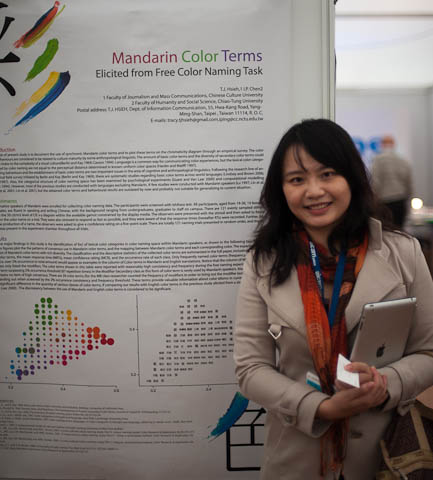
At the AIC 2011 meeting, Tsuei-Ju Hsieh from the Chinese Culture University presented the poster Mandarin color terms elicited from free color naming task she prepared with I-Ping Chen of the Chiao-Tung University.
Up to now, there have been only few color naming experiments in Mandarin and their behavioral results are outdated. Tsuei-Ju Hsieh enrolled 36 native Mandarin speakers and asked them to freely name 121 evenly sampled stimuli sweeping the 50 cd/m2 level of the 1931 CIE chromaticity diagram. The response times were also recorded and following the production of a name, the observers were asked to give a confidence rating on a five-point scale.
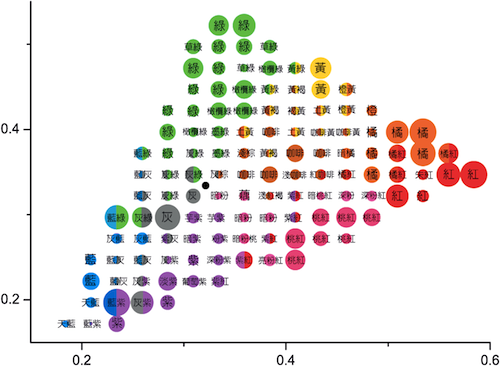
The result is the identification of the foci of lexical color categories in a color naming space within Mandarin speakers, as shown in the figure below:

There is significant difference in the quantity of various classes of color terms when comparing Tsuei-Ju Hsieh's results with the English color terms in a previous study elicited from a similar task.
A full journal paper is about to appear in Color Research and Applications.
Monday, June 20, 2011
Color naming experiment using 2D and 3D rendered samples

At the AIC 2011 meeting, Midori Tanaka presented the paper Color naming experiment using 2D and 3D rendered samplesColor naming experiment using 2D and 3D rendered samples she wrote with Shoji Tominaga and Takahiko Horiuchi, all of Chiba University.
Usually in color naming experiments the observer is shown color swatches and asked to provide a color term for each swatch. In Tanaka's psychophysics experiments the observers were shown a single color swatch and then asked to assign to it one of the 15 basic Japanese color terms (the 11 universal plus turquoise, chartreuse, gold, and silver).
While usually the color swatch is completely uniform, i.e., the pixels all have the same identical RGB values, Tanaka chose a different rendering in each experiment. They were 2D (i.e., identical RGB values), 3D rendering with low contrast shading, 3D with high contrast shading, and 3D with shading and specular reflection:

An unexpected result is that observer determine the color term significantly faster with the 3D sample than with the 2D sample. Unfortunately this does not lead to a methodology for faster color naming. Indeed, the main result of the paper is that the number of bright color terms decreases in the case of 3D samples, so the data from 3D samples cannot be compared directly with data from 2D samples.
Not unexpected is that orange and brown change in opposite directions from 2D to 3D. This paper is clearly the beginning of research to much better understand the mechanisms of color naming in the human visual system.
Midori Tanaka will graduate from her master course next March and she still has to decide whether to pursue a Ph.D. or find employment in industry. If you can provide her with an active role in your organization, please let her know.
Tuesday, June 14, 2011
Reduced functionality June 24-26
Friday, June 10, 2011
Color semiotics
Color semiotics: everyone is talking about it these days, but where can we find a certain rule or framework which defines it? What parameters are involved? Is this framework useful for designers? Can it be communicated? Can its variation be modelled?
Meet Maryam M. Darrodi, who is trying to answer all of these questions in her Ph.D. research under supervision of Professor Stephen Westland in the University of Leeds.
But there is a part for you too. You can join her Global Online Survey about Colour Semiotics in your very own native language and answer a few questions about a certain color by just clicking on this link: https://www.keysurvey.co.uk/survey/365495/1a02/.
This survey takes less than 3 minutes and you can participate as many times as you wish (each time you will be presented with a different color).
For more information visit http://coloursemiotics.wordpress.com/.
Wednesday, June 8, 2011
validating large-scale lexical color resources
Midori Tanaka has just finished her presentation on a color naming experiment using 2d and 3d rendered samples and we are starting our presentation on validating large-scale lexical color resources. Here are the slides:
Tuesday, June 7, 2011
AIC 2011 Reception

The Midterm Meeting of the International Colour Association (AIC) at the Zurich University of the Arts is in full swing. Here are some pictures from the reception:


Sunday, June 5, 2011
The Milky Way to AIC 2011

If you visit the European headquarters of the Mostly Color Channel (MCC), just a short 10 minute train ride with the Südostbahn (SOB) up the mountain takes you to Einsiedeln, which translates to hermitage.
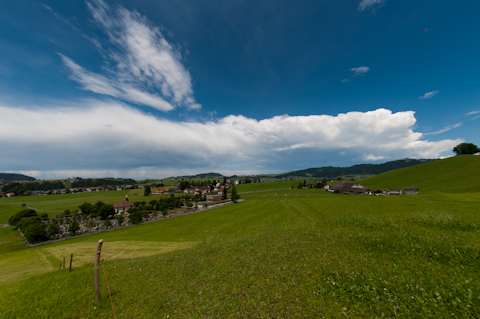
Although Einsiedeln's lush landscape today consists of fat fields on which cows graze, filling the air with the tolling of their bells, in the year 835 when the hermit monk Meinrad from Reichenau settled here, it was a dense forest.

If you walk up to the St. Benedikt vista point shown above, you will have a beautiful view of the monastery. The original Benedictine monastery was built in 934, but the building you see today is the sixth replacement, whose construction began in 1704.

As the towers suggest, this is the view from behind. One of the tricks the architect liked to play, was that of perspective. What is the difference between the image above and the one below? 85 mm vs. 66 mm focal length and about 960 m vs. 939 m elevation.

Anyway, many people do not approach the abbey by SOB but on foot, because their motivation is not MCC but a spiritual journey. Indeed, Einsiedeln is one of the major monasteries on the Milky Way, or Jakobsweg as it is called here.
Milky Way is the old Roman name, when this was a trading route, because it followed the Milky Way to the Atlantic Ocean. Today is has become in fashion again and is often called by its Castillian name of El Camino de Santiago. The branch through Einsiedeln feeds from Austria and Milano and has an unusual feature in that it crosses the lake of Zurich with a footbridge just a meter or so above the water. From the bridge from Rapperswil to Hurdensteg, which is at 410 m, you climb straight up the mountain to cross the Etzel Pass at the chapel of St. Meinrad, which is at 950 m, and enjoy this view as you approach the monastery towards the Baroque and Rokoko abbey church (Klosterkirche):

Given this physical exertion, it is no wonder in front of the esplanade the pilgrims find the Lady Fountain (Marienbrunnen or Frauenbrunnen or Liebfrauenbrunnen) where they can enjoy some fresh alpine spring water.

The importance of the monastery becomes clear from all the gold used in its decorations.

Looking up the abbey, the building is quite imposing, which is very surprising considering we are in a small alpine village distant from the metropoles.

Ora et labora governs the day of the Benedictine monk, hence there are innumerable clocks and other time pieces everywhere.

The pilgrims are welcomed in front of the main door in a serious but warm atmosphere.

In general, the natives are quite friendly and do not mind posing for a tired wayfarer from half a world away, made poorer every day from the relentlessly dropping Dollar.

The most well known native of Einsiedeln was Paracelsus (1493–1541), the inventor of modern medicine and pharmacology. For now, let us get ready to sway from the Milky Way and make a detour to the original goal: the Midterm Meeting of the International Colour Association (AIC) at the Zurich University of the Arts.
Wednesday, June 1, 2011
Mrs. Gisler's garden
A year has past since we wrote about the gardens of Mrs. Stine and Mrs. Nonaka. As the AIC Color 2011 midterm meeting date approaches, we slowly approach the venue, and what is better than exploring the local gardens?
Although last year's gardens had Japanese roots, they showed the clear signs of California's punishing arid climate. In Zurich, the climate is almost as moist as in Japan, so we can expect a comparable lushness. Today we visit Mrs. Gisler's garden:

The many tones of green are perfect, without any trace of blemishes from a scorching sun and deprivation of moisture in the air. At the moment it is raining and the brilliant green of the leaves is further accentuated.

Yellow flowers too:

Yellow? What is that yellow man-made object in the distance? Is it trying to compete with the flowers?

It is a small yellow table in front of a fancy metallic bench. Its perfect smooth geometry contrasts with nature's fractals.

Step back. Are we in gamut?

Let us check from closer:

From the bench, beyond the yellow table, we look on a small pond.


Despite the loud colors, it is very quiet here. The only sounds are distant, from up the ridge, were near Johanna Spyri's birthplace (immortalized in Heidi) the cows and goats graze, the bells tolling at their each step.

In the pond, the fish are busy eating the mosquitos floating on the still pond.