Friday, January 23, 2009

Electronic Imaging 2009 New SPIE Fellows

Wednesday, January 21 in San Jose we recognized three of SPIE’s newly promoted Fellows for 2009 who have made great contributions to the Electronic Imaging community and to this meeting. The 2009 Fellows Committee, chaired by James Harrington has selected 59 new Fellows of the Society, which were approved by the SPIE Board of Directors. Fellows are members of distinction who have made significant scientific and technical contributions in the fields of optics, photonics, and imaging. The annual recognition of Fellows provides an opportunity for us to acknowledge outstanding members for their service to the general optics community.

The first was Mr. John O. Merritt of The Merritt Group. Mr. Merritt's fellow promotion is for specific research and achievements in the areas of Stereoscopic Displays and Applications. His contributions include the advancement of 3D imaging in film-making, the development of a "Rapid Sequential Positioning" task used for evaluation testing and "gravity-referenced" video displays for the Navy teleoperated vehicle.

Second was Dr. Bernice E. Rogowitz of The IBM T.J. Watson Research Center. Dr. Rogowitz's fellow promotion is for specific achievements in human vision applications in electronic imaging. She has been a leader in research in perceptual areas relevant to imagingand visualization systems, in developing interactive software systems based on her deep understanding of these issues, and building a community linking the engineering and human vision communities.

Least but not last, was Prof. Shoji Tominaga of Chiba University, Japan. Prof. Tominaga's fellow promotion is for specific achievements in electronic imaging. His significant research includes analysis of the surface-spectral reflectance functions of inhomogeneous dielectric, work on the problem of estimating the three-dimensional scattering of light from a surface, and studies on imaging systems and algorithms for realizing human color constancy, predicting color appearance, and recognizing objects.

These Fellows join a prestigious list of more than 550 SPIE members so honored for their contribution to the discipline since the Society’s inception in 1955.

Shoji Tominaga, Bernice E. Rogowitz, John O. Merritt

Friday, January 16, 2009

Research in Color Science: Next Challenges

In the Ninties, when I still had sap flowing in my veins and had the energy to pursue a hobby of scientific research, I was organizing events like the color conference at the IS&T/SPIE Electronic Imaging (EI) symposium in San Jose every January.

One of the features was a Wednesday evening panel discussion on the future in our field. The panel members were the most influential movers and shakers in industry and academia, and the extremely skilled moderator was always A. John Michaelis.

Topics included titles like Where will electronic publishing lead us?, What aspects of electronic imaging limit the digital publishing revolution?, and Communicating with computers: How long can the keyboard and mouse survive? What comes next? Those panel discussions used to be very hot and had impact.

For example, at the one in 1998, somebody in the audience protested that we were using the term electronic publishing but that was not what we were talking about. The argument was that electronic publishing referred to the use of electronic technology to do publishing with the old mechanical workflow. Instead, we were discussing a radically different set of workflows, so we should coin a new name, like digital publishing.

This just came out spontaneously in the heat of a very animated discussion. It was followed by a few seconds of total silence, but then the name stuck.

Well, in reality it took a couple of years and I had to organize a conference called Digital Publishing to make it stick, but now this term is generally used since then.

With this background, I was very moved to learn that this year at EI the color conference has introduced a session called The Dark Side of Color taking place at the end of Wednesday afternoon.

Alas, as a little engineer working in the trenches, I am not able to attend EI. However, when Mohamed cannot go to the mountain, the mountain will go to Mohamed. In fact, we can simply organize an old style panel discussion post-EI here in Palo Alto. This way it is not a conference and it does not require travel.

So if Friday January 23, 2009 you are in the vicinity, please drop in at 1501 Page Mill Road at HP Labs from 3 to 5 in the afternoon. Some luminaries like Jan Allebach, Jennifer Gille, Gabriel Marcu, John McCann, Michael Kriss, Carinna Parraman, Alessandro Rizzi, Gaurav Sharma, and Sabine Süsstrunk have already signed up to be on the panel. It will be an open event with nothing to sign, but since we do not have an auditorium with an external door, you can get in faster if you email me before and I can have a visitor badge ready for you.

The panel discussion topic is Research in Color Science: Next Challenges and will take place Friday January 23 in the Sigma conference room from 3 pm on. I hope you can make it.

Thursday, January 8, 2009

A quantum imager for intensity correlated photons

Yesterday our paper A quantum imager for intensity correlated photons was published in the New Journal of Physics. NJP is published by the Deutsche Physikalische Gesellschaft and the Institute of Physics. The link to the paper is http://www.iop.org/EJ/abstract/1367-2630/11/1/013001, where you find this abstract:

We report on a device capable of imaging second-order spatio-temporal correlations g(2)(x, τ) between photons. The imager is based on a monolithic array of single-photon avalanche diodes (SPADs) implemented in CMOS technology and a simple algorithm to treat multiphoton time-of-arrival distributions from different SPAD pairs. It is capable of 80 ps temporal resolution with fluxes as low as 10 photons s−1 at room temperature. An important application might be the local imaging of g(2) as a means of confirming the presence of true Bose–Einstein macroscopic coherence (BEC) of cavity exciton polaritons.

Thursday, January 1, 2009

Today's color is orange

In my recent post on ephemerality of color names I wrote how these days オレンジ (orenji) is more frequent than 橙 (ダイダイ, daidai). Well, there is an exception — today's color is daidai, which is also the pronounciation for 代代, which is translated as for generations, hereditary, generation after generation.

With this linguistic game, today's color is orange and in Japan today people have offered mirror rice cakes (鏡餅, かがみもち) at their home altars, where the mirror's face is made out of a bitter orange.

Read all about it on Wikipedia's entry on kagami mochi.

今年も どうぞ 宜しくお願いします

Wednesday, December 24, 2008

Gunther Receives A.A. Michelson Award

At the annual CMG International Conference in Las Vegas last week, Dr. Neil Gunther was the recipient of the prestigious A.A. Michelson Award; the industry's highest honor for computer performance analysis and capacity planning. As he said in his acceptance speech, it was the fulfillment of a dream he had entertained at his first CMG Conference in 1993.

His presentation was unusual in that, rather than reviewing his own accomplishments, he presented a personal view of the experimental physicist Albert A. Michelson (after whom the award is named), his famous null measurement of the luminiferous aether, and its significance for both physics and computer management today; particularly in the context of the search for the Higgs boson at the LHC. As a theoretical physicist, Gunther holds the view that the Higgs will probably not be observed, many false positives notwithstanding. Like the aether search, it may well end up as the next famous null experiment.

Link to the announcement in Linux Magazin: click here.

Monday, December 22, 2008

Transitioning colors: glaucus

In Switzerland, when I was a pupil in elementary school, at the beginning of the school year we used to receive a small box of colored pencils in the main colors. The first years of school were spent learning the names and semiotics of those colors, as well as depicting our environment.

It was only later in elementary school that I learned a new color name, namely glauco. It was in a poem from our textbook, that we had to memorize.

The Zanichelli vocabulary translates glauco into English as blue-green, sea-green, glaucous. I guess the readers of this blog will be familiar with this color name from glaucoma, a condition of increased pressure within the eyeball, causing gradual loss of sight.

Today in Italian, glauco is associated most commonly with eye colors, because of the gray-green haze in the pupil.

Why am I counting this color among the transitioning colors? Over time, this color label is one that has changed quite dramatically in its association with a perceived color.

It starts with eye colors. My Sanesi classical Greek vocabulary from high school lists the following classical terms, in alphabetic order (apologies for the missing accents):

  • γλαυκιαω, to have an inflamed look
  • γλαυκ-ομματος, with inflamed eye
  • γλαυκος, scintillating, brilliant, shining || cerulean, azure
  • Γλαυκος, name of many characters
  • γλαυκοςτης, luster, shine of the eyes || cerulean color
  • γλαυκο-χρως, of azure color, of olive and pale color
  • γλαυκ-ωπις, of the shining, brilliant, cerulean eyes

In summary the classical use was for the shining color of eyes, mostly light blue, for example the color of Athene's eyes (glaukopsis). However, in the Homeric epics it has been used also for dark blue. Strangely, γλαυκο-χρως has been used also for olive and pale colors.

This strange use might at first explain why then in the later Middle Ages the meaning of the derived Latin term glaucus changed dramatically from blue-gray to yellow. Instead, I would like to speculate here that it might be connected to the loss of diphthongs as Latin became vulgarized.

In my Campagnini-Carboni classic Latin vocabulary from middle school I find these two definitions:

  • cærúleus, cerulean, azure, turquoise, dark; cærula cæli, or simply cærula, the azure, the azure sky
  • cerula, piece of wax

As you see, as the diphthongs were dropped with the vulgarization of Latin, cerulean blue might have become the color of wax. Indeed, Roger Bacon (~1214-1292) used glaucitas to refer to yellowness and ceruleus (wax color) as a yellow color falling between glaucus and citrinus (yellow and orange, respectively).

In the 14th century, Theodoric of Freiburg used glaucus with the same meaning. But then, in the mid-16th century, Scaliger (1557) put it back in the blue category, where it still was in the beginning of the 17th century with Francois d'Aguilon. (This data from Kuehni and Schwarz, Color Ordered, p. 8.)

If the label purple changed as a consequence of the collapse of a major civilization, the label glaucus might have been done in by an overworked or sloppy monk. In this case, γλαυκο-χρως used for olive and pale colors can be a medieval mistake rather than a genuine classical Greek color label.

Make sure, you dot your is and cross your ts, and watch out for those pesky diphthongs!

Wednesday, December 17, 2008

さきみだれる = blue light + cryptochrome 2

We scientists have a special way to ruin a poetic or romantic moment. For example, we might be sitting in front of the most powerful sunset, and all that we can think of is Rayleigh scattering and how what we see is just the effect of the fourth power on the frequency factor.

And now another natural phenomenon might be ruined: 咲き乱れる (さきみだれる), for which we do not even have a proper translation — it took a Japanese haiku master to come up with such a concept.

Here is how the editors of Science summarize the paper by Liu et al. from the department of Molecular, Cell, and Developmental Biology, University of California, Los Angeles:

Plants respond to light with a variety of developmental and physiological changes. The receptor for the blue-light wavelengths is cryptochrome. How blue light causes cryptochrome to alter cellular function has been a puzzle. Now, using a yeast two-hybrid screen, Liu et al. have identified a protein from Arabidopsis, CIB1, which, in the presence of blue light, interacts with the cryptochrome. CIB1 and cryptochrome colocalize in the plant cell nucleus, where CIB1 functions as a transcription factor. Together, these proteins bring the input of blue light into the signaling pathways that regulate flowering.

By the way, this cryptochrome mechanism is one of these tricks Nature is using over and over, in us humans too. CIB1, which is short for cryptochrome-interacting basic-helix-loop-helix, appears to affect primarily the amplitude, but not the period, of the circadian rhythm of the FT mRNA expression. Therefore, next time you complain about jet-lag, think the same mechanism also controls floral initiation and more poetically, 咲き乱れる.

Now, if we could only remember how to let a thousand flowers bloom in research labs!

Click this link to access the paper: Photoexcited CRY2 Interacts with CIB1 to Regulate Transcription and Floral Initiation in Arabidopsis.

Wednesday, December 10, 2008

Transitioning colors: purple

In my post on the ephemerality of color names I wrote that color names can go out of fashion and then the label of a given color is lost. It also happens that a label is persistent, but the color associated with that name changes. Purple is such an example.

Nathan's color thesaurus responds to "porpora" with the color of hexadecimal value b23372, which looks like


However, if we look at this old mosaic in San Vitale in Ravenna, we see a different color for the same label "porpora":

What happened?

From Phoenician times the purple colorant was extracted from molluscs living in the coast of present day Lebanon and Israel. It was a rare colorant, hence used only for textiles destined to the rich and powerful. In fact, in 1464 Pope Paul II decreed that cardinals have to wear purple.

By coincidence this was the time the Byzantine empire crumbled and in the Ottoman empire the Purple industry in the Eastern Mediterranean disappeared. Hence, the tailors had to switch to a red colorant, but the papal decree cast the label "purple" into concrete.

If today you visit a religious clothing store, when you ask for Purple you will get a red cape, as shown below. In this case, Italian crowdsourcing returns Purple more to the original color, but not quite.

This is a big problem for restorers. As you might have seen in the Sixtine Chapel or Leonardo's Last Supper, today's restorers are very aggressive in restoring the original colors, instead of just freshening up the old paint in its current state.

One way to figure out the original colors is to study the master's notebooks and find textual descriptions of the colors. Unfortunately, for a given label, the colors transition, especially today when all paints care constantly reformulated to make them less toxic.

Anyway, these color transitions is exactly why Prof. Giovanni Brini in Torino has compiled his comprehensive color name dictionary. It is intended for restorers who have to pin-point the color for a given name at a given date.

Tuesday, December 9, 2008

A wimp's 40th birthday

Industry analysts generally equate modern personal computing with the GUI, or graphical user interface. Therefore, March 1992 is generally seen as the birth of the PC, namely the release date of Windows 3.1.

There is then another group of analysts that then counters the GUI was really invented on 24 January 1984 when the Macintosh was released. Of course others then claim the GUI is older than that when Smalltalk with its WIMP paradigm was invented at Xerox PARC.

Actually, the WIMP paradigm is even older than PARC. The PC was really invented concomitantly with the mainframe, and the main person behind it was "Lick" Licklider. You can read up the PC's history in M. Mitchell Waldrop's "The Dream Machine."

Anyway, the acronym is WIMP, which stands for windows, icons, mice, and pointing. That goes back to 40 years ago.

It the PC's history was linear, today we would use them to solve partial differential equations. The basic idea was time sharing, later called adaptive computing and today called cloud computing. Not a reason to spend money on an iPhone, Blackberry, or Netbook.

The paradigm shift occurred in San Francisco on 9 December 1968 at 1 p.m. at the ACM conference, when Doug Engelbart demonstrated his On-Line System or NLS. It was about augmenting human intellect, and in a single demo (a.k.a. The Mother of All Demos) he introduced concepts like windows, hypertext, mice, cording keyboard, collaborative software (groupware), video chatting, networking, and more to a stunned crowd still using punched cards.

The celebrations are this afternoon at Stanford in the Memorial Auditorium.

Happy Birthday, WIMP!

The ephemerality of names

From the paper mentioned in my post of 2 December we know that color categorization is probably mediated by language, which is what is meant by the statement "a form of categorical perception that is lexically influenced." The next problem is how to deal with the ephemerality of language.

Languages are in constant evolution (well, maybe with the exception on French, where bytes are still called octets). For example, in Japanese the katakana script that was originally used for bureaucratic and male writing, has been repurposed to write words of foreign origin — and how many foreign words there are! Look at something as common as milk, which used to be 牛乳 (ぎゅうにゅう, gyuunyuu) but now is simply ミルク (miruku).

Closer to home, consider late ETH Prof. Heinrich Zollinger's work ca. 1975, where he collected color names from TKD chemistry students:

The ordinate is the frequency of occurrence for the name of the Munsell hue in the abscissa. Note how オレンジ (orenji) is more frequent than 橙 (ダイダイ, daidai) and ピンク (pinku) is more frequent than 桃色 (ももいろ, momoiro).

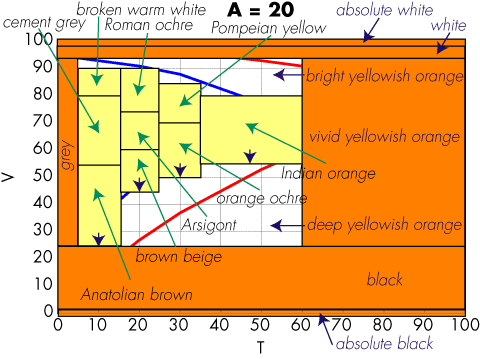
Maybe the change of the Japanese language is a bit extreme, but English is also changing fast, especially for words related to fashion, like color names. Look for example at the names in Coloroid hue 20 I showed last week:

Did you know the color name Arsigont? Did you know the difference between Pompeian yellow and Indian orange?

This is not a problem of the Coloroid system. Consult any color name compilation older than a few years, and you will find names that look unfamiliar. For example, a decade ago teal was all the rage in Palo Alto and all home decoration stores were selling many items in this color. Today, people hardly remember its appearance.

So, how do we deal with the ephemerality of language? Obviously a printed leather-bound collector's edition of a color dictionary is not the ticket. The ephemerality of a blog tool post is more like it. But color names are very hard to collect, we cannot start from scratch every few months.

This is why in the Italian version of his color thesaurus, Nathan included a mechanism to rate the pairing of the color name with the displayed color. As names fade, they get rated worse and by using the rating in the creation of the thesaurus, a more contemporary color name will emerge to label that color.