Saturday, October 10, 2009

Pink Ladies

In these difficult economic times, organizing a conference is hard. Most companies have sharply reduced travel and conduct even important business meetings online. Under the circumstances, the organizers of AIC Colour 2009 have done an excellent job. Although many habitués did not attend, the program had a good quality and the invited lectures were truly outstanding.

Monday, October 5, 2009

His "family attempted to throw his photographic collection away"

One of the things about skimming the wikimedia commons: licensing area is the stray photo of Leonard Nimoy.


That and the potential peril's of being a deceased photographer with a legacy awaiting curbside removal.

The Scanner is in the Frame

And why not?

A digital photo frame that scans your photo for immediate display.


The Exemode Yashica DVF828 is a digital picture frame with a built in scanner.

Simply take a picture with your digital camera. Next print the photo on a digital printer. Then scan the printed photograph in for immediate display. Otherwise find your shoebox full of photos and find a good one. Then scan the printed photograph in for immediate display.

Sunday, October 4, 2009

Saturday, October 3, 2009

Translucent Metallics

On one page is a fluorescent green vellum and on the other is a translucent metallic paper.


Not your typical course notes. But then this was an afternoon class at PINC on paper basics given by Sabine Lenz, founder of PaperSpecs.

Friday, October 2, 2009

AIC Judd Award

Since 1973, when Betty Judd proposed to establish an AIC award in memory of her husband, Deane Brewster Judd, to recognize outstanding work in the field of color science, the AIC has been carrying out the process of selection of the recipients for this award every two years. The selection is an arduous procedure that includes nominations by AIC members and analysis of antecedents of the nominees by a Committee composed of previous recipients of the award.

Arne Valberg receives Judd Medal from Jose Caivano

As chairman of the Judd Award Committee, AIC Vice President Berit Bergström informs that the winner of the AIC Deane B. Judd Award 2009 is Dr. Arne Valberg. She can report that they have received four single nominations and one jointly nomination. All nominees have made outstanding contributions to our understanding of colour. Berit Bergström really hopes that they all will continue working in the international colour community for many years to come. The members of the 2009 Judd Award Committee have been: Paula Alessi, Robert Hunt, John Hutchings, Mitsuo Ikeda, Daniel Lozano, Alan Robertson, Lars Sivik, Gunnar Tonnquist and Pieter Walraven. These nine previous winners of the award and past president gave very careful consideration to the nominations.

Arne Valberg receives Judd Medal from Jose Caivano

Arne Valberg was born on December 31st, 1938. Below is an excerpt from his bio sketch as published by the AIC.

Arne Valberg receives Judd Medal from Jose Caivano

Education and positions

  • Studies at the Univ. of Oslo and Univ. of Basle, CH 1961-1967
  • Graduated as Cand real in Physics, Univ. of Oslo 1967
  • Research associate, Univ. of Basle, CH 1968-1971
  • Dr. philos, Univ of Oslo 1976
  • Ranked 2 for a Professorship in Biophysics, Univ. of Trondheim 1976
  • Research Scientist, Norwegian Research Council for Science and the Humanities, Univ. of Oslo, University of California, San Diego
  • Max Planck Inst., Göttingen and Univ. of Freiburg, BRD 1972-1990
  • Associate Professor, Univ. of Oslo 1990
  • Professor of Biophysics and Vision Science, Univ. of Oslo 1993
  • Professor of Biophysics and Vision Science, NTNU 1991 to present

Major grants and research projects

  • Norwegian Research Council for Science and the Humanities
  • European Science Foundation
  • Max Planck Gesellschaft
  • Deutsche Forschungsgemeinschaft
  • Schweizerische Nationalfonds zur Förderung der wissenschaftliche Forschung
  • Roche Science Foundadtion
  • IBM Norway
  • NSB Norway
  • NATO Grants for Collaborative Research
  • Thonning Owesen's Foundation
  • Blindeforbundet (Norw. Association for the Blind)
  • Thorstein Erbos Fund
  • European Union

From 1968 to 1994

  • Joint research projects in vision (psychophysics and electrophysiology) with groups from:
  • Univ. of Basle, Switzerland (1974).
  • Univ of Freiburg, BRD (1974-1980; B. Breitmeyer and L. Spillmann).
  • Max Planck Inst. for biophysical Chemistry, Göttingen, BRD (1981-1990, O.Creutzfeldt and B. Lee).
  • Univ. of California, San Diego, USA (1973).
  • Univ. of Chicago, USA.

From 1994 to present

  • Joint research on Low vision with Tambartun Centre for Low Vision Rehabilitation (with P. Fosse) and Univ. of Oslo (J.H. Wold and T. Seim), Norway.

From 1998 to 2001

  • Interdisciplinary Program at NTNU, ”Information coding and functional organisation of populations of nerve cells” Together with professors E. Moser and H. Mustaparta.

From 2000 to 2004

  • Strategic University Program from Norwegian Research Council, ”Neural mechanisms of sensory functions and memory” (same collaborators as above). Includes one dr. student (I. Rudvin) and one master student (G. E. Nygård).

2002-2006

  • Joint project with Brain Research Unit, University of Freiburg on ”Lateral interactions in vision”. Includes one German dr. student.

2002-2006

  • EU Concerted Action together with research groups from universities of Tübingen, Manchester and Utrecht. Project title: ”Photoreceptor dynamics in age-related macular degeneration”.

Editor/Author

  • From Pigment to Perception. Advances in Understanding Visual Processes. Plenum, 1991 (NATO ASI Series)
  • Die Farbe (editorial board)
  • Editor of Proceedings from 3 Scientific Conferences held in Norway
  • Lys Syn Farge, 280 pages (Tapir, 1998)
  • Light Vision Color, 460 pages (Wiley, & Sons, 2005)

Publications

  • About 100 full scientific papers
  • About 100 abstracts/short communications/scientific reports/conference contributions
  • 3 books
  • Several popular science articles

Clipboards, Solar Cells & Fluorescence

Colored solar panels have been covered elsewhere, but reading some of the details gives me a new appreciation for my fluorescent clipboard.


Thursday, October 1, 2009

Networking in Sydney Harbour

During hard economic times and travel hampered by security concerns, it is tempting to try to keep abreast of one's field reading proceedings instead of attending the conferences themselves. However, you then miss two important opportunities.

The first is getting valuable feedback on your research. There is nothing more efficient than presenting your work in a daring and controversial way, because you incite the audience to challenge it. You might be sitting in your cave for years brooding on your problem, chasing down the solution on a wrong path, but at a conference after a 15 minute presentation you may get tips from those that worked on the problem before, and also invaluable feedback on fallacious thought patterns.

The second is serendipity: you may sit on a lawn in front of the conference venue and somebody might strike a conversation with you on a problem you are secretly starting to work on and give you a key lead.

Scientia Lawn

Serendipity may be a passive recreation as the sign suggests, but concomitantly it can also be very potent. I think this is what the sign's author had in mind.

On a Wednesday evening, when the AIC is in session, Sydney Harbour, or more precisely Darling Harbour, may be a good place to be.
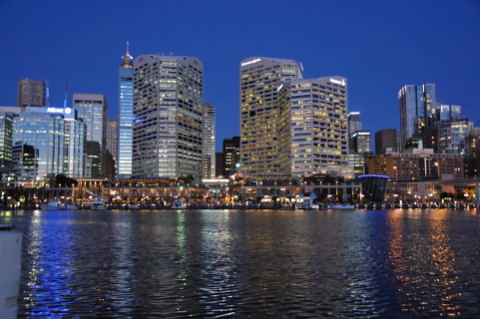
View from Darling Harbour

Carefully camouflaged in a garden restaurant you may find John and Mary McCann, and they will get you up to speed on the latest research on colour appearance for high dynamic range (HDR) imaging.
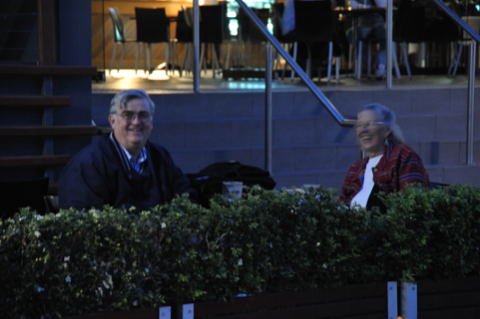
John and Mary McCann

And while you join them sitting at their table, on the pier in front of you, you may spot Prof. Jinsook Lee, who heads the newly formed AIC Study Group on Colour Naming.

Prof. Jinsook Lee

Thinking of it, boarding that vessel for a tour of the harbour may be a good idea.

In fact, I end up sharing a table with Maud Hårleman, who had presented an interesting paper on Thinking of colour with and without colour words the previous Monday and Anders Nilsson of the Färginstitutet.

Maud Hårleman and Anders Nilsson

Turns out Anders just released two weeks ago a new Web tool called NCS Navigator that allows you to explore NCS with a concomitant 3-dimensional view and a 2-dimensional projection. We had an interesting discussion on the suitability of various programming languages for implementing colour tools.

On my side of the table were Paul Green-Armytage and Harald Arnkil.

Paul Green-Armytage and Harald Arnkil

With Paul I had a long discussion about research on colour naming. For his dissertation he embarked to solve the same colour naming problem Nathan Moroney had, but he took a top-down approach instead of Nathan's bottom-up approach. After years of research, it is invaluable to be able to compare the two research approaches.

With Harald I had a discussion on Nathan's paper research he blogged yesterday. Turns out a colleague of his has worked on it for years and he was able to give me invaluable pointers.

In all, it has been a very productive evening.

Wednesday, September 30, 2009

Hi


Hi to everyone from AIC09 Sydney (as you can see from the picture),
happy to be part of the colored group
stay tuned ...

Bright and early

In a large metropolis the best light is in the morning, when the air is still pristine. Life in Coogee Bay starts bright and early. Many of the coffee shops open at six o'clock and immediately fill up with customers,
but the action is along the beach. Joggers and walkers occupy the promenade, and while the sand is being cleaned, swimmers emerge from the ocean and pools.

On the beach, coaches and personal trainers work out their clients.

Boxing appears to be a favorite with girls.

On the other side of the promenade, on the lawn, many group exercise classes are peaced through the daily training circuits by decisive coaches.