
Found in the desk drawer while looking for something else.
A nice souvenir from the 1994 meeting of the DCC/ISCC.
For the last month, when I had some dead time waiting until batch jobs run or the IDE rebuilds our GPU RIP system, I have been reworking the manuscript on understanding readability of colored text by crowd-sourcing on the Web I am trying to publish with Silvia Zuffi and Carla Brambilla, who did the actual work.
The work is about the threshold for readability efficiency, i.e., we are asking where the color contrast threshold is, at which reading performance in speed decreases or the number of errors increases.
In the introduction, we summarize the previous results. Here is what we learned about the effect of text polarity and background luminance:
The sign of the difference between background and foreground luminance defines polarity. Positive polarity, or negative contrast, is for example black-on-white, while an example of negative polarity, or reversed contrast, is white-on-black. Normal vision acuity is slightly better for reversed contrast, but the majority of studies on readability found that positive polarity is more suitable for text.
Previous studies performed on old displays produced different results about the effect of polarity on reading performance. This was due to the characteristics of the equipment; for the rapid refresh rate of modern displays, dark characters on light background seem to be better, but for the common refresh rate of old displays a dark background was preferable. Reading performance was also influenced by lighting conditions that could affect the perceptibility of flicker. Another review of early studies found an advantage of black-on-white for reading and characters recognition, while Legge did not find any difference in normal vision, but found that people with low vision read faster with reversed-contrast text. These were usually people with abnormal light scatter in the eyes. Pastoor found no evidence for an influence of luminance polarity on reading and search performance. According to Shiel polarity has a significant effect on visual performance in the sense that subjects perform better and have greater preference for dark targets on lighter backgrounds (positive polarity).
Sanders and McCormick suggested that a light background might be advantageous under situations with glare or reflection problems because it may reduce the visibility of reflected light. Scharff and Ahumada investigated whether the effect of text polarity is due to different sensitivities in the “on” and “off” retinal pathways, or the result of more experience with dark text on light background. They observed that light backgrounds yield better performance, with a predominant effect on the polarity of the text. As for the effect of luminance background, Lin found that in the case of positive polarity, better performance is obtained for a lighter background at the same luminance contrast but at different background luminance. The lessons learned from previous studies that are relevant to our experiment can be summarized as follows:
- Luminance contrast is the dominant factor to address readability
- The luminance polarity affects readability (negative polarity is more difficult)
- The luminance of the background affects readability (lighter backgrounds are preferable)
- An additional color contrast does not facilitate reading when a sufficient luminance contrast exists
- On achromatic background, wavelengths at the extremes of the spectrum are more difficult for text.
As seems to be the annual May ritual, our blogging system was updated. As you are noticing, the design now matches the overall hp.com look with its small white font. I spent a day fixing up old posts that became unreadable due to transparency for a light background, or because the font color was that of the color being discussed, such as International Klein Blue or Blue Iris.
I am very busy, as we are still fighting to get the performance up to the 1600 ppm target, so I took the liberty to take shortcuts, like just dropping transparency. In some places the text might be fuzzy because the anti-aliasing was done on a white background, and I do not have time to redo it on a black background. My apologies, but blog posts are ephemeral.
À propos 1600 ppm, although our blog has been moved from research to technology at home in the HP blog directory, Nathan and I are still totally focused on commercial printing (like the 7000 below, which is our current test device), so do not expect to see our technology on your kitchen table. And our target audience are still our fellow color scientists.

 Nathan last Friday blogged about humans using animal related colors such as leghorn and elephant's breath. Northern Arizona University's Prof. Con Slobodchikoff (portrayed left) turned the tables: he had similar-sized women (human females) stroll through a prairie dog community wearing yellow, blue, or green T-shirts and listened to the prairie dogs chatting about the shirts' colors.
Analysis of the calls' frequency patterns revealed that the chirps for blue shirts were different from those for yellow and green, which elicited the same calls. The results support the idea that the prairie dogs are incorporating colors into their alarm calls, the researchers report. The prairie dogs' dichromatic vision can distinguish yellow and green from blue but easily confuses yellow with green.
For all the details, read the paper Prairie dog alarm calls encode labels about predator colors in the journal Animal Cognition, Volume 12, Number 3 / Mai 2009.
Nathan's next challenge is to develop a user interface suitable to Gunnison's prairie dog (Cynomys gunnisoni) for his color naming experiment.
Our blog is different from the other HP blogs in that it is more whimsical, esoteric, and even eschatological. Most of all, it is different because we tend to use images in every post.
Nathan has a fancy camera and we shoot many of our own pictures. Others come from HP's Image & Video Library or from old clip art bought in the early days of the Web. One image that prompted several inquiries is this one:

I had no idea of its origin. I can use it legally because I bought with some software on February 13, 1996. However, I cannot remember the circumstances, hence it remained a mystery. One reader of this blog, S. V. of the University College Dublin, finally solved the mystery.
It goes back to Camille Flammarion's 1888 book L'atmosphère: météorologie populaire. The wood engraving is described in the Wikipedia in the entry Flammarion woodcut.
The image shown in the Wikipedia is different from the one above. Our's is missing the title "Urbi et Orbi" and the coloration is different from that of Hugo Heikenwaelder, Vienna 1998.
Around 1987, I was working in a bustling and teeming research lab. I was traveling relatively little, because every researcher traveling in the area was without fail coming to visit, so I could be an active member of the color science community without having to attend each and every conference.
Since the lab was banking on synergy and serendipity, my work was very focused, which was reflected in my desk:

There was no clutter because I was working on just one research item. Of course Saturdays were an exception, because after the routine shopping at the farmers market and the almond croissant with coffee at the long defunct Italian bakery at the corner of Waverley and University, I would head to the office and play with ideas from papers read during the week or ideas from conversations in the SF Bay Area color scientists meetings Friday afternoon at the Tied House micro-brewery. Then I would incorporate the best gems into my code library. The desk would get very messy by day's end, but I would clean it up first thing Monday morning.
When in 1990 I changed employer and moved across the street, my role changed. It was my turn to create a bustling organization, teeming with people carefully groomed to magically make synergies and serendipity happen naturally.
Because my work was no longer focused but had to span the large set of interests dear to my new employer, I started building little piles on my desk. Each pile was the accumulation of hot papers on a topic I thought could be of interest for research by somebody in my sphere of influence. I was attending numerous conferences, so the piles grew quickly, until the economic bubble in Japan burst and I was out of a job.
My wife convinced me to stick to my activity of providing direction and to influence research groups, in the hope it would help me find a real job. I also started again reviewing manuscripts, typically over a manuscript per week. This allowed me to be intimately familiar with the research of all color imaging scientists in the world. It also allowed me to easily see the research vectors and who is hitting on all pistons vs. those straying off the path or getting stuck in the sand. More importantly, I could discern the interpolators from the extrapolators, the followers from the leaders.
Typically around April I would consult my piles and attempt a prediction of the future research in color imaging. The result would then be a series of sessions to be held at one or more conferences. With my wife's help I would send out personalized letters to the various scientists explaining the content of a session and how I would like them to contribute a paper on their piece of the work to the conference so it nicely fits in the session. Of course, each session would start with an invited paper from one of the leaders.
On the positive side, this helped my becoming a deus ex machina, invisibly making things happen and steering research without being detected. On the negative side, despite my efforts to operate like a cloaked ninja, my supervisors still felt I had too much visibility for a puny software engineer. It were more principled and distinguished scientists whom such roles would suit.
As corporations and their many organizations meander, activities are terminated, resumed, terminated, etc. in an endless come and go, like a relentless tide in the western style ocean 洋. Hence, a few years after disarticulating myself from all academic activities, I slowly but stealthy slipped into it again, this time into the services of various governmental organizations, influencing very long term research vectors in the benefit of society.
During all this, I kept providing tender love and care to my piles. But then, as the organizational division between the illuminated and the ignorant became more of a chasm that cannot be crossed, I again had to dissociate from my academic activities to focus on optimizing ANSI C code. This time, my piles also had to go!
One by one I gave them my farewell and transferred them into the blue recycling bin kindly provided in my cubicle.
Today is the day to say farewell to one of my more cherished piles: complex color. Most of what color engineers do deals with aperture color, perceived color for which there is no definite spatial localization in depth, such as that perceived as filling a hole in a screen. However, in color imaging we deal mostly with complex color.
To me the difference became exceedingly apparent in a personal experience. I was attending one of the ISCC annual meetings in the early Nineties. One of Smith and Pokorny's student had given an excellent paper presenting some new results in chromatic induction he had obtained in pursuit of his Ph.D. thesis. In the evening of the same day, the conference reception took place in a ballroom that had been recently refurbished. The carpet was in a deep cobalt azure background carrying a tan arabesque design; it looked grand and the decor with the elaborate chandeliers had a certain majestic feel. The tapestry on the walls matched the carpet.
That is, until you were closer to the wall. There you could resolve the pattern in the tapestry, which was a more muted azure with a bright orange filigree. From distance, the carpet and the tapestry matched, but from close they clashed. With what I learned in the student's presentation, this was the start of a precious pile on complex color.
A little later came Stanford's Brian Wandell's research on spacial CIELAB and his student Xuemei Zhang's Ph.D. on S-CIELAB: A Spatial Extension to the CIE L*a*b* DeltaE Color Difference Metric.
At the beginning of the new Millennium, in May 2002 Prof. Lucia Ronchi sent me a large envelope with pieces of colored fabric and a black and white piece of paper. It contained a letter instructing me to mount the fabric pieces on a high-speed fan and observe them. When the fan is accelerated to the highest speed, the letter explained, you will get a succession of colored concentric discs. She found an explanation for the black and white patterns, but not for the colored patterns. It also went onto the complex color pile.

But my most precious paper in the complex color pile is a manuscript for IEEE TIP Todd Ell and Stephen Sangwine wrote early 2005. It came out January First, 2007 under the title Hypercomplex Fourier Transforms of Color Images. I had a brief email exchange with the second author. Their method had a radically new approach, which took them 10 years to research, produce, and create.
Subsequently, several derivative manuscripts — mostly from Asia — crossed my desk, but they did not make it onto my pile, because the authors mostly had downloaded the Matlab code and just played with it, without fully understanding the underlaying theory and not adding a substantial contribution of their own.
Since I stopped a while back tending to my piles, I do not know how the work progressed, but as of 2007 it had a lot of potential. Essentially, the three color coordinates are viewed as the complex parts of a quaternion. The breakthrough was to find a Fourier transform in the quaternion field. They made it practical using the Cayley-Dickson form to represent quaternions, then they invented the symplectic decomposition.
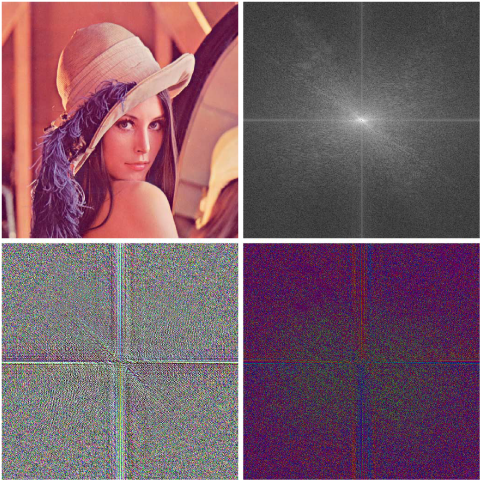
In the case of quaternions, the hypercomplex spectrum yields a modulus, a phase, and an axis image. I do not know how this is interpreted in color imaging, but I have the sensation it is something powerful. Finding out probably takes two years of playing with their Matlab library to fully understand the underlying mathematics and build an intuition. Then another couple of years to come up with a new insight. With another couple of years to find a solution to a difficult problem and develop an application, this is beyond a Ph.D. thesis assignment. It is also beyond what can be done in a skunkworks project.
In fact I am not even able to understand the meaning of the inverse hypercomplex Fourier transform. The complication is that quaternions are not Abelian in their second operation. One ends up not with a forward an a backward Fourier transform, but a whole graph of relationships between the operators.

Ell and Sangwine explain: The above is an operator graph showing a summary of the known relationships between the seven operators. The directed lines indicate forward transforms. Navigating the same line in the opposite direction denotes the corresponding inverse transform. Conjugate and reversal are shown with undirected lines since they are their own inverses. Navigating the graph along an closed path yields the identity operator. Solid points indicate spatial domains and hollow points indicate frequency domains.
さよなら, farewell complex color pile. I hope the recycler will reincarnate you as an important book.
The compensation of researchers depends on their publications. For example, in China a Principal Investigator's basic yearly salary is several thousand dollars and the basic stipend for grad students is about $500 a year. The rest is made up with productivity-based supplements, and publication boni are part of the productivity-based supplements. Here is some data for the Chinese Academy of Sciences's Institute of Chemistry:
Boni are divvied according to the author's contributions. In addition, universities also pay productivity-based salaries to professors. [Source: Science, 322, 664-666].
Here at HP Labs we accumulate points and there is a list of the publication venues for which points are given. In our project we can get points if we publish in the ACM Special Interest Group on Computer Graphics and Interactive Techniques Conference, with the caveat that only the first author gets the credit (we are nice to each other and rotate the author sequence).
Since SIGGRAPH rejects 83% (2004) of the submitted manuscripts (see here for comprehensive statistics), and since our work is more D than R, doing a publication that yields points is a very long shot, sort of a fata morgana, or aspirational goal as it is called here in HP.
What is a good strategy to publish in a top journal? At the bottom of this post you will find a table with the 2007 impact factors of journals in the fields related to the posts in this blog. The Cancer Journal for Clinician is just an anchor, to show what can be achieved.
The next two entries are Nature and Science, which we also ignore, because here at HP they are in a category called "publicity" and therefore do not earn points, although it is very hard and labour-intensive to get into them.
You could now think you just start with a submission to the Proceedings of the IEEE and then work yourself down the list until you are no longer rejected, then you lobby with your manager to get some fractional credit. Alas, this is a bad strategy.
The impact factor is computed over two years, and if you really do ground-breaking research, it will take longer for the fruit of your labour to appear on the radar screen. For ground-breaking research you should look for a 10 to 15 year horizon and aim for a total number of citations around 100 before you croak.
You have to think long-term. Ground-breaking research is rejected at first. For example, the Swiss Physicist Albert Einstein came up with Brownian motion, the photoelectric effect, the special theory of relativity, and the general theory of relativity, all around 1905. However, he was not able to land a teaching position at the ETH in Zürich. Instead, he had to work as an examiner at the patent office.
Put yourself in the shoes of the journal's editor. Let us take a big unsolved problem, like the universal solution to the gamut mapping problem, let us call it UGM. One morning you wake up and you have the solution, based on following trajectories on the surface of a manifold over a complex Galois field. It is very computation intensive and you devise an algorithm using massively parallel computation, which your colleague implements on a GPU.
You now have the problem that you have to feed pages rendered with your algorithm to a printer running at 1000 pages per minute. Another colleague comes up with a photon resonator exploiting the photon bandgap, which another colleague implements using nanotechnology to grow it atop a naked GPU chip, so you can beam the separation bitmaps over to the marking engine in a fiber optics cable.
No matter where you submit it, the editor will not have an associate editor understanding the entire manuscript, and will assign it to an associate editor with a short queue. This associate editor will struggle finding reviewers, and unless he or she by chance has worked on the same problem, will not have a good guess, and just assign it to random reviewers from the journal's pool.
Lesson: if you know potential reviewers, let the editor know when you submit the manuscript. Of course they have to be neutral: your boss and your mother are not acceptable.
Since your manuscript will be rejected anyway, do not go by the impact factor. Instead, find out which journal will give you the most constructive reviews. A journal in which you have published before, or a journal with a broad scope will be a better bet. In the UGM case, Optical Engineering might be a good bet, because it covers both photonics and imaging science, while being application oriented.
Also, a new journal will be a good bet for a complex manuscript, because the editor will be more willing to accept a paper from a prestigious scientist, even when it is arcane. A new journal does not yet have an impact factor, therefore receive less submissions and the associate editors have more time to help you with constructive comments.
You get rejected, and submit it to the next journal. Do not just send it in. Instead, revise your manuscript with the good comments from the reviewers. Also, incorporate the new research you did in the meantime, especially that suggested by the reviewers.
Explain your previous rejection and your improvements in the cover letter to the editor. Since there are only few researchers working on UGM, there is a high probability one of the reviewers is the same that rejected your manuscript in the previous journal's submission. Unless you explain yourself, the reviewer will just read the title and inform the editor that you are submitting the same manuscript to multiple journals and you will be black-listed.
Due to the difficult but important nature of UGM in real-time, there is a chance others have come up with a different solution and have also been rejected many times. There is a good chance (associate editors must have good memory) such a researcher will be asked to review your manuscript.
If you have bad luck, the reviewer will be bitter and stick it to you. Do not write a nasty note to the editor, it would be wasted time. Instead, study the review, then use a search engine to sleuth the reviewer's identity. In the subsequent submissions, put the reviewer's name in the list of those to exclude. This is perfectly legitimate and done all the time, even by me.
The other risk you incur is that one of the reviewers takes on your research and publishes it before you, without even citing you because you were not able to publish yet and you are not famous. Therefore, you have to educate the others working on UGM and create publicity for your research. Attend all top conferences and present a paper on a part of the solution, like in our example at one conference you report on manifolds over complex Galois fields for UGM, at the next on massively parallel computing for UGM, at the next on the photon bandgap for UGM, etc. This is known as salami publishing; do it for conferences, but not for papers.
When you select the conferences, look where the action is. For UGM it is not SIGGRAPH, but a lot is happening in China, Japan, and Korea. So you need to travel, and since these days it is hard to get funding, a rich uncle helps, or a spouse in finance, law, or marketing, especially when a native speaker of Mandarin.
Once everybody associates you with your research, it cannot be "stolen." Also, potential reviewers have learned from your conference presentations and have a better chance to understand you "big enchilada" manuscript. Also getting the Turing Award or the Judd Award will help you getting your manuscript accepted; talk to your mentor.
In summary, here is the journal ranking list, but use it wisely, not like a board game. For truly ground-breaking research, rejection is normal: persevere. Disclaimer: I am not working on UGM nor anything else connected to color science or color reproduction, UGM is just an illustrative figment of my imagination.
| Journal | 2007 impact factor |
|---|---|
| Cancer Journal for clinicians | 69.026 |
| Nature | 28.751 |
| Science | 26.372 |
| Proceedings of the IEEE | 3.820 |
| Journal of Vision | 3.791 |
| Optics Letters | 3.711 |
| Optics Express | 3.709 |
| Applied Physics Letters | 3.596 |
| IEEE Transactions On Pattern Analysis And Machine Intelligence | 3.579 |
| ACM Transactions on Graphics | 3.413 |
| International Journal of Computer Vision | 3.381 |
| New Journal of Physics | 3.264 |
| IEEE Transactions on Image Processing | 2.462 |
| Real-Time Imaging | 2.270 |
| Vision Research | 2.055 |
| Journal of the Optical Society of America B - Optical Physics | 2.030 |
| Pattern Recognition | 2.019 |
| SIAM Journal on Scientific Computing | 1.784 |
| Journal of the Optical Society of America A - Optics, Image Science and Vision | 1.776 |
| Applied Optics | 1.701 |
| Communications of the ACM | 1.593 |
| IEEE Internet Computing | 1.551 |
| IEEE Transactions on Multimedia | 1.518 |
| SIAM Journal on Numerical Analysis | 1.470 |
| Computer Vision and image Understanding | 1.417 |
| IEEE Computer Graphics and Applications | 1.398 |
| Computer | 1.367 |
| IEEE Transactions on Systems Man and Cybernetics Part B-Cybernetics | 1.353 |
| SIAM Journal On Computing | 1.310 |
| Journal Of Mathematical Imaging And Vision | 1.220 |
| Image and Vision Computing | 1.027 |
| Electronics Letters | 1.009 |
| IEEE Spectrum | 0.933 |
| Pattern Recognition Letters | 0.853 |
| Journal of Visual Communication and Image Representation | 0.832 |
| Optical Engineering | 0.757 |
| Signal Processing | 0.737 |
| Journal of Digital Imaging | 0.717 |
| Journal of Imaging Science and Technology | 0.707 |
| Optical Review | 0.683 |
| SIAM Journal on Discrete Mathematics | 0.674 |
| Color Research and Application | 0.619 |
| EURASIP Journal on Advances in Signal Processing | 0.619 |
| Pattern Analysis And Applications | 0.515 |
| International Journal Of Imaging Systems And Technology | 0.482 |
| Journal of Electronic Imaging | 0.455 |
| Optik | 0.385 |
| International Journal Of Pattern Recognition And Artificial Intelligence | 0.374 |
| World Wide Web-Internet and Web Information Systems | 0.300 |
| Imaging Science Journal | 0.220 |
| SMPTE Motion Imaging Journal | 0.088 |
| IET Image Processing |

The April issue of the Journal of Vision has an interesting editorial on comparing citations and downloads for individual articles. Beau concludes that download statistics provide a useful indicator, two years in advance, of eventual citations. Downloads are also a useful measure in their own right of the interest and significance of individual articles.
For me, these download statistics have always been spooky. In a post of 5 March 2007, I was puzzled about the interest in an old tech. report on a Professional Portrait Studio for Amateur Digital Photography, which is totally outdated. It was written when amateur cameras had no more than 6 effective bits per pixel per channel, low sensitivity, and most of all, an amazing shutter lag of 4-6 seconds.
The download wave started in January 2006, and since then it has been in the top 10 downloads almost every month. How can 400 hundred people a month be interested in it?
Then, in October 2008 an equally misterious wave of downloads started for Spectrophotometer Calibration and Certification. That is a quite arcane subject, with not many people interested in it. However, it remains in the top 10 downloads, with 586 downloads just in the last month of April. What is going on?
In the old days, when publication was on paper, things were easier to explain. For example, in 1996 I cooked up in a few days and under pressure a tech. report with the suggestive title W3 + Structure = Knowledge. More than 300 people sent cards to HP ordering a copy of the report. This was when a tipical report averaged less than 10 requests and only the report on the C++ standard template library had received more requests.
But it was understandable. In June 1996 the dot-com boom was in full swing and companies were running big advertisment campains claiming to be the dot in .com or describing how the Internet was a tsunami. Except for HP, who was totally mum about the Internet. So, it is understandable that when the first HP publication with Internet as a keyword appeared, people would jump on it.
When a few months later I rewrote it under the title Internet's Impact on Publishing, it had the same popularity. Then I rationalized that since the previous report was mostly hot air, people just wanted to see if HP really has nothing up the sleeve. In fact, when I rewrote it once more under the title Structure and Navigation for Electronic Publishing, it went totally unnoticed.
In summary, I can understand the old order logic, but not the modern download logic. Do you have any insights you can share?

After a few years of developing in Java then in Matlab, I am now back maintaining code written in ANSI C. Mind you, the code is masterfully architected and written, you could not write it better in Smalltalk. This is industrial strength code that is expected to be very robust and highly performant.
Programmers often state you can write much faster code in C than in Java. As I implement my changes and additions, I find myself having to write ancillary code taking care of variable initialization, bounds checking, and object finalization. Also, I get bitten by side-effects while running regression tests.
Once I have added that ancillary code, a C program is no longer faster than a Java program. In fact in Java those functionalities are taken care of through very tightly written code in the run time system. It runs more efficiently than the code I can write while keeping the product price still within target and meeting shipping deadlines.
The dirty secret is that in C you can write lousy code that skips steps like variable initialization, bounds checking, and object finalization. This way you get faster code, but you leave open doors for malicious hackers. Also, debugging and maintenance of such code is much more expensive.
Speaking of code expense, although programmers are cheap, my time spent writing and debugging that ancillary code is also a cost.
In summary, you can write equally efficient commercial programs in Fortran, C, C++, C#, Smalltalk, Java, and others. If you are a good architect and frugal programmer, the programs will be surprisingly similar in style and performance. However, the more modern a language is, the less time it will take you to get there, and the less ugly code written by others you will encounter.
Vintage cars can be sexy, but I prefer the comfort of airbags, antilock brakes, traction control, and electronic fuel injection.

1964: Tops 10 is developed as the major user software interface for Digital's 36-bit machines. Tops 10 was developed from a 6-K word monitor for the PDP-6. It included user files and I/O device independence, and a command control program.
 These are times similar to Venice in 1500, when Aldo Manuzio (alias Aldus Manutius, 1452-1516) joined a printing business and became a publisher. The adoption of Gutenberg's printing press, the brain drain of scientists from the collapsing Byzantine Empire bringing with them the Greek classics, an educated population that could read Greek, and a flourishing spice business whose profits allowed ordinary people to afford books; all of these contributed to a vibrant, innovative environment.
The price of Manuzio's books was about a teacher's day's salary. Before, books could be afforded only by princes and wealthy monasteries. Compare this with the price/performance development of computers and software.
Manutius formulated a key idea that made him a main contributor to the Renaissance: he became a publisher instead of a printer. He searched for material and selected what he thought might have the largest readership. When he came across a classic text he thought might appeal to a wide audience, he had it translated from the Greek and published in Latin, and when he thought he might have a best-seller, he would even publish it in Italian, the common people's language.
The lesson from Manutius is that although one can become rich by working hard operating a printing press, one can become wealthier by working smart and exploiting new emerging technologies (embracing and extending).
The press was owned by an established printer, Andrea Torresano. Manuzio managed the printing shop, selected the texts to be published, made editorial decisions, and arranged for the marketing of the books
Technology is just an enabler; paradigm shifts have more to do with social values. In Manuzio's time, one major problem was the sheer size of books. He came up with some technological solutions, like inventing the italic type style that can be easily read at a smaller size, and folding the paper form (folio) into 16 sheets to reduce the dimensions and make books portable. But with these techniques the books of the time where still too voluminous.
Manutius could have used a technical solution, like publishing each work in several volumes. Instead, he called upon a value judgement. In his time, the largest part of a book was taken by the annotations, which could be several times the number of words in the original text. It was believed that the value of a manuscript depended on the annotations, and on the number and quality of the commentators. Manutius decided that his readers would read the classics for their own intrinsic beauty and the comments would be of interest only to the scholarly. He published only the original text.
Publishing a book stripped of the annotations was not an obvious decision in Manuzio's time, and this is exactly the kind of disruption that a successful technology for the Web must enable. In 1500 Venice, general education and wealth had reached a critical mass; Manutius recognized the potential of the new market and came up with the critical ideas and technologies to redirect books from an erudite audience to the general public.
The Web media industry is evolving to the Internet the technologies initiated by Manutius and the methodology introduced by the press in the 1850s; this media industry is not inventing a disruptive technology — opportunity is knocking.

One of the distinguishing features of humans is the ability to communicate complex thoughts. This ability is mastered at various levels by different humans, and those who have exceptional abilities are sought out. It the beginning they were shamans, but when civilizations were born some 6,000 years ago, they were structured in teaching and leadership organizations.
In the western culture, the oldest written historical records of such organizations are from the pharaonic dynasties. They were in charge of the calendar, court protocols and the training of rulers among other things. For example, a pharaoh had to be trained to become able to perform such feats as being in control of a lion, or riding a chariot at full speed on a dirt road charging an enemy army without getting hurt.
The techniques are the same as those used today, viz. forms of deep concentration like mindfulness, autogenic training, or meditation. These exceptional human's creative process is esoteric, as opposed to the exoteric process of us "normal" humans. The esotericism can be mystical (like in Kūkai's Shingon-shu or Abu Bakr's Sufism) or scientific (like in Jacques Derrida's deconstruction).
An example more close to us is the creative method of inventing mathematical theories. Until the beginning of last century, mathematics was organized along a number of disciplines, like number theory, calculus, geometry, etc. Then the so-called crisis of foundations, which lasted for about thirty years, broke out until new theories on ordered sets, lattices, topological spaces, groups, rings, fields, vector spaces, partial differential equations, etc. made it possible to reorganize mathematics from the point of view of structure.
In 1935 the members of the Bourbaki seminar started working on the multi-volume treatise “The Elements of Mathematics,” which is published under the nom de plume “Nicolas Bourbaki.” The way general structure theory is used to creatively extend mathematics is intellectually equivalent to Kūkai's process of reading sutras horizontally.
 Back to Egypt. The pharaonic leadership organizations later metamorphose under Christian influence and infiltrate into Europe in the form of monasteries. If a date important to us has to be set, it would be 529, when Benedict of Nursia built the abbey at Monte Cassino, which was the first modern western think tank. In fact, when for the first electronic imaging symposium of this Millennium John McCann and I were looking for a framing story for our welcome letter, we wrote a fictional account that we placed at Monte Cassino at the imaginary first imaging conference of the previous Millennium:
On 23 January 1000, Rodulfus Glaber of Auxerre finally reached sight of the symposium site on Montecassino. He was carrying a precious document from Amalfi, where he had met Ibn Sina (Avicenna) who was on his way to the new Dar al-ilm science library in Cairo to research for his Canon of Medicine. Avicenna gave him a copy of the Chinese Diamond Sutra scroll, the first printed document. While Glaber was admiring the print quality of the images, Avicenna had told him, that was nothing compared to the new imaging science invention that will dominate the new millennium, mentioning a paper by al-Hasan Ibn al-Haytham (Alhazen) on the camera obscura. At Montecassino, Glaber was burning to meet a monk from Malmsbury Abbey to discuss with him how the Canterbury School of manuscript illumination could catch up with these new inventions. Glaber was also somewhat anxious, because according to Benedectine Regula Magistri XXXVIII he had to give the luncheon lecture for the whole week.
On 23 January 2000, we welcome you comfortably to the first imaging conference of the new millennium, the Electronic Imaging Symposium. The IS&T and SPIE launched this symposium at a historical juncture; the end of the cold war has marked the end of big research. Before, a young researcher would have had to start his or her career humbly, doing grunt work for the senior fellows and slowly building a publication portfolio by working very hard. Giving a paper at a conference was a big hurdle to jump and was the first step on a career.
The Electronic Imaging Symposium is the stalwart of the new research paradigm. Rather than a stuffy restricted club, our symposium has been more of an uplifting bazaar, where the emphasis is on the rapid communication of new ideas. The conference chairs have been courageous visionaries, who have been willing to take the risk of encouraging unknown researchers with brilliant ideas, a task that is much harder than accepting papers based on the author's fame.
In this new research paradigm, career is no longer an escalator where one moves up as long as one works hard. Today there are many different — often intersecting — paths up the hill to successful careers; therefore, it is essential to build networks of colleagues with similar interests. New breakthroughs have to be detected immediately and must be assimilated in a very short time. In this situation the symposium fulfills two roles.
- The first role is to serve as a synchronization event for a community. Everybody hears the latest results and can contribute to that emergent property that is the state-of-the-art in electronic imaging.
- The second role is to interact with others in the community, to seek clarification at the source, to discover new opportunities for synergism, and to learn about the war stories that cannot find a way in scholarly publications.
We are honored that we can launch the Symposium on Electronic Imaging into the new millennium. A rich assortment of short courses allows you to quickly get in-depth knowledge from the masters of the art. The conferences are organized in programs that group similar research areas; the system of synchronized presentations encourages you to hop from conference to conference, maximizing the likelihood of serendipity. Last but not least, the informal atmosphere is meant to encourage you to interact with the speakers; take advantage of discussion sessions, panel sessions, and receptions to network and build a strong community.
The various Conference Chairs have made a special effort to make this conference a memorable event. The plenary speakers will reveal their roadmaps for the future. This year's symposium is an event you cannot miss.
See you in San Jose!
Giordano B. Beretta, Hewlett-Packard Co.
John J. McCann, McCann Imaging
Symposium Chairs
As I mentioned in my previous post about the colophon, the Benedictine monks transcribed and annotated books. They still do that today, like for example Brother Dominique, whose bio sketch on the Internet reads as follows:
Brother Dominique. Born 1954, I live since 14 years in the sanctuary Lady of Vorbourg in Delémont. There we welcome pilgrims, and your servant has digitized the books on our Web site. The raven reminds of the one who brought the poisoned bread loaves that were given to Saint Benedict. The comments are those of a reader who tries to form his own opinions and some personal notes.
Dan B. of the Google Book Project is possibly one of the avid readers of this blog. And the copyist of 2009 is as ahead of time as the copyist of 529 was. If you stand still, you fall behind.
Back to imaging and esotericism, but in the meantime hang on to digitizing and printing books, it is your homework if you reach the bottom of this post.
 Around 1600, Hans Lipperhey, an optometrist from Middleburg, built an instrument to see closely distant things. This was the first practical telescope, but in 1608 the Council of the Province of Zeeland rejected his patent application on grounds it lacked novelty. Why was Lipperhey's invention of the telescope not considered a breakthrough? First, the idea was great, but the magnification was weak; second, he did not have a killer application. He did imaging, but he was not esoteric. Maybe he was just chasing a voyeuristic instinct with his spyglass.
The breakthrough was made a year later, and that is why this year we celebrate the 400th anniversary of the telescope and modern astronomy. It took an esoteric thinker so strong even the pope could not tame him.
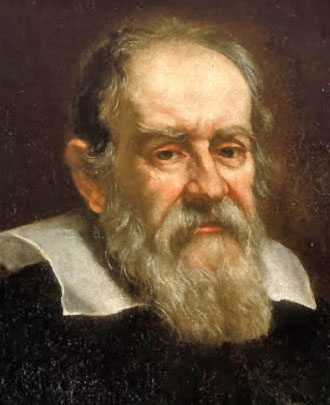 In 1609 Galileo Galilei knew what the killer application was: tracking celestial bodies. Having a goal, he improved the magnification technology first by a factor 4 over Lipperhey's, then by a factor 30. The improved technology and the scientific collection of experimental data allowed him to publish the starry messenger newsletter Sidereus Nuncius in March 1610, and astronomy took off faster than blades or the iPhone today. Moons on Jupiter! Can you think of anything more exciting and captivating? Can you not be a cosmologist in 1610? Astutely naming the four moons after the powerful Medici bankers brought in the funding for more research, so shattering and revolutionary the Vatican felt threatened.
Skip forward 400 years. You have invented a digital press. What would you expect Galileo to do for you today? Let us first adjust the currency for the inflation over the past 400 years. You are a conglomerate or keiretsu (系列) and your business is $100G, i.e., to qualify as a killer application, it has to be a $10G idea, a so-called B++ idea.
Building a digital press and shipping it to the customer is like Lipperhey's telescope. You make a buck, but you do not become rich. Since in 2009 we like the concept of SaaS or software as a service, Galileo could sketch up a solution like this:

This would allow him to publish his Sidereus Nuncius, even remotely, and PSIP would ensure Johannes Kepler would see matching colors to those on Galileo's display. PSIP? Wait a minute, we already read that, it was the blog post on XNS and print services last year's March 19. That did not qualify as a B++ idea. Think farther out of the box.
If you ever visited a printer, i.e., a plant with a press that manufactures printed artifacts, you know that the printer is only a single piece in the building. Printing is manufacturing, and the press is just one machine in the factory.
There is a lot going on before the press: calculating printing costs and writing bids, preflighting the material, reformatting and processing it as necessary, obtaining missing elements like fonts and images in the correct format and quality, managing color profiles, making proofs, subcontracting manufacturing steps to a trade press or a remote partner, etc.
There is also a lot going on after the press: collating, laminating, folding, binding, trimming, quality-checking, shrink-wrapping, packaging, shipping, billing, etc. This is a bindery in Lausanne:
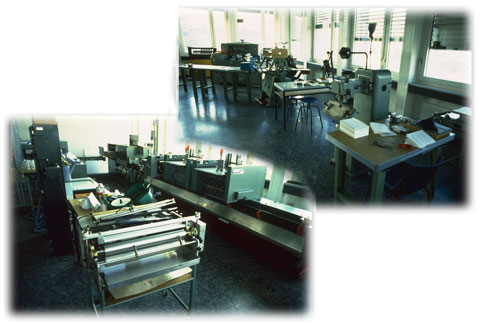
I am showing the bindery because this is where the money is made. In 1568, Jost Amman published his Ständebuch, in which for each profession (Stand) he had a woodcut and a description of the profession in the professional's words.
If you read these descriptions, the book binder is the only one who states (in the last line): "I make a lot of money with my work":

Galileo thinks: "hmm, this might be a B—, I think I can do better." He thinks about the idea of publishing his Sidereus Nuncius, in Prague, so Johannes Kepler can get it right away, but then hears the rumor that that year (1612) Kepler was thinking of moving to Linz in Austria, so to be sure he would need a printer both in Prague and Linz.
With Medici's funding, buying the digital press is not a problem. Having the vendor shipping the press and finding good operators is not a problem either. The problem is all that stuff before and after the press. Many interested printers already have other presses and all the related equipment. The real problem is making it all working together.
Sure, there are legions of printing consultants that can integrate the press, build all the color profiles, install all the correct firmware versions in the various devices, but it is a slow, error-prone, and difficult process.

So here is Galileo's B+ idea. How does Intel make money by selling at cut-throat prices products that cost a fortune to develop and manufacture? Hand how can they keep doing Tick-Tock at that frenetic rate?
They could not do it with an army of consultants who travel around and upgrade fabs. Not at that speed and cost. Since all of Intel's fab facilities are fully automated and software controlled, the correct processing parameters and machine schedules are more or less uploaded from their Hillsboro research fab. Think about that; Intel will upload an entire factory!
Galileo hires a scientist with the required skills and starts a project to build a system that can upload from a print shop all their equipment parameters, their accounting, bid models, customer profiles, etc. Trust? it is a matter of branding. People trust Galileo.
Once all the information is in the lab, the system will come up with a number of options to upgrade the print shop. The sales rep and his or her sales engineer negotiate with the customer. Then the required equipment is shipped and installed. Once it is up and networked, the print shop is downloaded and the printer starts working and making money. Voilà, c'est simple, n'est pas?
But Galileo is not content with B+, he is shooting for B++. He is thinking of all the work tracking stars, taking notes, cross-checking data, writing papers, formatting them, etc. is a lot of work. And let us be honest, spending the night in a good restaurant in good company in Arcetri is more fun than staring in a telescope.
There are a lot of smart people in the world. They may not all be esoteric speculative designers like him, but there a lot of very smart and motivated people who can produce highly valuable printed goods. Galileo realizes two things: already Aldo Manuzio in Venice had found out that you make more money as a publisher than as a printer, and if the price is right, you can recruit a lot of top-notch collaborators through crowd-sourcing (of course, a crumbling Byzantine empire helps).
This is where being big is important, because to build a network of a gazillion editors and pay them automatically according to the sale of their publications requires vast resources, like your own bank to settle all the payments and a flexible open digital rights management system.
The latter is actually the easiest part, because MPEG-21 already contains a solution and MPEG-A—Multimedia Application Formats has all the code to quickly rig up a prototype and get the funding to build a production system.
See, was that not easy? All you need to do is put Galileo or somebody of his caliber in charge. When it is about communication, humans have always been willing to spend large amounts of money, because that money is an investment. But do not forget you need those special people that have valuable entities to communicate, groom your brand.
Homework: Why does Brother Dominique not have a B++ project?
Time for this scribe to wrap up and go back tweaking printer drivers. With Brother Dominique, a colophon invoking a pulchra puella? No. En lieu, to close the loop with Derrida, I will deconstruct in front of your very eyes a woman: 女. She consist of three strokes. Although you can never mix macho katakana with girly hiragana, we will take the strokes in order as a hiragana, a katakana, and a kanji: くノ一. In romanji that is kunoichi — Ninja!

Note: If you are a pupil or student and found this post researching on the Internet for your assignment, be aware that here you are not reading a scientific journal of archive quality. This is just an informal blog post and you are reading fiction written for entertainment (and branding).
When we think about places we have never visited, we build on other information about the place—the stereotypes—we have gained from variou...


