Friday, March 21, 2008

More on print services

My post about print services appears to have caused some confusion. While I prefer to get feedback in the form of comments, so others can also comment and a dialogue is established, here are some clarifications — at the risk of making things even muddier.

The first confusion is when the same word is used for something different, a subtle polysemy problem. What we call now the Internet, was called the ARPAnet thirty years ago. At that time Xerox had Ethernet local area networks (LAN) at its sites, and they were interconnected through gateways to create the Xerox Internet. This Internet was a node on the ARPAnet and used the same naming scheme, so it was seamlessly integrated. For example, you could write my email address as beretta.pa@xerox.com or as beretta@pa.xerox.com.

PARC was also connected to other networks, like the DecNet, but is was not seamlessly integrated and your email address had to finish in !ucb!parc|beretta to find its way to a gateway from which I could access it.

Thirty years ago was before the general availability of workstations, so the ARPAnet did not have many nodes. However, the Xerox Internet had thousands and workstations. Therefore, the researchers at PARC had to solve all the scalability issues before anybody else was even aware of them.

While the Internet connects logical machines, the World Wide Web hyperlinks documents, using a protocol called HTTP. Initially the Web was mostly text-based, but then its inventor at CERN found out how easy it was to implement a graphical browser on the NeXT system, and the rest is history.

first graphical browser

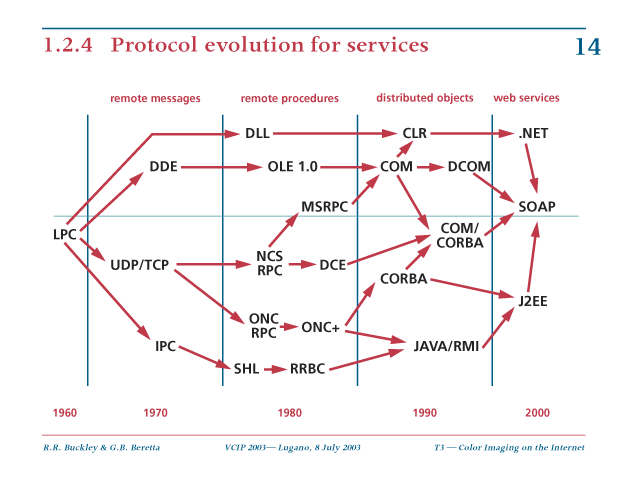
Next, RPC did not disappear, but it was constantly metamorphing. Here is a diagram of the protocol evolution for services Rob Buckley drew several years ago. It stops at 2000, and now there is a number of web service frameworks, a list of which you can find on the Wikipedia.

protocol evolution for services

A popular way to represent Web service architectures is using the so-called three-tier architecture concepts.

three tier architecture concepts

Two popular models are Microsoft's .net and Sun Microsystem's J2EE.

.net to J2EE model comparison

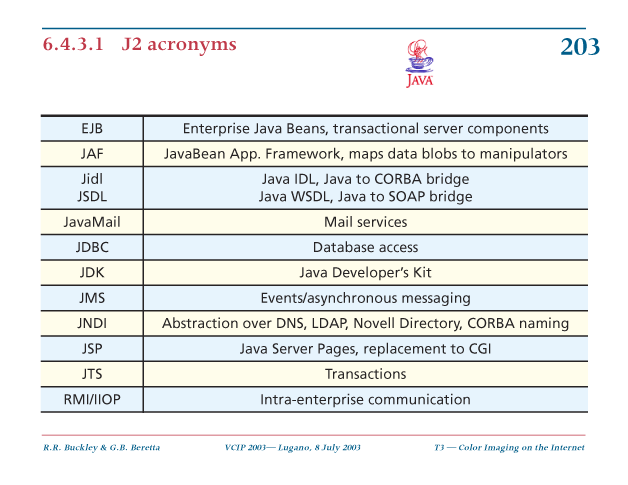
The jargon on the right hand side can be decoded with this J2 acronym list.

J2 acronyms

Finally, print services are not used just for printing but also for proofing. The latter is somewhat delicate, because the print provider needs to maintain control of the proofing device and the viewing conditions. One approach is to use a remote sensor to assess the ambient conditions and then apply a color appearance model (USP 6,078,732 etc.). Another approach is to use an electronic color proof (ECP) node that mediates the sharing of information about the capabilities of nodal color devices, the interpretation of color image data to the devices, and the control of color reproduction (USP 6,157,735 etc.).

remote printing and proofing

Thursday, March 20, 2008

Blue iris

Iris Blue

A Web color like #333399 is easy to remember. How did I get to it? I went to Pantone's Web page for their color of the year for 2008: Pantone® 18-3943 Blue Iris. There I averaged the pixel colors in the depicted Pantone 18-3943 TCX textile swatch and obtained CIELAB value (23, 27, -53), which in RGB hex coordinates is 333399.

Iris at Gamble Gardens, Palo Alto. (c) Giordano Beretta. All rights reserved.How did Pantone get to this color? On their Web page they explain "From a color forecasting perspective, we have chosen PANTONE 18-3943 Blue Iris as the color of the year, as it best represents color direction in 2008 for fashion, cosmetics and home products," explains Leatrice Eiseman, executive director of the Pantone Color Institute®. "As a reflection of the times, Blue Iris brings together the dependable aspect of blue, underscored by a strong, soul-searching purple cast. Emotionally, it is anchoring and meditative with a touch of magic. Look for it artfully combined with deeper plums, red-browns, yellow-greens, grapes and grays."

That was how they selected it. As for the description of this color, they write "Blue Iris is a beautifully balanced blue-purple. Combining the stable and calming aspects of blue with the mystical and spiritual qualities of purple, Blue Iris satisfies the need for reassurance in a complex world, while adding a hint of mystery and excitement."

Wednesday, March 19, 2008

Print services

Computer science — or informatics, as it is called more appropriately in Europe — has a less linear progress history than other technologies. Indeed, many a breakthrough technology was forgotten only to be reinvented several decades later. I had already posted on concurrent programming (in the comments) and color encoding.

For example, the idea of punching the octal codes of a program on a paper tape instead of toggling it in every time on the console switches was so straightforward it got quickly adopted. But already the idea of using an assembler or compiler to generate the octal codes from a formal language took a bit longer to sink in.

Back in the Sixties and Seventies, when computer users were debating on whether 96 column punch cards were better than 80 column punch cards, computer scientists were busy inventing tools to make their professional life easier by using computer technology. However, the semantic gap from what they were doing to the reality of punch cards was so big, that most of not many of their ideas did not make it into the real world, only to be reinvented thirty years later.

One hot topic at that time was distributed computing. Long before protocols like TCP/IP, HTTP, etc. were invented, things were harder to do and had to happen a step at a time. An example was Grapevine, a multicomputer system on the Xerox research internet. It provided facilities for the delivery of digital messages such as computer mail; for naming people, machines, and services; for authenticating people and machines; and for locating services on the internet. You can read about it in Andrew D. Birrell, Roy Levin, Roger M. Needham, and Michael D. Schroeder, Grapevine: an exercise in distributed computing, Communications of the ACM, Volume 25, Issue 4 (April 1982), Pages: 260-274.

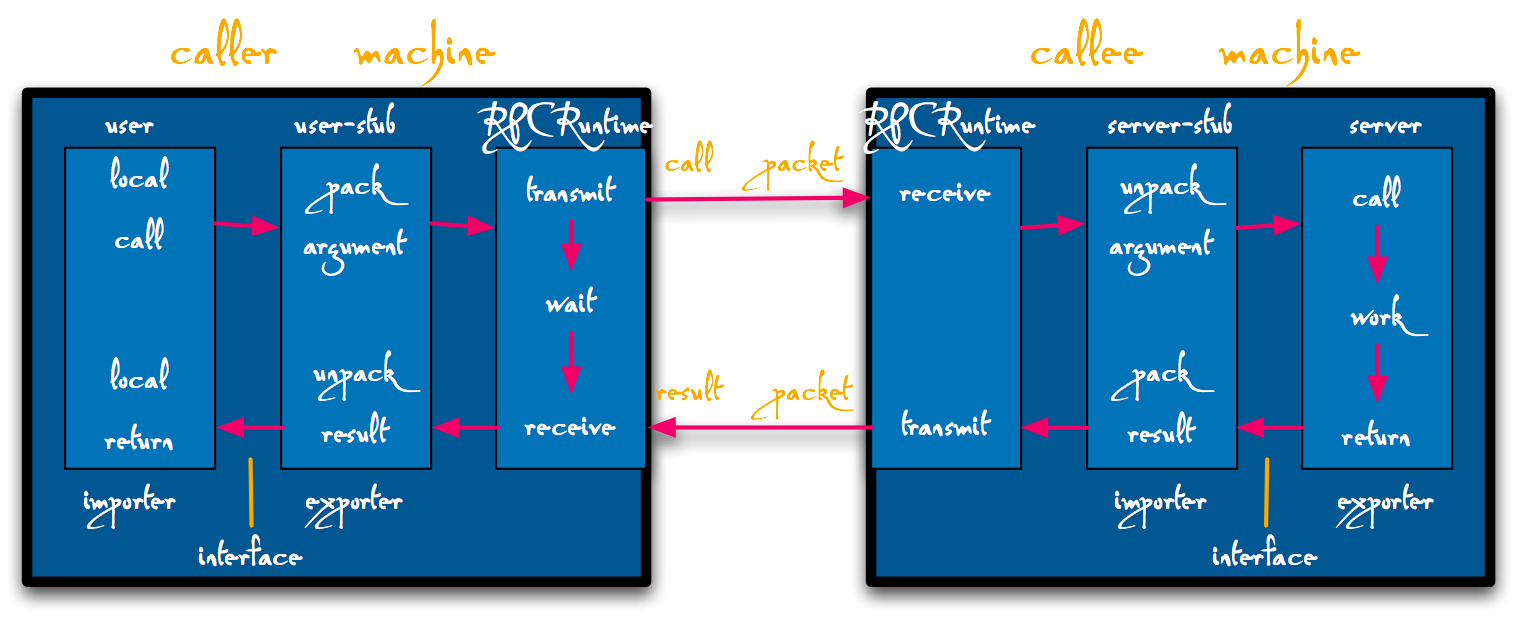
Once we can exchange digital messages and name entities, we can call procedures or invoke methods on a different machine. As we can read in the first paragraph of Andrew D. Birrell and Bruce Jay Nelson, Implementing remote procedure calls, ACM Transactions on Computer Systems, Volume 2, Issue 1 (February 1984), Pages: 39-59,

The idea of remote procedure calls (hereinafter called RPC) is quite simple. It is based on the observation that procedure calls are a well-known and wellunderstood mechanism for transfer of control and data within a program running on a single computer. Therefore, it is proposed that this same mechanism be extended to provide for transfer of control and data across a communication network. When a remote procedure is invoked, the calling environment is suspended, the parameters are passed across the network to the environment where the procedure is to execute (which we will refer to as the callee), and the desired procedure is executed there. When the procedure finishes and produces its results, the results are passed back to the calling environment, where execution resumes as if returning from a simple single-machine call.

The components of the RPC system, and their interactions for a simple call

What was powerful in the Cedar implementation of RPC described in this paper, was that it came with a program called Lupine, which automatically generated the user and server stubs to marshall and unmarshall the procedure parameters into messages. Lupine was so powerful that even a dummy like me could implement a distributed service in an afternoon.

It is not that Xerox did not try to productize this technology. Indeed, it created a product version of RPC called Courier and build a whole network systems architecture on this foundation. As an example, let us look how the first print service product evolved from a research effort.

In the early days of personal computers (PC), printing was very cumbersome. It entailed powering down the PC, carrying the disk to the printer room and inserting it into the PC controlling the printer and booting it up, and finally printing. At the end the printer controller had to be powered down, the disk transferred to the original PC, which could then be booted up again.

In the mid 1970 this lead to the invention of the Ethernet for connecting a PC to a printer's controller and the development protocols to transfer data and control over the Ethernet. The basic concept underlying these protocols was RPC. The main protocol was the PARC Universal Packet (PUP).

In the late 1970s Xerox released a commercial version of this architecture, meeting the most stringent Federal requirements, under the name Xerox Network Systems (XNS). XNS supported a large number of services, among which name, authentication, gateway, time; and filing, mailing, printing, scanning, etc. Like PUP, all XNS protocols were based on RPC, specifically Courier. Later TCP/IP was able to be rapidly developed based on the experience with PUP and XNS.

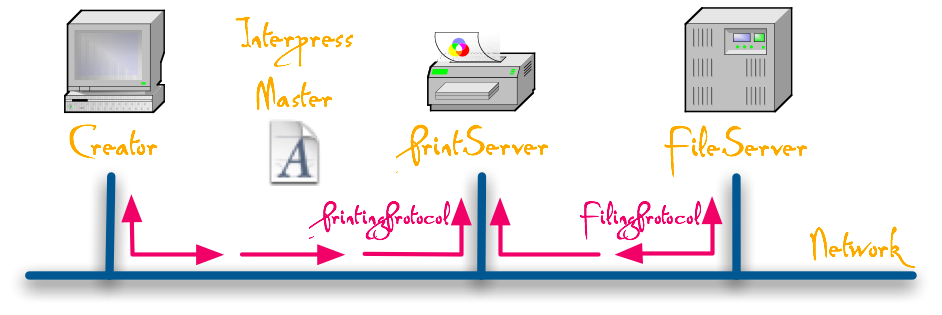
XNS clients use the Printing Protocol to cause documents to be printed on a Print Service. The Printing Protocol model assumes an abstract printer service which has three distinct processing phases: spooling, formatting, and marking.

A client requests service and, if the Print Service is able to grant the request, the client is given a print request identifier. The Print Service provides status of the job, which the client can request via the identifier, as well as a capabilities ticket (Properties).

The print request consists of a list of links to the documents to be printed, as well as a request ticket (Options). The Printing Protocol includes all security requirements of the Government and a priority. The documents are transferred with the Bulk Data Transfer Protocol. The Authentication Protocol is used for security and the Time Protocol is used to manage time.

In XNS the documents have to be in the Interpress page description language, which can be regarded as a precursor of PDF. An important feature of Interpress is that all pages are independent and can be processed independently in any order, as most suitable for the printer.

XNS Print Service architecture

An important feature of XNS Print Services is to assure that a document printed by different printers will look the same and has the same consistent high quality. To achieve this, the XNS architecture specifies the Print Service Integration Standard (PSIS). The PSIS defines the base case to which all XNS Print Services must adhere to assure compatibility. The principal areas addressed by PSIP are: Interpress level, character encoding, naming syntax, font usage, file usage, minimal service provisions, color encoding, and Printing Protocol usage (exception handling).

Tuesday, March 11, 2008

Roaring silence

As I mention in my green description block on the top of this page, I am relating you a view from my window. From the window of my corner cubicle I see the entire Silicon Valley. A little closer, beyond that empty parking lot that is the constant reminder of better times, I see HP's Corporate Headquarters.

As Nathan wrote in his two previous posts, last Thursday afternoon we had quite a big event there, announcing the new reorganized HP Labs. In addition to the speaches to the press from HP's top brass, there was also an Experience Zone with demonstrations of HP's most advanced research projects.

Interestingly, the morning of the same day down the road in Cupertino, Apple also had a press event for their iPhone SDK. By comparison, when I look through Friday's newspapers, the HP Labs event has been received with a roaring silence. It is not that we did not try. For example, the widely reported idea of shaking the iPhone to delete the pictures is not much cooler than Chandra's blackboard shaking off a heat-generating traditional data center.

If you do not want to click through all the goodies in the HP IdeaLab, you can watch a nine minute summary video on Tom Foremski's IMHO blog post 90 minutes of HP Labs reboot in about 9 minutes…. If you want the full information, including the press kit, you can find it on HP's communication page.

As I am writing this, I am on the phone with Prof. Lucia Ronchi, who told me a related story. Kitty corner of her house in Arcetri, next to the National Institute of Optics founded by Galileo, there is a salumeria (a store selling cold cuts). About 20 years ago, they were selling the salami wrapped in rather old paper, until one day a scientist from the Instutute had a closer look at the paper. He asked the butcher from where he got the paper and was shown a trunk full of papers they had discovered in the basement. The papers were Galileo Galilei's original manuscripts.

Did the journalists just use the HP event to wrap their salami?

Why is this noteworthy? In a place and time when for the past 25 years corporations have butchered their research labs, HP announces that its central research lab will refocus to do more fundamental research. This will lead to new technologies on whose basis new divisions can be built and the comany can be grown faster than the competition.

This is something that goes against the flow here in the USA.

Indeed, Sunday evening I was watching the weekly business report on NHK. They were reporting on the two floods of dollars currently flowing into the Gulf States. The first are the petrodollars from Americans filling their gas guzzlers with gasoline from petrol costing $109 a barrel, the second from us tax payers through companies like KBR, who are assisting our government in the war against terrorism and also buying the services for the Iraq's reconstruction in those countries.

about California

Then a Japanese government representative gave a long explanation in front of a map of America on something about California, because our state was highlighted. Unfortunately he was talking too fast for my rudimentary Japanese for me to make sense of what he was saying.

Then they interviewed some top economists from a Gulf State financial institution. They explained how they were swimming in dollars and how hard it was to make those funds useful to humanity. Their institution had decided to pick countries with a high intellectual potential, i.e., where a lot of highly educated people could put the funds to good use to invent new products and bring wealth to their nation.

currently financed countries

On a map of the world they explained that these countries are of course those in the Middle East, then Egypt, Spain, Austria, Pakistan, and Korea. They explained some of the projects they are financing and stressed how they are geographically allocating their funds.

Then — and this was the reason for this TV program — they explained how also Japan is such a country with a high intellectual potential. As an example, they pointed at the large quantity of research aiming to invent new sustainable energy sources. Consequently, thir investments are now also flowing to Japan. Interestingly, in the above map America , i.e., the dollar countries, is not represented.

new set of countries with investments

In this context, last Thursday's event at HP was very unorthodox to have happened here in the USA. It shows that HP is better aligned with the world than the rest of the big American companies. And we who are doing this high risk work to better humanity are better citizens of the world.

And now feel free to print this page on your HP printer and use it wrap your salami.

Tuesday, March 4, 2008

Encoding color

No matter what color space you are using, how you are compressing an image's spatial content, and in what file format you will encapsulate your image, you have to choose a color encoding standard. In this post I will write about color encoding.

One of the first color encoding standards had been proposed by Xerox in their document XNSS 289005 dated May 1990 and based on their earlier Raster Encoding Standard, which was the basis for Interpress. Color coordinates were normalized to the [0, 1] interval, but not constrained to it, to allow for the correct representation of out-of-gamut colors. For each image and each color channel, offsets and scaling factors where specified to represent the coordinate values with a certain number of bits.

In the Eighties personal computers were slow and had little memory, so efficiency was very important. It turns out that if an image is represented in the CIELAB color space with a realistic gamut, 8 bits are sufficient to store a color coordinate with sufficient precision to avoid artifacts. We then invested a considerable effort in decoding the color coordinates in a the fewest possible number of clock cycles. To implement a color management system you had to be a Cedar wizard. You also had to have a very good understanding of scientific computing, because the Xerox Color Encoding Standard also had the concept of tolerances as integral part of encoded color.

A few years later a much more pragmatic approach was taken. Color had become sufficiently cheap to be used in the office and it was necessary that an ordinary engineer be able to implement a color management system. The thinking was that by then almost all CRT monitors used the ITU-R BT.709-2 primaries, had a D65 white point, gamma 2.2, and achieved a luminance level of 80 cd/m2. With this one could require all input and output devices should be build according to this specification, and then simply normalize the RGB coordinates to [0, 225] and forget about color management systems. For good measure, the gamma non-linearity was thrown in the encoding (before, for efficiency we used only linear color model operators and did the gamma operation in firmware in the display controller).

This sRGB trick worked well for a decade. However, today, after 45 years of R&D, LCD displays have taken over and CRTs have virtually disappeared. LCDs do not have a gamma and do are not limited to the ITU-R BT.709-2 phosphor gamut. For the backlight unit (BLU) typically an active local-area dimming (ALD) direct-array of LEDs is used. These LEDs have as much as 70% external quantum efficiency and use multi-spectrum phosphors to generate a very wide color gamut.

As an aside, today's LCD technology is so fast, that color-field-sequential approaches are again considered, which eliminate the inefficiency of color filters in the panel.

Today's panels have a depth of 12 bits in each channel, a gamut that almost reaches the visual system's gamut, and can blast out 500 cd/m2 or more. True, your visual system is in film mode and you will adapt to the display, but if you just send sRGB coordinates to the display, it will look very ugly. When a modern display is unleashed, color must be managed.

Furthermore, a modern consumer digital camera can capture up to 14 bits per channel. Why do you want to throw them away by encoding your images in sRGB? Keep at least 12!

How then should you encode your color images? Fortunately there is no need to reinvent the wheel. The people in the digital effects business had to deal with these issues many years ago and developed several high dynamic range (HDR) color encoding standards. Most display controllers support at least one of them in hardware, namely Industrial Light and Magic OpenEXR (EXR). Open here refers to the C++ source code published by ILM for reading and writing OpenEXR image format files.

To learn more on this topic, Greg Ward's white paper High Dynamic Range Image Encodings is a good starting point.

Saturday, March 1, 2008

Maya blue paint: an ancient nanostructured material

I must be going through a blue period. After posting on the Blue Hour and just the day before yesterday on International Klein Blue, yesterday's New York Times brings us The Grim Story of Maya Blue by Kenneth Chang (subscription required). Nathan tells me I have to post about it. On the Web, Maya Blue is color #73C2FB.

Maya Blue

Yoko on top of the pyramid, Chichén Itzá in YucatánI will not write about Chaak, the rain god, and of human sacrifice. You already read that in yesterday's newspaper. In fact, we happened to visit Chichén Itzá in Yucatán back in 1994 and nearby we even visited the Cenote of Sacrifice shown below at right. The guide explained us those sacrifices, noting they were only performed as a last resort during draughts.

Until 1993, Maya Blue paint was a mistery, because it survived the harshest conditions in the jungle, and even modern acids, without fading. No need for Ingeborg Tastl's Fading Tool when you use the original Maya Blue pigment!Cenote of Sacrifice

The mistery was solved by Constantino Reyes-Valerio (1922 - 2006), who is also the creator of the Maya Blue Web site. His research revealed that the indigo dye from the leaves of añil was encased in a superlattice of palygorskite, a magnesium aluminium phyllosilicate. He contributed the beautiful image below at left.A warrior with Azul Maya on the background. Constantino Reyes

You can read about the science behind this paint in the Science magazine of 12 July 1996 in the article Maya Blue Paint: An Ancient Nanostructured Material by M. José-Yacamán, Luis Rendón, J. Arenas, and Mari Carmen Serra Puche (subscription required).

They describe that the añil dye was obtained from the sprigs of the xiuquilit (indigophera sp.) plant. However, the superlattice of palygorskyte mixed with indigo molecules does not explain by itself the color tone of Maya blue.

They found that the low concentration impurities of Fe, Mn, and Cr must also be present. Indeed, metallic and oxide particles of nanometer dimensions can strongly influence the optical properties of a material, and small impurity concentrations are sufficient to produce particles.

Science 12 July 1996Nanoparticles can have both linear and nonlinear optical properties. Linear absorbance of small particles can create a resonance feature related to surface-plasmon excitation. The main effect of the particles is classical in nature, although quantum effects are not excluded. Particles much smaller than the wavelength of visible light have an extinction spectrum dominated by the imaginary part of the refractive index. The blue color comes from an absorption curve peaked in the visible part of the spectrum. The oxide metals can account at least in part for the color. In addition, many of the particles are nonspherical, and planar defects may play an important role in the optical properties. The color of Maya blue could be at least partially associated with the presence of nanoparticles.

The authors further report that it is likely that impurities were added to the indigo during the preparation of the añil (heating clay in añil at 100ºC). Oxidation or encapsulation of particles in the substrate explains the acid-resistant character of the paint. The indigo molecules encapsulated in the palygorskite pores probably also contribute to the final color. The combination of an intercalated clay forming a superlattice and the metallic and oxide nanoparticles supported on an amorphus substrate makes the ancient Maya blue look like modern nanostructured materials.

Maya Blue

Friday, February 29, 2008

This is not International Klein Blue

IKB International Klein Blue

However, it is the color displayed on http://www.international-klein-blue.com/, so I guess the Web rendition of IKB is #002FA7. This is very far from the color specified by French artist Yves Klein (28 April 1928 - 6 June 1962). I once was in a room full of his paintings at the Kunsthaus in Zürich, and the effect was stunning. One trick was that these painting are correctly displayed by hanging them projecting out slightly from the wall, so that the canvasses appear to be suspended in space.

The ultramarine IKB paint is applied on the canvas with thick, highly textured strokes. Take the time to sit on a bench in front of a solid IKB painting, and the painting will hit you. The chromaticness is as high as it can get, and the few S-cones in your retina are contribuing to your visual system as they never have before. It will teach you, what the "deep" in "deep blue" means.

Klein started using IKB in 1958 and between 1960 and 1961 he created 15 monochrome IKB paintings. He developed IKB with chemists to achieve paint with the same chroma as dry pigment. This is done by suspending the pigment in a clear resin, and it allowed him to obtain the first patent (actually, just an enveloppe Soleau) for a color. As far as I know, IKB was never produced commercially.

Speaking of commerce, there is an interesting story about the first exhibition at the galleria Apollinaire in Milano. The eleven canvasses, although identical, were not appreciated equally by the public — they were sold for different prices. Klein concluded that each painting, as well as its material reality, was impregnated with an immaterial quality that made it distinct from the others.

And now I already see Nathan planning his next post, where he will not ask you to name colors, but to price them…

Wednesday, February 27, 2008

Single Electron Imaged with Quantum Strobe

Reader and frequent commenter Rocket Roo posted this comment on a relatively old post. I believe it is worth starting a new thread on it.

A quantum stroboscope based on a sequence of identical attosecond (10-18 s) pulses has been used to release electrons into a strong infrared laser field exactly once per laser cycle (coherent scattering). The resulting electron momentum distributions are recorded as a function of time delay between the IR laser and the attosecond pulse train using a velocity map imaging spectrometer. More details can be read at http://focus.aps.org/story/v21/st7. See the movie at http://www.atto.fysik.lth.se/video/emovie.mov.

Friday, February 15, 2008

Printers on the run

Printing used to be an art where patience was premium. Creating the plates for a book required years to make all the type. When Johannes Gutenberg invented the moveable metal type, the bar was lowered and more artisans were able to enter this trade. In fact, Gutenberg was really in the font business and allowed entrepreneurs to enter the business without needing a large staff of type makers. Consequently, competition became fierce.

Fortunately, some 50 years later Luca Pacioli invented the double-entry accounting system, which brought with it the new printing application of business forms. About at the same time Aldus Manutius invented publishing, and a vibrant economy with the expanded literacy of the population drove demand for printed pieces, keeping a large number of presses busy.

As Marshall McLuhan wrote, instead of saving work, labor-saving devices permit everybody to do their own work, i.e., it lowers the entry bar. For printers this has always entailed two things: improve the workflow so that rush jobs with special requirements can be handled efficiently, and move up in the value chain to provide integrated services.

Running a press is only the manufacturing part of the business. Understanding the customer means attracting more business and submitting proposals that offer more value to the customer and higher profits for the printer. Next is scheduling the jobs so that employees and equipment are always busy and cost is kept down. Finally, the finishing and fulfillment areas have to be organized for an encumbered workflow.

Workflow efficiency

One feature where a printer can achieve higher returns through mastering a complex workflow is color. Engraved playing cards were a gold mine, especially when a printer was able to print color with fine detail. When in 1797 Alois Senefelder invented lithography, it took only 19 years until Godefroy Engelmann invented chromolithography using 6 to 19 partial colors, but sometimes printing with 24 and even 30 colors.

It took a long time to invent all the technologies to achieve the next big goal, namely separated color: color filters, halftone screening, line screen, crossline screen, and in 1910 finally panchromatic film. However, in mechanical printing color remained difficult and time consuming, because it required color correction through masking, which was more an art than a technology.

The turnaround came only in 1948 when Arthur C. Hardy and F.L. Wurzburg, Jr., invented the scanner, which used the Neugebauer equations to determine the color correction in a single step. We started talking about electronic printing, because the mechanical color separation was replaced with an electronic circuit.

Yet, the quest of making the workflow more efficient had not abated. Actually, the workflow was still the same, with all the problems like pasting a separation on the wrong form in the stripping room, or the film emulsion side up instead of down.

It was only with the advent of the digital press, that a radically new and more efficient workflow was possible. Today images enter the workflow already in digital form, with all the necessary metadata to process it, such as an ICC profile and IPTC information. All devices in the workflow are carefully characterized and calibrated. A color management system handles the device's various ICC profiles and applies the necessary color transformations.

HP has been involved from the beginning in the standardization that led to the ICC profiles, and as a leader in the Consortium has acquired considerable expertise in the domain. We not only offer a range of digital presses, but also a range of proof printers covering the gamut of both digital and analog presses.

Indeed, today an important part of printers is managing their customer’s expectations. McLuhan’s quote above entails that copy creators are no longer skilled editors, but often amateurs, who use the wrong tools, like Word or even PowerPoint instead of QuarkXPress or InDesign. Even worse, they may use a photo printer with glossy media and a dozen inks to create what they believe to be a “proof.”

In such situations, the first step is to create a true proof print for the customer — if necessary remotely at the customer’s location. Today customers also expect to be able to submit distributed print jobs, where shorter runs are printed closer to the end-user to save on transport costs.

At HP we have solved all these problems and no matter whether you have an ICC-based workflow or offer your customers a GRACoL workflow, we have the right resolution to solve the technical details for you, so you can focus on making your customer happy.

Integrated services

The second route to success is to work up in the value chain. Labor saving devices permit also the printer to perform services that are more valuable. For example, in the last twenty years the pre-press houses have disappeared, with printers taking over their place.

Often printers also employ graphic artists that help customers convert a piece created with office tools in a piece with proper optical spacing, ligatures, kerning, etc. In addition, graphic elements can be redrawn with more appropriate tools, with well-chosen line weights, mitering, knock-out, and trapping. Often it is not just the esthetical appearance of the piece, but also ripping efficiency, like when transparency is flattened out.

All this results in increasingly complex pre-flight scenarios. At HP we have deep XML experience that allows us to create workflow management tools with smart pre-flight analysis tools that can automatically sort through the endless pages of errors and warnings to resolve all issues, such as color transformations, locating professional fonts, and finding suitable resolution images.

Today printers are climbing further up in the value chain by maintaining their own address lists and renting them to their customers, sometimes even managing the feedback loops from the cards or Internet responses of the end-user.

Managing address lists evolves to targeted marketing, where the address list contains sufficient demographic data to allow narrowing the recipients of a mailing to those more likely to respond. Data-mining is becoming more and more a valuable tool for targeted marketing.

From there is it a simple step to variable data printing, where each piece is customized to the recipient. For example, the advertisements in a magazine or newsletter can contain the actual address of an outlet geographically close to the recipient’s home address.

Climbing up in the value chain can also mean that the printer no longer requires a PDF file from the customer, but can instead tap directly into the SQL database of the customer’s Enterprise Resource Planning (ERP) system.

This is where HP is different from the other press manufacturers. Indeed, HP is not only one of the most prominent press manufacturers; HP is also the largest IT company. HP not only provides the datacenters required to fulfill these complex high value print jobs, but also the consulting services necessary to implement them.

Covering the full gamut from proof printers and digital presses to datacenters, IT services, networking, and consulting, HP is in the unique situation of being able to provide integrated solutions that allow today’s printers to succeed in the modern landscape of global competition. With HP, printers can focus on a single vendor and concentrate on what they do best, instead of having to juggle a disparate number of vendors.

Tuesday, February 5, 2008

On starting new research laboratories

These are very busy times for me and I have not been able to keep up with what is happening outside my window, down in the Valley. So here are some musing useful to research managers forming new laboratories.

Our brains are not pre-wired. Although we are born with a structural scaffolding, synaptic connections are created as long as we learn. There is evidence that at the onset of puberty the brain — by then a knotted tangle of neuronal axons — may get reorganized by replacing convoluted connections with more direct ones, a highly individual process that appears to end with puberty. This entails that we are all different, because we all have different experiences, and even when we share the same experiences, we reorganize them differently and therefore our thinking patterns are different.

Nevertheless, our thinking patterns can be grouped in a small number of cognitive styles. Understanding these styles is important for a hiring manager, because once a person with the wrong style is hired, it cannot be changed and a conflict situation is created. Or, when in a reorganization a new manager-worker diad is created, a conflict arises when the manager expects a different cognitive pattern than the worker has. In real life, managers cannot tatoo their worker's tonsils, nor make mercenaries of them, as some executives dream (see post of 6 March 2007).

A first cognitive style is that of thinking in parallel, like in a computer it would be implemented with an associative memory. People with this cognitive style are good at extrapolating and therefore make good mathematicians, scientists and artists. They also tend to be self-motivated and can drive a micro-manager crazy because they always have to go to the ground of things.

A second cognitive style is that of thinking serially, like in a computer it would be implemented with a pipeline. People with this cognitive style are good at interpolating and therefore make good engineers and designers. They also tend to be great listeners and are grateful for any outer input that allows them to work more efficiently.

A third cognitive style is that of recognizing the action item of the moment and execute it, like in a computer would be a scheduler. People with this style are very flexible and are good at quickly solving the emergency of the moment; they make good consultants and sales people. They work very well in a situation like an emergency room, were they can quickly triage patients, treat them, and completely tune out when they go home.

I am sure there are more cognitive styles, but I did not think about it and I am not versed in psychology; this is all I have to deal with in my ordinary life.

Some people have the capability to bridge two cognitive styles, and these are the people that are most valuable. For example, when I was working in CSL at PARC, when we were hiring we were considering only people that excelled both in coming up with new science and in reducing it to practice. We called these people speculative designers.

leadership and creative professions

As I wrote in my post of 3 March 2007, today's research labs are more interested in entrepreneurial researchers, i.e., those that can straddle engineering and marketing.

To finish where I started, managers should appreciate the different cognitive styles and employ their subalterns accordingly, only so can managers build a successful organization that will support them and make them successful. The managers who will try to mold their employees to their own style will fail.

the manager with his employees

The activity of a researcher is to invent. Invention is not a logical process; as Kleist interpreted Kant’s critique of the pure reason, the world you see through a pair of green spectacles is a concomitant and independent view of a same truth. Most of all, invention requires phantasy and the free spinning of ideas. Research managers must see in their employees a good balance between the homo ludicus and the homo sapiens, between otium (leisure) and its negation: negotium .

The manager has to see in the subaltern scientist the ability to have an intuition and to also bring it to fruit. A well-honored intuition and the ability to trust it are essential tools for doing research. However, all too often the only application of the intuition is to build pies in the sky or Luftschlösser. Some researchers consider the expression of their ideas in a publication to be their final product. In a good laboratory researchers believe that the ability to reduce ideas to practice is at least as important; it is essential if they want to empower people.

Yet, they do not want to be the slaves of ephemeral “marketeers”; by empowering people, researchers mean that they want to shift paradigms, invent disruptive technologies, discover emergent properties. To shift paradigms scientists attempt to pose and answer basic questions that can lead to fundamental breakthroughs. A laboratory's competitive edge depends on its ability to invent radically new approaches to computing and its uses, and then “sell” these rapidly to the engineering groups. Good research laboratories look for a commitment to solving real problems in the real world. Their focus is on technology in use, and people there are passionate about seeing their ideas embedded in products that shape the way people work, think, interact, and create.

This is different from what goes on in engineering or many less successful research labs, where the focus is on improving current technology and advancing the status quo. Researchers who had taken a job somewhere else, when they embarked on a project they would probably have had a pretty good idea of how and when their work would pay off. The problems they would have addressed would be well defined. They would have helped improve computer technology state-of-the-art by going one step farther along a well-plotted path.

In a well-managed research group there is no plotted path. The problems researchers in a good lab work on will be the ones they help to invent. When researchers embark on a new project, they will have to be prepared to go in directions they could not have predicted at the outset. They will be challenged to take risks and to give up cherished methods or beliefs in order to find new approaches. They will encounter periods of deep uncertainty and frustration when it will seem that their efforts are leading nowhere.

This is why following their instinct is so important. Only by having deep intuitions, being able to trust them, and knowing how to run with them will they be able to keep their bearings and guide themselves through unchartered territory. The ability to do research that gets to the root is what separates merely good researchers from world-class ones. The former are reacting to a predictable future; the latter are enacting a qualitatively new one.

Going to work in a good laboratory, researchers are sacrificing the security of a safe approach in which they can count on arriving at a predictable goal. But they have the opportunity to express their personal research “voice” and help to create a future that would not have existed without them.