Friday, February 29, 2008

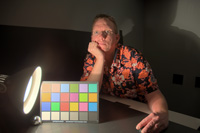
This is not International Klein Blue

IKB International Klein Blue

However, it is the color displayed on http://www.international-klein-blue.com/, so I guess the Web rendition of IKB is #002FA7. This is very far from the color specified by French artist Yves Klein (28 April 1928 - 6 June 1962). I once was in a room full of his paintings at the Kunsthaus in Zürich, and the effect was stunning. One trick was that these painting are correctly displayed by hanging them projecting out slightly from the wall, so that the canvasses appear to be suspended in space.

The ultramarine IKB paint is applied on the canvas with thick, highly textured strokes. Take the time to sit on a bench in front of a solid IKB painting, and the painting will hit you. The chromaticness is as high as it can get, and the few S-cones in your retina are contribuing to your visual system as they never have before. It will teach you, what the "deep" in "deep blue" means.

Klein started using IKB in 1958 and between 1960 and 1961 he created 15 monochrome IKB paintings. He developed IKB with chemists to achieve paint with the same chroma as dry pigment. This is done by suspending the pigment in a clear resin, and it allowed him to obtain the first patent (actually, just an enveloppe Soleau) for a color. As far as I know, IKB was never produced commercially.

Speaking of commerce, there is an interesting story about the first exhibition at the galleria Apollinaire in Milano. The eleven canvasses, although identical, were not appreciated equally by the public — they were sold for different prices. Klein concluded that each painting, as well as its material reality, was impregnated with an immaterial quality that made it distinct from the others.

And now I already see Nathan planning his next post, where he will not ask you to name colors, but to price them…

Wednesday, February 27, 2008

Single Electron Imaged with Quantum Strobe

Reader and frequent commenter Rocket Roo posted this comment on a relatively old post. I believe it is worth starting a new thread on it.

A quantum stroboscope based on a sequence of identical attosecond (10-18 s) pulses has been used to release electrons into a strong infrared laser field exactly once per laser cycle (coherent scattering). The resulting electron momentum distributions are recorded as a function of time delay between the IR laser and the attosecond pulse train using a velocity map imaging spectrometer. More details can be read at http://focus.aps.org/story/v21/st7. See the movie at http://www.atto.fysik.lth.se/video/emovie.mov.

Friday, February 15, 2008

Printers on the run

Printing used to be an art where patience was premium. Creating the plates for a book required years to make all the type. When Johannes Gutenberg invented the moveable metal type, the bar was lowered and more artisans were able to enter this trade. In fact, Gutenberg was really in the font business and allowed entrepreneurs to enter the business without needing a large staff of type makers. Consequently, competition became fierce.

Fortunately, some 50 years later Luca Pacioli invented the double-entry accounting system, which brought with it the new printing application of business forms. About at the same time Aldus Manutius invented publishing, and a vibrant economy with the expanded literacy of the population drove demand for printed pieces, keeping a large number of presses busy.

As Marshall McLuhan wrote, instead of saving work, labor-saving devices permit everybody to do their own work, i.e., it lowers the entry bar. For printers this has always entailed two things: improve the workflow so that rush jobs with special requirements can be handled efficiently, and move up in the value chain to provide integrated services.

Running a press is only the manufacturing part of the business. Understanding the customer means attracting more business and submitting proposals that offer more value to the customer and higher profits for the printer. Next is scheduling the jobs so that employees and equipment are always busy and cost is kept down. Finally, the finishing and fulfillment areas have to be organized for an encumbered workflow.

Workflow efficiency

One feature where a printer can achieve higher returns through mastering a complex workflow is color. Engraved playing cards were a gold mine, especially when a printer was able to print color with fine detail. When in 1797 Alois Senefelder invented lithography, it took only 19 years until Godefroy Engelmann invented chromolithography using 6 to 19 partial colors, but sometimes printing with 24 and even 30 colors.

It took a long time to invent all the technologies to achieve the next big goal, namely separated color: color filters, halftone screening, line screen, crossline screen, and in 1910 finally panchromatic film. However, in mechanical printing color remained difficult and time consuming, because it required color correction through masking, which was more an art than a technology.

The turnaround came only in 1948 when Arthur C. Hardy and F.L. Wurzburg, Jr., invented the scanner, which used the Neugebauer equations to determine the color correction in a single step. We started talking about electronic printing, because the mechanical color separation was replaced with an electronic circuit.

Yet, the quest of making the workflow more efficient had not abated. Actually, the workflow was still the same, with all the problems like pasting a separation on the wrong form in the stripping room, or the film emulsion side up instead of down.

It was only with the advent of the digital press, that a radically new and more efficient workflow was possible. Today images enter the workflow already in digital form, with all the necessary metadata to process it, such as an ICC profile and IPTC information. All devices in the workflow are carefully characterized and calibrated. A color management system handles the device's various ICC profiles and applies the necessary color transformations.

HP has been involved from the beginning in the standardization that led to the ICC profiles, and as a leader in the Consortium has acquired considerable expertise in the domain. We not only offer a range of digital presses, but also a range of proof printers covering the gamut of both digital and analog presses.

Indeed, today an important part of printers is managing their customer’s expectations. McLuhan’s quote above entails that copy creators are no longer skilled editors, but often amateurs, who use the wrong tools, like Word or even PowerPoint instead of QuarkXPress or InDesign. Even worse, they may use a photo printer with glossy media and a dozen inks to create what they believe to be a “proof.”

In such situations, the first step is to create a true proof print for the customer — if necessary remotely at the customer’s location. Today customers also expect to be able to submit distributed print jobs, where shorter runs are printed closer to the end-user to save on transport costs.

At HP we have solved all these problems and no matter whether you have an ICC-based workflow or offer your customers a GRACoL workflow, we have the right resolution to solve the technical details for you, so you can focus on making your customer happy.

Integrated services

The second route to success is to work up in the value chain. Labor saving devices permit also the printer to perform services that are more valuable. For example, in the last twenty years the pre-press houses have disappeared, with printers taking over their place.

Often printers also employ graphic artists that help customers convert a piece created with office tools in a piece with proper optical spacing, ligatures, kerning, etc. In addition, graphic elements can be redrawn with more appropriate tools, with well-chosen line weights, mitering, knock-out, and trapping. Often it is not just the esthetical appearance of the piece, but also ripping efficiency, like when transparency is flattened out.

All this results in increasingly complex pre-flight scenarios. At HP we have deep XML experience that allows us to create workflow management tools with smart pre-flight analysis tools that can automatically sort through the endless pages of errors and warnings to resolve all issues, such as color transformations, locating professional fonts, and finding suitable resolution images.

Today printers are climbing further up in the value chain by maintaining their own address lists and renting them to their customers, sometimes even managing the feedback loops from the cards or Internet responses of the end-user.

Managing address lists evolves to targeted marketing, where the address list contains sufficient demographic data to allow narrowing the recipients of a mailing to those more likely to respond. Data-mining is becoming more and more a valuable tool for targeted marketing.

From there is it a simple step to variable data printing, where each piece is customized to the recipient. For example, the advertisements in a magazine or newsletter can contain the actual address of an outlet geographically close to the recipient’s home address.

Climbing up in the value chain can also mean that the printer no longer requires a PDF file from the customer, but can instead tap directly into the SQL database of the customer’s Enterprise Resource Planning (ERP) system.

This is where HP is different from the other press manufacturers. Indeed, HP is not only one of the most prominent press manufacturers; HP is also the largest IT company. HP not only provides the datacenters required to fulfill these complex high value print jobs, but also the consulting services necessary to implement them.

Covering the full gamut from proof printers and digital presses to datacenters, IT services, networking, and consulting, HP is in the unique situation of being able to provide integrated solutions that allow today’s printers to succeed in the modern landscape of global competition. With HP, printers can focus on a single vendor and concentrate on what they do best, instead of having to juggle a disparate number of vendors.

Tuesday, February 5, 2008

On starting new research laboratories

These are very busy times for me and I have not been able to keep up with what is happening outside my window, down in the Valley. So here are some musing useful to research managers forming new laboratories.

Our brains are not pre-wired. Although we are born with a structural scaffolding, synaptic connections are created as long as we learn. There is evidence that at the onset of puberty the brain — by then a knotted tangle of neuronal axons — may get reorganized by replacing convoluted connections with more direct ones, a highly individual process that appears to end with puberty. This entails that we are all different, because we all have different experiences, and even when we share the same experiences, we reorganize them differently and therefore our thinking patterns are different.

Nevertheless, our thinking patterns can be grouped in a small number of cognitive styles. Understanding these styles is important for a hiring manager, because once a person with the wrong style is hired, it cannot be changed and a conflict situation is created. Or, when in a reorganization a new manager-worker diad is created, a conflict arises when the manager expects a different cognitive pattern than the worker has. In real life, managers cannot tatoo their worker's tonsils, nor make mercenaries of them, as some executives dream (see post of 6 March 2007).

A first cognitive style is that of thinking in parallel, like in a computer it would be implemented with an associative memory. People with this cognitive style are good at extrapolating and therefore make good mathematicians, scientists and artists. They also tend to be self-motivated and can drive a micro-manager crazy because they always have to go to the ground of things.

A second cognitive style is that of thinking serially, like in a computer it would be implemented with a pipeline. People with this cognitive style are good at interpolating and therefore make good engineers and designers. They also tend to be great listeners and are grateful for any outer input that allows them to work more efficiently.

A third cognitive style is that of recognizing the action item of the moment and execute it, like in a computer would be a scheduler. People with this style are very flexible and are good at quickly solving the emergency of the moment; they make good consultants and sales people. They work very well in a situation like an emergency room, were they can quickly triage patients, treat them, and completely tune out when they go home.

I am sure there are more cognitive styles, but I did not think about it and I am not versed in psychology; this is all I have to deal with in my ordinary life.

Some people have the capability to bridge two cognitive styles, and these are the people that are most valuable. For example, when I was working in CSL at PARC, when we were hiring we were considering only people that excelled both in coming up with new science and in reducing it to practice. We called these people speculative designers.

leadership and creative professions

As I wrote in my post of 3 March 2007, today's research labs are more interested in entrepreneurial researchers, i.e., those that can straddle engineering and marketing.

To finish where I started, managers should appreciate the different cognitive styles and employ their subalterns accordingly, only so can managers build a successful organization that will support them and make them successful. The managers who will try to mold their employees to their own style will fail.

the manager with his employees

The activity of a researcher is to invent. Invention is not a logical process; as Kleist interpreted Kant’s critique of the pure reason, the world you see through a pair of green spectacles is a concomitant and independent view of a same truth. Most of all, invention requires phantasy and the free spinning of ideas. Research managers must see in their employees a good balance between the homo ludicus and the homo sapiens, between otium (leisure) and its negation: negotium .

The manager has to see in the subaltern scientist the ability to have an intuition and to also bring it to fruit. A well-honored intuition and the ability to trust it are essential tools for doing research. However, all too often the only application of the intuition is to build pies in the sky or Luftschlösser. Some researchers consider the expression of their ideas in a publication to be their final product. In a good laboratory researchers believe that the ability to reduce ideas to practice is at least as important; it is essential if they want to empower people.

Yet, they do not want to be the slaves of ephemeral “marketeers”; by empowering people, researchers mean that they want to shift paradigms, invent disruptive technologies, discover emergent properties. To shift paradigms scientists attempt to pose and answer basic questions that can lead to fundamental breakthroughs. A laboratory's competitive edge depends on its ability to invent radically new approaches to computing and its uses, and then “sell” these rapidly to the engineering groups. Good research laboratories look for a commitment to solving real problems in the real world. Their focus is on technology in use, and people there are passionate about seeing their ideas embedded in products that shape the way people work, think, interact, and create.

This is different from what goes on in engineering or many less successful research labs, where the focus is on improving current technology and advancing the status quo. Researchers who had taken a job somewhere else, when they embarked on a project they would probably have had a pretty good idea of how and when their work would pay off. The problems they would have addressed would be well defined. They would have helped improve computer technology state-of-the-art by going one step farther along a well-plotted path.

In a well-managed research group there is no plotted path. The problems researchers in a good lab work on will be the ones they help to invent. When researchers embark on a new project, they will have to be prepared to go in directions they could not have predicted at the outset. They will be challenged to take risks and to give up cherished methods or beliefs in order to find new approaches. They will encounter periods of deep uncertainty and frustration when it will seem that their efforts are leading nowhere.

This is why following their instinct is so important. Only by having deep intuitions, being able to trust them, and knowing how to run with them will they be able to keep their bearings and guide themselves through unchartered territory. The ability to do research that gets to the root is what separates merely good researchers from world-class ones. The former are reacting to a predictable future; the latter are enacting a qualitatively new one.

Going to work in a good laboratory, researchers are sacrificing the security of a safe approach in which they can count on arriving at a predictable goal. But they have the opportunity to express their personal research “voice” and help to create a future that would not have existed without them.

Wednesday, January 16, 2008

MySQL in transit

A blog post on the Performance Agora just flashed by. Apparently Sun Microsystems intends to buy MySQL. This is the M in LAMP, which stands for Linux, Apache, MySQL, and PHP and is part of the magic behind some of your more audacious posts. Here is the link: http://perfdynamics.blogspot. com/2008/01/sun-to-purchase-mysql.html

Tuesday, January 15, 2008

A whiter shade of pale

When we render complexion in preferred color reproduction, we must enhance the color to match local cultural expectations. The expectations are set by color consultants, who are influenced by what is available from industry. A recent breakthrough will require we tweak our color lookup tables.

CC-By-SA-2.5 Daniel BachlerKanebo Cosmetics Inc., the maker of the Blanchir brand of medicated whitening skin care, has developed a way to double the skin-penetrating capacity of magnolignan, a compound for skin whitening products that inhibits the activity of the enzyme tyrosinase which catalyzes the production of melanin. By adjusting the ingredients of the carrier oil, Kanebo was able to develop a formulation of magnolignan that penetrates below the keratinous layer to the true skin, where the cells that activate melanocytes live.

The new product will be released this spring, so there is still plenty of time to update the perceptual color rendering tables.

Sunday, January 6, 2008

The ether of knowledge

From the beginning of human kind, populations have given special status to certain members so they perpetuate the population's growing knowledge. We suggest today these people's job has become much more complex and they must also be extraordinary harvesters.

In the earliest days, an extraordinarily gifted member of a population would be seeked out and trained to become a shaman. Shamans hold the population's accumulated wisdom on their ecosystem — what can be eaten, how a disease can be cured, when climatic events happen, etc. As shamans age, they accumulate experience, increasing the population's wisdom, and pass it on to their successor. This wisdom also includes the spiritual knowledge.

When populations become more complex, this job becomes more institutionalized and is organized in a formal school. An example are the monastic orders introduced by the Egyptian dynasties. The Egyptians also documented how a special school is invented to groom future Pharaohs and make them become seemingly super-human — the school of leadership.

Today this social role is fulfilled by the scientists. In most societies the spiritual wisdom has been factored out and assigned to a separate job line, but scientists are still formed in a formal educational system consisting of universities. However, the amount of scientific knowledge exchange has increased exponentially over the past millennium (see here for a fictional account).

Indeed, we can write that today the rate of scientific exchange has become so dense, that scientific knowledge constitutes an ether (of course, formally this is known as an emergent property).

One phenomenon that has long vexed scientists is anthropocentricity. In the 1960s, biology was finally able to overcome its anthropocentric views, encouraged mostly by the new understanding of the cell's functioning and in particular the proteonome of human cells being controlled by mitochondria, living beings hosted in our cells.

This has changed our views of diseases, which from then on are no longer seen as a sinister bacterium or virus attacking the human body, but instead as a living being harnessing another living being to propagating itself. At that time the joke became popular, that the chicken and egg problem has an easy solution, namely that the egg was first and it invented the chicken to propagate itself in time.

In the 1970s, in some countries like Switzerland this led to a radical change of how medicine was practiced. It was recognized that it would be absurd for a disease to kill its host because it would also kill the disease. So more emphasis was put in understanding how the disease and the human body interact, so that the human body can be strengthened to be able to fight off the invader. A new class of medicines was invented and, after a hiatus of over two millennia, the concept of psychosomatic diseases found a new revival.

Back now to the ether. We can similarly postulate that due to the dense communication, new inventions and discoveries mature in humanity as a whole and are present without human intervention. The scientist's role is to detect an invention or discovery when it is ripe and harvest it. As noted above, this is variously called emergent property, paradigms shift, or technology disruption.

This ether theory can easily be proven by looking at the pharmaceutical industry. Contemporaneous pharmaceutical research is extremely difficult, expensive, and takes 20 or more years for a new cure. Therefore, pharmaceutical research is conducted in the greatest secrecy.

Yet, when one looks at patent applications, one sees that several independent research teams invent similar pharmaca within a few days from one another. Given the duration, complexity, and secrecy of the process, this can only be explained that collective understanding has reached a point where everybody can detect the invention in the ether.

The corollary is that the best scientists are the ones with the best antennas (and the least noise in the form of distractions), and also that location is important. For example, even if everything can be found on the Web, here in the Silicon Valley we have the competitive advantage of a denser ether. You cannot go to a party or dinner without being exposed to new knowledge in your field.

This is what I meant to contribute in my purpose statement in the green box on top of this page. From my window I have an extraordinary view of the ether and I am sharing it with you. Just aim your antenna correctly, then take action.

Thursday, December 13, 2007

High-Dynamic-Range (HDR) Photographic Survey

Mark FairchildLast August, Prof. Mark D.Fairchild, Professor of Color Science and Director of the Munsell Color Science Laboratory in the Chester F. Carlson Center for Imaging Science at the Rochester Institute of Technology released an image database for research in High-Dynamic-Range (HDR) imaging. This database is called the HDR Photographic Survey.

In these days, when camera sensors have a bit depth of 12 or 14 bits and LCD panels are at 12 bits, developing good compression and rendering algorithms for HDR images is increasingly important. Also, most SLR cameras nowadays feature automatic exposure bracketing, so it is relatively easy to create HDR images. The problem is having well characterized reference images that everybody can use, so algorithms can be compared.Mark Fairchild in 9 brackets

One aim of Prof. Fairchild's HDR Photographic Survey is to provide such images in the public domain to researchers working on HDR systems and perception with a key feature being the inclusion of camera characterization data to allow conversion to accurate device-independent image data, colorimetric measurements of original scene elements, color appearance scaling of scene elements, and other scene data allowing increased utility of the images.

There are 106 images in all. Twenty-eight have accompanying colorimetric and appearance data. The remaining images have various data associated with them, but as a minimum have an absolute luminance calibration. The link is http://www.cis.rit.edu/fairchild/HDR.html.

The images are saved as OpenEXR files. The OpenEXR format retains the image data as 32-bit floating-point values. These minimally-processed — and photometrically linear — OpenEXR files are what is available in the database. Each HDR image retains a dynamic range of about 800,000:1 (19-20 stops, or bits, of real image information).

The advantages of knowledge of the original scenes, both direct and through the appearance scaling and colorimetric data, cannot be overstated. It is already evident that having such data combined with HDR images can greatly enhance research on human visual perception and imaging techniques.

Image content includes many natural landscapes, but also portraiture and indoor/outdoor scenes of man-made objects. Lastly, some extra images are also available that are simply nice photographs.

The database images and data are in the public domain for research purposes. It is only requested that they not be reproduced for commercial purposes and that the source of the images be acknowledged in any publications or presentations resulting from research in which they are used.

Monday, December 10, 2007

Income level: economists are wrong

In traditional economic models of decision-making, the most important determinant of individual well-being is the absolute level of income. A recent study based on brain activity observed using functional magnetic resonance imaging (fMRI) proves these models wrong. Indeed, social comparison affects individuals' subjective well-being, and thus behavior.

Dr. Armin FalkThe study was done at the Neuroeconomics Lab at the University of Bonn located at the Life&Brain Research Center by Dr. Armin Falk and his co-workers and is reported in the 23 November 2007 issue of Science, Vol. 318. no. 5854, pp. 1305 - 1308 in the paper Social Comparison Affects Reward-Related Brain Activity in the Human Ventral Striatum.

The team in Bonn had access to two MRI machines placed side by side and was able to concomitantly give the same task to two subjects while rewarding them differently in case of coincident success. They included nineteen subject pairs, and analyzed data from 33 subjects.

The task involved estimating the number of dots on a screen. At the end of each of 300 trials, both subjects received a feedback. This feedback provided information about both subjects' performance (whether the estimates were correct or incorrect), as well as about both subjects' payments in a given trial. Subjects solved the estimation task correctly in 81 percent of the trials.

Analysis of variance suggested that the importance of relative comparison is independent of the level of payment. In addition, there was no significant impact of the side of the activation or the scanner type. Thus, the results provide neurophysiological evidence for the importance of social comparison on reward processing in the human brain.

Compensation boards should keep this in mind, if they want their organization's success to be sustainable.

Thursday, December 6, 2007

Bit rot antidote

PDF 1.7 is now a Draft International Standard, soon to become ISO 32000.

In my October 30 post on Photo permanence and durability I had written about the problem of bit rot. For documents, since 1993 the best antidote for bit rot has been PDF (Portable Document Format). In fact, since then I always keep a copy of my documents in its original format and in PDF. Most of my tutorial materials are created in FrameMaker, but since Adobe abandoned it on the Mac platform, I often end up making small changes directly in the PDF file, which I can edit in Illustrator or in PitStop, depending on the edit's nature.

Now PDF 1.7 has become an even more potent antidote to bit rot, because the ISO has promoted it to a Draft International Standard. To learn more about this, read Jim King's PDF blog entry of December 4 with title ISO Ballot for PDF 1.7 Passed!.

Above I wrote explicitly about documents, not about pictures. If you put your pictures in a PDF file you will always be able to read them, but note that PDF is a structured file format, not a file format for images. Therefore, inside a PDF file, the image will be encoded for example in GIF, JPEG or JPEG-2000. These encodings are also ISO standards, so there will always be decoders for them. However, JPEG does not specify a file format, so wrapping JPEG images in a PDF file is better against bit rot. This is not an issue for JPEG-2000, which specifies also file formats.