Sunday, May 18, 2014

Old telecoms should be let to die

Today's techno-melodrama is on the damage old incumbent telecoms like AT&T are doing to the American economy by reducing our efficiency as their customers. We should just let them die of natural causes and move our service as soon as we can to newer technologically savvy companies.

In 1984, when I started working at Xerox PARC, I did not get a plain old telephone. Instead, at PARC we were using the Etherphone, which was packet based instead of being circuit based like plain old telephone service (POTS). We were wearing active badges, so the Etherphone system knew where we were in the building. When a phone call came in (this was before robocalls) the system would transfer the call to the nearest phone and play our personal tune (Doug Wyatt had skillfully arranged a Beethoven Prélude for my tune). To make a call, you could either dial a number, or just type "phone jane doe" in a command tool viewer and the Etherphone would look up Jane's number in the phone book and initiate the call.

Not being a great communicator, at home I have kept living for the last 30 years with the same anti-diluvial POTS from Ma' Bell. This was until May 7, 2014 when I made the bad decision to switch to AT&T's voice over IP (VoIP) service. More precisely, the bad part of the decision was to stay with that moribund dysfunctional colossus that is AT&T. I should have done my homework and switched to one of the new skilled VoIP providers.

I am not using the phone a lot, so at first I did not notice the line had been cut by AT&T for a couple of days. It was only when my roommate noticed that I was no longer getting robocalls (that theater of the absurd where the computer of a solicitor illegally calls the computer of my AT&T digital answering machine and bizarrely tries to sell to it some useless service such as carpet steam cleaning), that I checked if a phone was off the hook and noticed the line was dead.

Indeed, that same day on May 7 AT&T had promptly disconnected my landline, but instead of giving me VoIP, they switched my number to a service they call "AT&T Wireless Home Phone" which is run by their subsidiary Cingular Wireless, as their service people keep calling it. In my house I get zero to one bars on AT&T wireless, so I am not interested in that. Also, they gave me the Uverse equipment for VoIP, not the Wireless Home equipment.

So far, I have made three trips to the AT&T store in Palo Alto and I have been on the phone literally for several days with a number of people in AT&T’s support organizations (they have several and they do not talk to each other: they are dysfunctional). However, except for once for a few hours last Saturday’s morning, AT&T has not been able to restore my phone service.

This is where companies like AT&T are recklessly damaging the American economy. The life task of us scientists and engineers is to invent technologies that make society more efficient. The task of service companies is to deploy these technologies so general wealth is increased and we get to live in a better world.

Dysfunctional companies like AT&T not only prevent us from becoming more efficient: through their dysfunction they prevent us from doing our work and therefore they are a dead weight to society by slowing down its productivity.

AT&T Chairman, Chief Executive Officer and President Randall L. Stephenson

AT&T is a $127 billion conglomerate led by Chairman, Chief Executive Officer and President Randall L. Stephenson. Obviously, he does not know how to run an efficient organization. Maybe the campaign "It Can Wait" for which he is famous refers to his inability to integrate the companies making up his conglomerate.

According to the target compensation table on page 44 of AT&T’s 2014 proxy statement, Mr. Stephenson’s total target compensation is $20,600,000 per annum. Assuming Mr. Stephenson works 48 weeks a year and shows up five days a week, he works 240 days a year. Therefore, he makes over $85,833 a day.

So far, Mr. Stephenson wasted 11 days of my life, so he owes me already $944,163. To be honest, he does not owe this money to me but to my employer, because for 11 days so far at work I could only type with one hand since the other hand holds my phone while I am on calls with his various disconnected support services. In my free time I cannot relax to recharge my batteries to get back to work in good shape. Instead I have to interact with powerless AT&T employees.

I am sure this is not only happening to me but to thousands of AT&T customers. When we tally up the wasted time using Mr. Stephenson’s total target compensation, we get a significat number of the economic damage this causing to our society in terms of dollars.

Could Mr. Stephenson just be an innocent victim of a broken system? No! In January 2000, I spent $4,500 ($6,135 adjusted for inflation) to run an underground conduit from the utility box in the sidewalk to the service entrance in the back of the house. The City of Palo Alto had us put in the pipe because they had run an optical fiber cable in our neighborhood’s street as part of their Fiber to the Home (FTTH) project.

After the first 90 or so houses got hooked up with a 100 mbps Internet connection, the City turned off the light in the FTTH cable. This was because AT&T and Comcast had sued the City on this initiative and the City determined it did not have the financial means to fight out a battle in court. This proves that the AT&T executives are not innocent bystanders. Rather, they are ruthless bullies.

When I commute to work, I do not take the Ford street or the General Motors street and pay them a fee of $300 per month for their service. Rather, the respective governments own and maintain the various road communication systems like the interstates, the county roads, the city roads, etc. We call them freeways and we pay them through various taxes, fees, and tolls.

Today the Internet has the same economic importance as the road transportation system. It is time for the various governments to exercise their eminent domain rights and take the communications infrastructure over from inept private companies unable to provide a dependable service.

In light of the 2000 Watt Society, it would make sense to tax the consumption of electric energy to finance the Internet infrastructure, because of the energy footprint of the digital economy. To pay for the necessary new infrastructure investments, the government can levy installation fees, tolls on expensive usages, etc.

Like in road transportation the government provides the freeways but not the cars or the gasoline, the role of ISPs and content providers can be left open for competition to the many skilled new companies that know how to run communications services efficiently.

For example, my current ISP is AT&T, but they outsource the service to Yahoo!, which could provide me the ISP service directly. Similarly there are many efficient content providers and telecom providers that can do this much much better than the old companies. Examples are Amazon, Apple, Facebook, Google, Hulu, Netflix, Ooma among the most well known ones.

Let us jump ship from the old companies that are no longer able to provide reliable and affordable services. We do not need people making more than $85,000 a day while not delivering. Let them go back into the trenches and splice optical fiber cables.

In the meantime, I am incommunicado, so if you want to reach me, either come to my door or send a carrier pigeon.

Friday, May 16, 2014

Color-coded pedestrians in Shibuya

NTT Docomo Inc. made a computer simulation visualizing what would happen if 1,500 pedestrians walked across the famous crossing in front of Shibuya station in Tokyo while texting: only 36% would make it across safely.

The pedestrians are color-coded by departure point and walk at 3, 4, or 6 km/h. They all have average height and weight, i.e., 160 cm resp. 58 kg. The model further assumes that texting reduces the vision range by 80% to 1.5 m. The green light lasts 46 seconds.

The result shown in the simulation is that only 547 pedestrian crossed without accidents. The others collided and either had to stop to apologize, fell, or dropped their phones.

Tuesday, May 13, 2014

Commuting to work

For most of my life I have been lucky to work just 3 km from home, so I have not been exposed too much to the commuting woes. For example, when I arrived in the Silicon Valley, the 101 freeway had two lanes in each direction separated by a wide median strip planted with oleanders. Over the years, the median strip has disappeared and 101 became a freeway with four crowded lanes in each direction. For the last two or three years, a fifth auxiliary lane is being added in each direction in the portion between Marsh Road (Facebook) and 85 (Google, LinkedIn, Microsoft), so I have heard a lot of yammer from my coworkers.

For the past year I have been a commuter myself, barreling down 23 km to the San Jose airport every day. Unfortunately there is no usable public transportation, so I am condemned to this daily freeway maltreatment. It starts after 2 km, when I enter 101 on Embarcadero, where about 20% of the drivers illegally cross two double lines at a 90º angle to force themselves in a passing lane before the actual freeway entrance, while pushy Gbusses force themselves from the high occupancy vehicle lane to the exit lane and a few 100 m later a slew of cars try to make a –90º turn from the leftmost lane to the San Antonio Road exit.

During the past year I have tried to develop a driving model that would reduce my stress, but not very successfully. Last Saturday finally was able to see a sophisticated model in action and it was an eye-opener: I got to ride a Google Car from the Googleplex down 101 to the 280 interchange and back.

Sitting behind the "driver" I had a good view of the laptop on the lap of the lady in the front passenger seat, displaying the car's model of the surroundings based on the lidar spinning on top of the car and also a radar in the front of the car, an inertial sensor in the rear wheel axis and last but not least on countless hours of tweaking the model based on the feedback of skilled professional drivers like Anja—our pilot on this trip—who rides full-time for her work.

On the console we see the freeway lanes, our projected route, and the surrounding vehicles. When a vehicle creates a dangerous situation, it is marked with a danger sign. The model recognizes the lights of emergency vehicles and can pull over according to the law. However, it ignores other car's blinkers. In fact, the American driving culture is that the other drivers are your enemies and you do not want to warn them by letting your intentions to be known: the blinker is either never turned on or left blinking.

While as a human I can model a few cars around me, Google's algorithm can model many cars around our self-driving car, in all directions. When our car gets in the blind spot of another car, the icon of that car is flagged with a danger sign. With a surprising frequency, the flagged cars cut us off at a dangerously close distance. Since I am not driving, I can look in the offending cars and can never see those drivers turning their heads to check the clearance. Therefore, they are all driving erratically without looking, resulting in the car being cut off, breaking and propagating this backwards to the following cars.

Like computers can beat humans at chess because they can predict a larger number of steps, Google's car is better than human drivers because it can by far model more vehicles than a human can. Yet, humans are too stupid and reckless for Google's algorithm to be completely foolproof. For example, at one point in Santa Clara we were in the right lane and a big truck tried to pass us driving above the speed limit and on the shoulder. Our pilot Anja recognized, maybe from the truck's exhaust fumes, that he did not have enough torque to pass us and the shoulder turned into a ditch a few meters further ahead. This would have left the truck driver to either go full speed into the ditch or ramming us, so she floored our brakes.

Those reckless drivers are in part professional drivers who spend their working day on the freeway driving trucks, taxis, limos, etc. This indicates that most humans are unfit to drive cars.

But are driver-less cars the answer? When I was a teenager, I thought that by 2014 I could fly to the moon with TWA or PanAm and get to Paris in a couple of hours on a Trans Europ Express (TEE). It would never have crossed my mind that in 2014 I would be driving a car on a freeway full of incompetent erratic drivers.

The mistake being made by the Caltrans agency is to build those auxiliary lanes. Instead, they should have built a train like the S-Bahn on that old median strip. A skilled professional train driver could get me to work in a few minutes, safely and without stress.

Monday, April 7, 2014

Sony to bring 4K tech to surveillance cameras

If the recent flow of billions of dollars in VC capital into the data storage and analysis industry is any indication, we have evolved into compulsive data packrats. However, even billions of people cannot type all the data we hoard. It takes color imaging to produce exabytes of data. Millions of selfies and cat movies contribute to the data stash, but only machines can create "new" data at exabyte scale.

One of the most prolific kind of data generation machines are the surveillance video camera systems. With the relentless widening of the social gap, a larger proportion of the population is evolving into desperate sub-proletarians with nothing to lose. This increases home robberies and is triggering a boom for home video security systems.

On February 25 we wrote on purple disks from Western Digital (the corresponding disks from Seagate have a turquoise label) optimized for surveillance video. Unfortunately, the images the police sends to the neighbors asking for help in identifying thieves are often too blurry to clearly recognize a perpetrator.

Around 2015, Sony plans to put its 4K-resolution technology in its surveillance cameras, which will boast significantly improved picture quality. Even zoomed-in images will appear sharp. Larger CMOS sensors will be employed, and software to make effective use of the images will be developed.

This quadrupling of video image resolution will be a bonanza for the data storage industry, as the global market for surveillance cameras will grow from ¥700 billion in 2013 to nearly ¥1 trillion in 2015 ($6.791 billion to $9.402 billion).

Nikkei article

Thursday, April 3, 2014

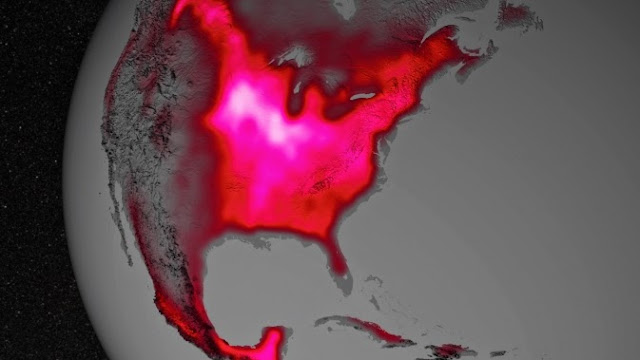
Half of the United States is glowing a bright pinkish red

Data from satellite sensors show that during the Northern Hemisphere's growing season, the Midwest region of the United States boasts more photosynthetic activity than any other spot on Earth, according to NASA and university scientists.

Healthy plants convert light to energy via photosynthesis, but chlorophyll also emits a fraction of absorbed light as fluorescent glow that is invisible to the naked eye. The magnitude of the glow is an excellent indicator of the amount of photosynthesis, or gross productivity, of plants in a given region. In the image below, the color red was applied to the illustration to represent the glow.

Image Credit: NASA's Goddard Space Flight Center

Research in 2013 led by Joanna Joiner, of NASA's Goddard Space Flight Center in Greenbelt, Md., demonstrated that fluorescence from plants could be teased out of data from existing satellites, which were designed and built for other purposes. The new research led by Luis Guanter of the Freie Universität Berlin, used the data for the first time to estimate photosynthesis from agriculture.

According to co-author Christian Frankenberg of NASA's Jet Propulsion Laboratory in Pasadena, Calif., "The paper shows that fluorescence is a much better proxy for agricultural productivity than anything we've had before. This can go a long way regarding monitoring – and maybe even predicting – regional crop yields."

Unlike most vegetation, food crops are managed to maximize productivity. They usually have access to abundant nutrients and are irrigated. The Corn Belt, for example, receives water from the Mississippi River. Accounting for irrigation is currently a challenge for models, which is one reason why they underestimate agricultural productivity.

NASA press release: Satellite Shows High Productivity from U.S. Corn Belt

PNAS paper: Global and time-resolved monitoring of crop photosynthesis with chlorophyll fluorescence

Friday, March 21, 2014

3D print selfie

Sony Music Communications Inc. started selling the 3-D Print Figure product last year in which a figure is sculpted using full-color 3-D scanners. To create the figure, the scanner first obtains data through the scanning of a person from head to toe.

Then a computer models the data and outputs images through a 3-D printer using color ink, special bonding materials and white plaster powder. The price for a figure ranges from ¥49,000 to ¥120,000 ($600–$1500), depending on the size. According to Yosuke Takuma, who planned this business for Sony Music Communications, these 3-D figures are popular among people who want to mark such special occasions as weddings and matriculation ceremonies.

Koji Iwabuchi and his wife Yumi visited the studio from Suginami Ward, Tokyo, to order figures to commemorate their 20th wedding anniversary. “It’s like photography at the end of the Edo period as we cannot move at all,” Koji Iwabuchi said. “It’s interesting to feel like Ryoma Sakamoto. In the future, it might become an ordinary thing, but it’s fun that few people have experienced this,” he said. Ryoma Sakamoto (1836-1867) is known as the subject of some famous photos from that time.

Article with pictures

Thursday, March 20, 2014

Hyphenation of color compounds

In computer technology, the golden rule for hyphenation of new technology terms is to write them as separate words when they are first coined, as hyphenated words when they are widely used in the technology community, and as monolexemic terms when the terms are widely used by the general population. For example, in the Sixties we had electronic mail, in the Seventies we had e-mail, and around 1993 when the Arpanet was commercialized and renamed to Internet everybody went on email.

This rule is pretty simple to remember. For color compounds the situation is a little sticky, because if changed significantly in the 16th Edition of The Chicago Manual of Style. According to rule 7.85, section 1, under colors (page 375), the new rule is that in the manner of most other such compounds, compound adjectives formed with color words are now hyphenated when they precede a noun. They remain open when they follow the noun.

Examples:

  • emerald-green tie
  • reddish-brown flagstone
  • blue-green algae
  • snow-white dress
  • black-and-white print

but

  • his tie is emerald green
  • the stone is reddish brown
  • the water is blue green
  • the clouds are snow white
  • the truth is not black and white

While we are at it, rule 7.76 regarding the capitalization of “web” and “Internet” also changed. Chicago now prefers web, website, web page, and so forth—with a lowercase w. But capitalize World Wide Web and Internet.

Since files are now more important than colors, Chicago prefers to present abbreviations for file formats in full capitals. Therefore, write PDF instead of pdf, even when usually we use the latter when we actually specify file names.

More Chicago capitalization examples:

  • Macintosh; PC; personal computer
  • hypertext transfer protocol (HTTP); a transfer protocol; hypertext
  • Internet protocol (IP); the Internet; the net; an intranet
  • the Open Source Initiative (the corporation); open-source platforms
  • the World Wide Web Consortium; the World Wide Web; the web; a website; a web page

Returning to the opening, although nobody younger than 21 years of age has ever experienced a world without email, on page 380 the over twenty-one-year-old white-haired Chicago people still prefer e-mail and e-book.

Glass brain flythrough

This video gives viewers a colorful peek into the complex workings of the human brain as it thinks. In this case, we are “flying through” the brain of a volunteer who is been asked to simply open and close her eyes and hands, National Geographic reports. This 3D brain visualization was created by researchers at the University of California (UC), San Francisco, and UC San Diego with a combination of technologies, including an MRI scan, EEG and diffusion tensor imaging, a process that reveals tissue layout. Known as the Glass Brain, the imaging technology works in real time and may be used to learn more about how the human mind processes information.


Click here for more information

Tuesday, March 18, 2014

Traps in big data analysis

When I was a student, I had chosen mathematical statistics as one of my majors. At the time, the hot topics were robust statistics, non-parametric methods and optimal stopping times. Descriptive statistics was not part of the curriculum (PowerPoint did not yet exist and there was no need for meaningless 3-D pie charts).

In the student houses I lived, there were always medical students at the end of their studies who had to get a doctorate. Residencies were grueling and at that time the least effort thesis was to punch in some historical medical data. On their way home from the clinic, these students would spend part of the night in the empty punch card rooms, for about 6 months.

Thereafter, they would bring the punch cards to the data center and get 10 to 20 centimeters of SAS printout—and the desperation of not knowing how to get from hundreds of cryptic tables to a one hundred page thesis.

Many of them ended up knocking on my door with the printout and scratching their head. Because in the data center the students could not tell what analyses they needed—after all, there never was an experimental design—the data center people just ran all and every function available in SAS. Classical garbage-in garbage-out.

So, I had to tell the students to stare at the data and come up with a few hypotheses, then use the ANOVA routines to confirm them and the regression routines to do a few nice graphs.

Unfortunately, after all these years we are not much better off. Indeed, now we have to deal also with "big data hubris," the often implicit assumption that big data are a substitute for, rather than a supplement to, traditional data collection and analysis. Now we have tools like Google Correlate that allow us to correlate tons of apples with megatons of oranges.

A recent interesting paper by David Lazer et al. is a nice summary of how big data analysis allows us to create more statistical garbage: Lazer D, Kennedy R, King G, Vespignani A. Big data. The parable of Google Flu: traps in big data analysis. Science. 2014 Mar 14;343(6176):1203-5. doi: 10.1126/science.1248506. PubMed PMID: 24626916.

The authors conclude: "Big data offer enormous possibilities for understanding human interactions at a societal scale, with rich spatial and temporal dynamics, and for detecting complex interactions and nonlinearities among variables. We contend that these are the most exciting frontiers in studying human behavior. However, traditional 'small data' often offer information that is not contained (or containable) in big data, and the very factors that have enabled big data are enabling more traditional data collection. The Internet has opened the way for improving standard surveys, experiments, and health reporting. Instead of focusing on a 'big data revolution,' perhaps it is time we were focused on an 'all data revolution,' where we recognize that the critical change in the world has been innovative analytics, using data from all traditional and new sources, and providing a deeper, clearer understanding of our world."