
This episode will be repeated in the San Francisco Area tonight at 11:00PM on KQEDW (Digital 9.3). Elsewhere, check your local listings.

I received some interesting feedback on the color naming tech. report. A reader implied that in traditional psychophysics experiments the informants are first screened for color vision deficiencies (CVD), and our on-line experiment fails to do that. This was felt to be a grave omission especially in light of the two recent JOSA A papers by Kimberly Jameson and Natalia Komarova: http://www.opticsinfobase.org/josaa/abstract.cfm?URI=josaa-26-6-1414 and http://www.opticsinfobase.org/josaa/abstract.cfm?URI=josaa-26-6-1424.

Last year at the IS&T/SPIE Electronic Imaging symposium in San Jose the conference Color Imaging: Displaying, Hardcopy, Processing, and Applications started a session on controversial topics called "The Dark Side of Color." These are papers that transcend the incremental research methodology of solving a problem, proving the solution's contribution in an experiment, and reporting the result in a conference. This session consists of papers were authors go out on a limb, not afraid of intuition and speculation, and propose new paradigms.
A preprint of our contribution is now available at this link: http://www.hpl.hp.com/techreports/2009/HPL-2009-363.html.
Studiose, storiche, giornaliste ed esperte del colore, Lia Luzzatto e Renata Pompas hanno maturato una lunga esperienza internazionale sul colore. Membre di network internazionali riconosciuti, tengono lezioni, conferenze, seminari in aziende, istituzioni e università. Oltre a centinaia di articoli e contributi in libri collettivi, hanno al loro attivo numerose pubblicazioni.

Maverick is the antonym of conformist or a culturally competent person. Synonyms include: individualist, nonconformist, free spirit, unorthodox person, original, eccentric; rebel, dissenter, dissident, enfant terrible; informal cowboy, loose cannon.
When we do a psychophysics experiment the old fashioned way in a lab, we want informants that are culturally competent persons. In fact, we are very careful in writing clear instructions, make sure the informants understand them, and check they follow the rules. The experimental conditions are strictly controlled so all informants perform exactly the same experiment.
When we do a psychophysics experiment the new way on the Web using crowd-sourcing, we get all beaten up by our colleagues and our papers keep getting rejected. "You are getting all those disruptive loose cannons out there, your results are meaningless." Well, we could almost reply "consider this formula:"
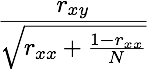
I have to write "almost" because James Shilts Boster started writing his paper The Value of Cognitive Diversity: The Correlation of Local Aggregates with World Standards on May 6, 2004, but then as far as I know never got around to publish it.
The formula is for the mean correlation of the aggregated responses to a world standard. rxy is the average individual informant's correlation with the world standard, rxx is the average correlation among informants on the similarity judgment task, and N is the number of informants in the pool of aggregated responses.
This formula teaches that when N is small, like in the case of the old fashioned experiment, then we get the best correlation when all informants are culturally competent. Check!
However, when N is large, like in crowd-sourcing, then each new conformist informant does not contribute much to the correlation. Instead, it is the maverick informants, or better, the disagreement among informants that allows their aggregation to closely approximate the world standard. Surprise!
With this we call all rebels, dissenters, and mavericks out there and beg them to contribute to our color naming experiment at the link of their language on this page: http://www.hpl.hp.com/personal/Nathan_Moroney/mlcn.html
This is a motto I was using 25 years ago. At that time I was working on VLSI design automation tools at Xerox PARC, more specifically on design rule checkers for full custom CMOS. The designers were doing so many layout errors that I could not understand how a top notch designer could do them. I had the suspicion that some of the designers could have a color vision deficiency — and 20 years later I discovered one of them is a dichromat — but that was not explaining the the type and volume of errors. I decided to investigate.
 Researchers at the Lawrence Berkeley National Laboratory have engineered a new class of bowtie-shaped devices that capture, filter and steer light at the nanoscale. These "nano-colorsorter" devices act as antennae to focus and sort light in tiny spaces, a potentially useful technique for harvesting broadband light for color-sensitive filters and detectors.
On September 28, I reported on the keynote lecture on Why are animals colourful? Sex and violence, seeing and signals Justin Marshall gave at the AIC in Sydney. Prof. Marshall gave a description the mantis shrimp's eye noting how it can see polarization with the help of a structure like a kind of nanotube.
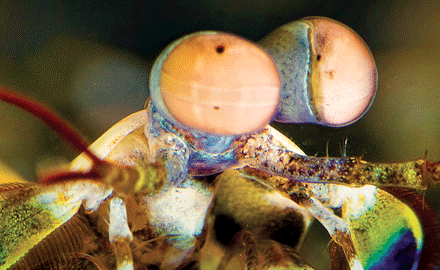
With his colleagues, Prof. Marshall has just published a letter in Nature Photonics 3, 641-644 (2009) with the title A biological quarter-wave retarder with excellent achromaticity in the visible wavelength region.
This paper explains in detail how the mantis shrimp detects polarization. The authors illustrate how a novel interplay of intrinsic and form birefringence results in a natural achromatic optic that significantly outperforms current man-made optical devices. Achromatic here means that polarization detection is independent from the wavelength (±2.7º), which is something we humans do not really know how to build.
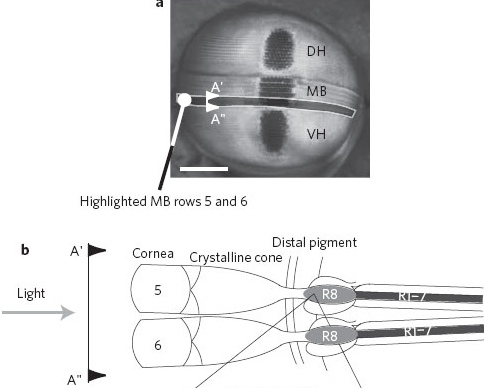
A syntectic mantis shrimp eye could be a boon for remote sensing. However, with mother nature being and order of magnitude better than what physicists can build, this will not happen any time soon. It is interesting that this structure has not been repeated in any other animal, as far as we know.
When we think about places we have never visited, we build on other information about the place—the stereotypes—we have gained from variou...


